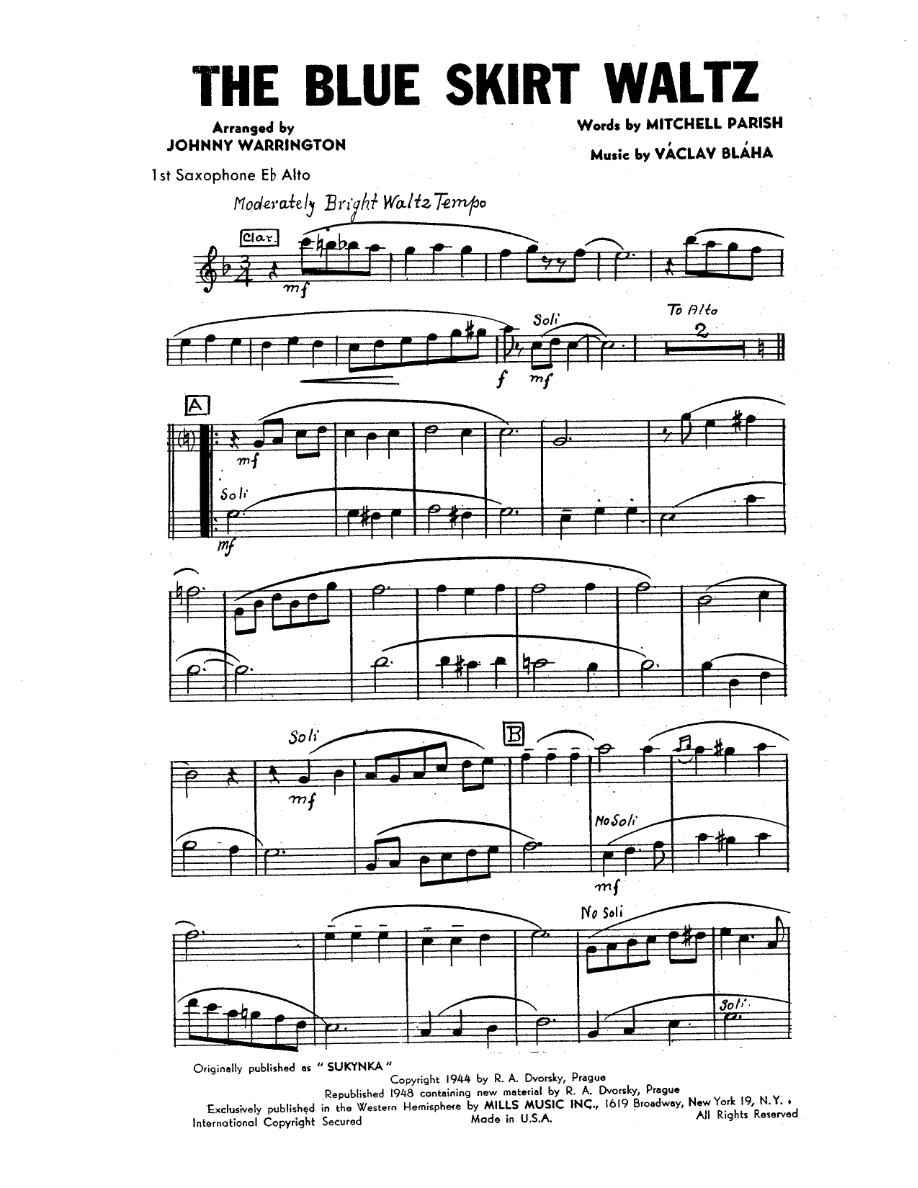
The Blue Skirt Waltz (J.Warrington)
Composed by Vaclav Blaha
Arranged by Johnny Warrington
- Ensemble: Big Band Dance
- Style: Big Band Dance
- Pages: 30
- Instruments (7): Alto Sax, Tenor Sax, Trumpet, Trombone, Piano, Bass, Drums
- Difficulty: medium
- Content: Individual Parts
- Format: PDF Download (Instant)
- Price: $18.99
## SECTION 1: Description Vaclav Blaha's charming "The Blue Skirt Waltz," originally a popular European folk tune, found widespread acclaim in the mid-20th century, becoming a staple of dance halls and radio airwaves. While not a traditional jazz standard, its enduring melody and accessible waltz rhythm made it a prime candidate for big band interpretation during an era when dance orchestras dominated popular music. This particular arrangement by the prolific Johnny Warrington captures the quintessential "Big Band Dance" style of the late 1940s and early 1950s, a period characterized by lush orchestrations, smooth voicings, and a focus on danceability. Warrington, renowned for his ability to transform popular tunes into sophisticated yet accessible big band charts, imbues this piece with an elegant, medium-tempo 3/4 feel, perfect for a graceful foxtrot or a refined waltz on the dance floor. The mood is one of lighthearted nostalgia and romantic charm, evoking the golden age of ballroom dancing. Warrington's distinctive arranging approach is immediately evident in this chart. He masterfully balances the original tune's simplicity with rich harmonic textures, employing his signature close-voicing techniques within the brass and saxophone sections to create a full, resonant sound. The melody is predominantly carried by the alto saxophone and trumpet in unison or octaves, often supported by warm trombone counter-melodies and piano fills. Expect classic big band soli sections where the saxophones weave intricate lines together, followed by brass punctuations that build dynamic interest without ever becoming overly aggressive. While there isn't a dedicated improvised solo section in the traditional jazz sense, Warrington provides opportunities for individual instruments to shine through melodic features and obbligato lines, particularly in the trumpet and alto saxophone parts. The arrangement maintains a consistent key, allowing the ensemble to focus on blend and articulation, culminating in a satisfying, full-ensemble final chorus that leaves a lasting impression. Performing "The Blue Skirt Waltz" as arranged by Johnny Warrington is a rewarding experience for ensembles aiming to authentically recreate the big band dance sound. The technical demands are moderate, focusing more on precision, blend, and rhythmic accuracy in a 3/4 meter rather than complex improvisation or extreme ranges. The chart is well-suited for high school jazz ensembles with strong lead players, as well as community bands and college groups looking to expand their repertoire with classic dance numbers. The primary challenge lies in maintaining the elegant waltz feel consistently throughout, ensuring smooth transitions between sections, and achieving a cohesive ensemble sound that projects both warmth and clarity. The arrangement’s charm lies in its accessibility and its ability to transport both performers and audience back to an era of refined musical entertainment, making it a delightful addition to any concert or dance program. ## SECTION 2: Performance Notes This arrangement of "The Blue Skirt Waltz" should be approached with a consistent, elegant medium waltz feel (3/4 time). The conductor should emphasize a light, flowing pulse rather than a heavy downbeat, encouraging musicians to "dance" through the phrases. Key technical challenges include maintaining precise articulation in the saxophone soli sections and achieving a balanced blend between the brass and saxophones, particularly when they share melodic lines. Trumpet 1 and Alto Sax 1 carry significant melodic weight and should focus on a clear, warm tone. Trombone parts often provide harmonic support and counter-melodies, requiring smooth legato playing. No special techniques like plunger mutes or extended ranges are required. Rehearsal time should be dedicated to ensuring rhythmic accuracy in the 3/4 meter, achieving seamless dynamics, and practicing the ensemble's collective interpretation of the graceful waltz style. ## SECTION 3: FAQ Q: What instruments and parts are included in this arrangement? A: This arrangement is scored for a classic big band dance ensemble, including Alto Saxophone, Tenor Saxophone, Trumpet, Trombone, Piano, Bass, and Drums. The full set of 7 instrumental parts is provided. Q: What is the difficulty level of "The Blue Skirt Waltz (J.Warrington)"? A: This arrangement is considered intermediate in difficulty. It requires solid ensemble playing, good rhythmic precision in 3/4 time, and capable lead players, making it suitable for advanced high school, community, and college jazz ensembles. Q: What is the musical style and historical context of this arrangement? A: This arrangement embodies the "Big Band Dance" style of the late 1940s and early 1950s. It features lush orchestrations of a popular waltz tune, designed for ballroom dancing and reflecting the popular music trends of that era. Q: What makes Johnny Warrington's arrangement of "The Blue Skirt Waltz" unique? A: Warrington's distinctive approach includes his use of close voicings for a rich ensemble sound, elegant melodic treatment, and a focus on creating a sophisticated yet accessible dance chart that highlights the charm of the original waltz. Q: What is the recommended tempo and approximate duration for this piece? A: The recommended tempo is a medium waltz, typically around 120-130 beats per minute for the dotted half note. The approximate performance duration is between 2:30 and 3:00 minutes, depending on the chosen tempo.