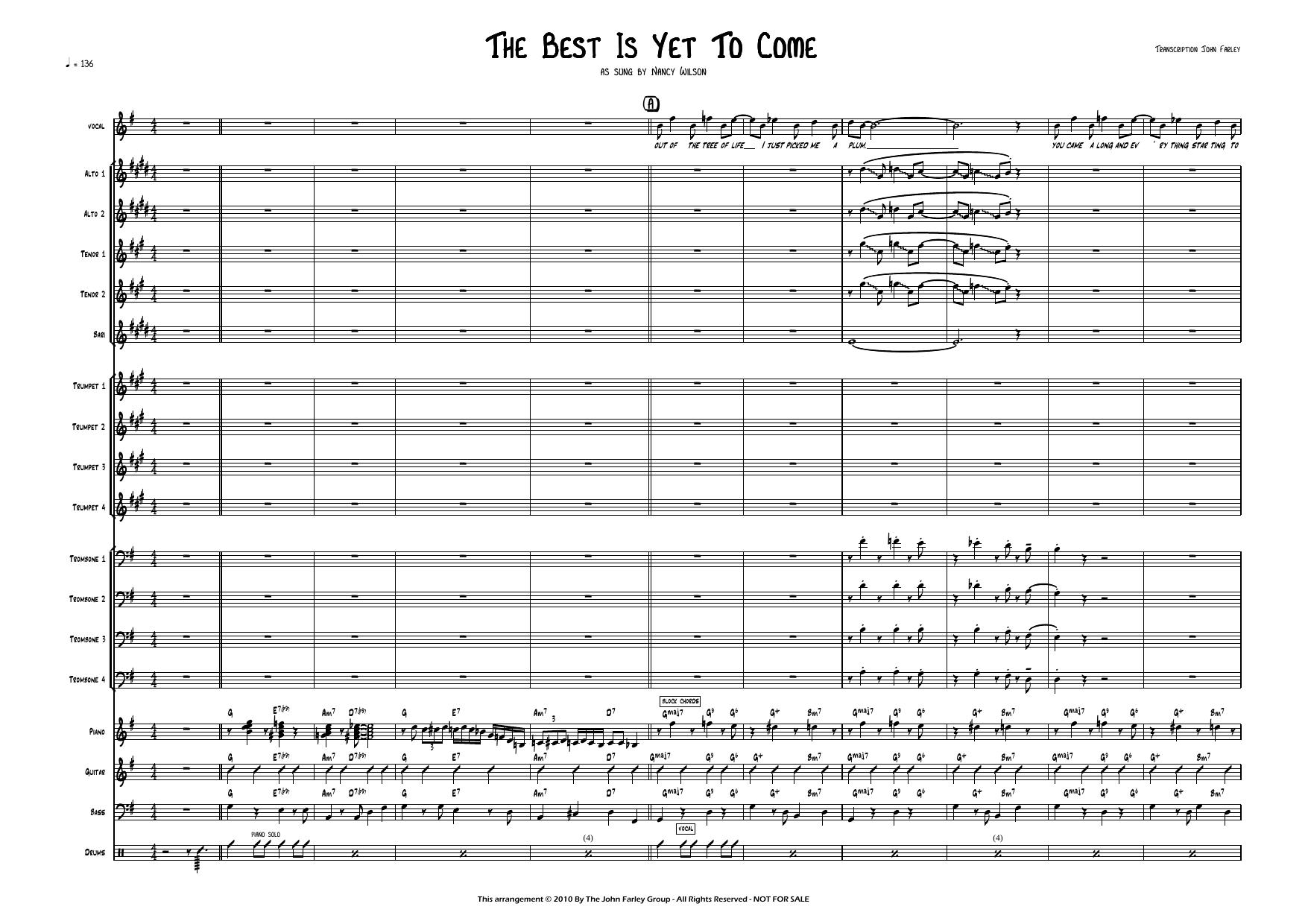
The Best Is Yet To Come (J.Farley) N.Wilson voc
Composed by Cy Coleman
Arranged by John Farley
- Ensemble: Big Band
- Pages: 34
- Instruments (18): Vocal, Alto 1, Alto 2, Tenor 1, Tenor 2, Bari, Trumpet 1, Trumpet 2, Trumpet 3, Trumpet 4, Trombone 1, Trombone 2, Trombone 3, Trombone 4, Piano, Guitar, Bass, Drums
- Difficulty: medium
- Content: Individual Parts
- Format: PDF Download (Instant)
- Price: $24.99
Cy Coleman and Carolyn Leigh’s iconic 1959 collaboration "The Best Is Yet To Come" remains one of the crown jewels of the Great American Songbook, forever immortalized by Frank Sinatra’s legendary 1964 recording with the Count Basie Orchestra arranged by Quincy Jones. Representing the pinnacle of mid-century vocal jazz sophistication, this tune captures the swagger, optimism, and swinging exuberance of the Las Vegas Rat Pack era. Its enduring appeal lies in its infectious rhythmic drive, buoyant melodic contour, and a lyric that shifts seamlessly from playful charm to soaring confidence, making it an indispensable staple for jazz vocalists working with a large ensemble. John Farley’s masterful big band adaptationtailored for a dynamic vocal lead (in the style of N. Wilson) breathes fresh life into this standard through a vibrant, brass-forward medium-up swing framework. Set in a bright, energetic 4/4 groove, the arrangement opens with an anticipation-building vamp before the vocalist enters, supported by crisp, interlocking horn background figures that evoke the classic Basie-meets-Jones aesthetic. The harmonic palette tastefully expands upon Coleman’s original changes with sophisticated altered dominants and clever chromatic voice-leading in the saxophones, maintaining a breezy, optimistic mood that gradually builds in intensity from the first verse to the final triumphant chord. Farley’s writing shines brightest in the tightly knit horn solis and the exhilarating shout chorus, which serves as the emotional peak of the chart. The saxophone section enjoys lush, block-chord voicings that contrast sharply with punchy, staccato brass counterlines. The melody is shared fluidly between the vocal soloist and key instrumental sections, with a dedicated solo space—ideally suited for tenor saxophone or trumpet—that allows a soloist to stretch out over standard blues-inflected changes before roaring back into the head. The vocal part is meticulously articulated to guide the singer through dynamic peaks and rhythmic phrasing nuances. Advanced high school, collegiate, and professional community big bands will find this 34-page arrangement to be an exceptional vehicle for showcasing a powerhouse vocalist while testing the ensemble's stylistic cohesion. Because the chart relies heavily on articulation discipline—requiring seamless execution of short swing eighth notes, well-placed accents, and controlled dynamic swells—it serves as an invaluable educational tool for developing authentic big band phrasing. At the same time, its sheer entertainment value guarantees an enthusiastic audience response, making it a standout feature for any concert or festival program. Success with John Farley’s arrangement hinges on strict adherence to stylistic swing phrasing and articulated dynamic control. The rhythm section must establish a relentless, forward-moving medium-up swing tempo (around 160–168 BPM), with the drummer driving the ensemble using a crisp ride-cymbal pattern and light hi-hat chokes on beats two and four. Horn players should carefully observe all marked articulations; standard eighth notes must be swung with appropriate weight given to the upbeats, avoiding both overly stiff straight eighths and sluggish triplet figures. Pay close attention to the background figures behind the vocal soloist—these must remain dynamically subservient (around piano to mezzo-piano) to ensure the lyrics and vocal tone remain pristine, before opening up fully during the ensemble shout chorus. Brass players should utilize standard cup or bucket mutes where indicated for textural variety, ensuring that falls and doits are executed cleanly without sacrificing intonation. Conductors should rehearse the ensemble sections independently of the vocalist first, ensuring that the horn interplay locks tightly with the bass and drum groove before adding the featured voice. Q: What instruments and parts are included in this arrangement? A: This chart is scored for a flexible 9-instrument big band lineup that includes a Vocalist, Alto Saxophone, Tenor Saxophone, Baritone Saxophone, Trumpet, and accompanying rhythm section instrumentation across a comprehensive 34-page score and parts set. Q: What is the difficulty level of this chart? A: It is graded as advanced intermediate to advanced, making it ideal for skilled high school, collegiate, and professional jazz ensembles due to its demanding swing articulation, reading requirements, and tempo demands. Q: What is the historical style and context of this piece? A: The arrangement is rooted in the mid-century swinging big band tradition, heavily inspired by the classic Frank Sinatra and Count Basie collaborations arranged by Quincy Jones during the 1960s. Q: What makes John Farley’s arrangement unique? A: It features sophisticated harmonic reharmonizations, tightly woven saxophone solis, and a high-energy shout chorus that brilliantly balances a featured vocal performance with rich, brass-driven counterlines. Q: What is the performance duration and recommended tempo? A: The piece runs approximately 3.5 to 4 minutes and is designed to be performed at a bright, buoyant medium-up swing tempo of roughly 160 to 168 BPM.
Questions and answers
- What is included in the The Best Is Yet To Come (J.Farley) N.Wilson voc PDF?
- The verified current file contains a conductor score and individual parts across 34 pages.
- How many instruments or parts are listed for The Best Is Yet To Come (J.Farley) N.Wilson voc?
- The verified instrumentation list contains 18 entries for this Big Band arrangement.
- Who is credited for The Best Is Yet To Come (J.Farley) N.Wilson voc?
- Composer: Cy Coleman. Arranger: John Farley.
- What difficulty is listed for The Best Is Yet To Come (J.Farley) N.Wilson voc?
- The verified difficulty level is medium.
- Can I preview The Best Is Yet To Come (J.Farley) N.Wilson voc before buying?
- Yes. The product page provides a preview generated from the current PDF file.
- How is The Best Is Yet To Come (J.Farley) N.Wilson voc delivered?
- After successful payment, the digital PDF is made available for download. The displayed price is $24.99.
Musicians Also Search For
The Best Is Yet To Come John Farley PDF • The Best Is Yet To Come John Farley sheet music • The Best Is Yet To Come arranged by John Farley • John Farley big band charts • John Farley jazz arrangements PDF • The Best Is Yet To Come Cy Coleman sheet music • The Best Is Yet To Come Cy Coleman big band arrangements • Cy Coleman big band charts • The Best Is Yet To Come big band arrangements • The Best Is Yet To Come big band PDF download • The Best Is Yet To Come jazz sheet music • big band sheet music download • The Best Is Yet To Come conductor score PDF • The Best Is Yet To Come individual parts download • The Best Is Yet To Come sheet music PDF • buy The Best Is Yet To Come sheet music • download The Best Is Yet To Come PDF • The Best Is Yet To Come jazz charts • best John Farley big band arrangements • Cy Coleman arranged by John Farley • The Best Is Yet To Come printable sheet music • big band repertoire PDF