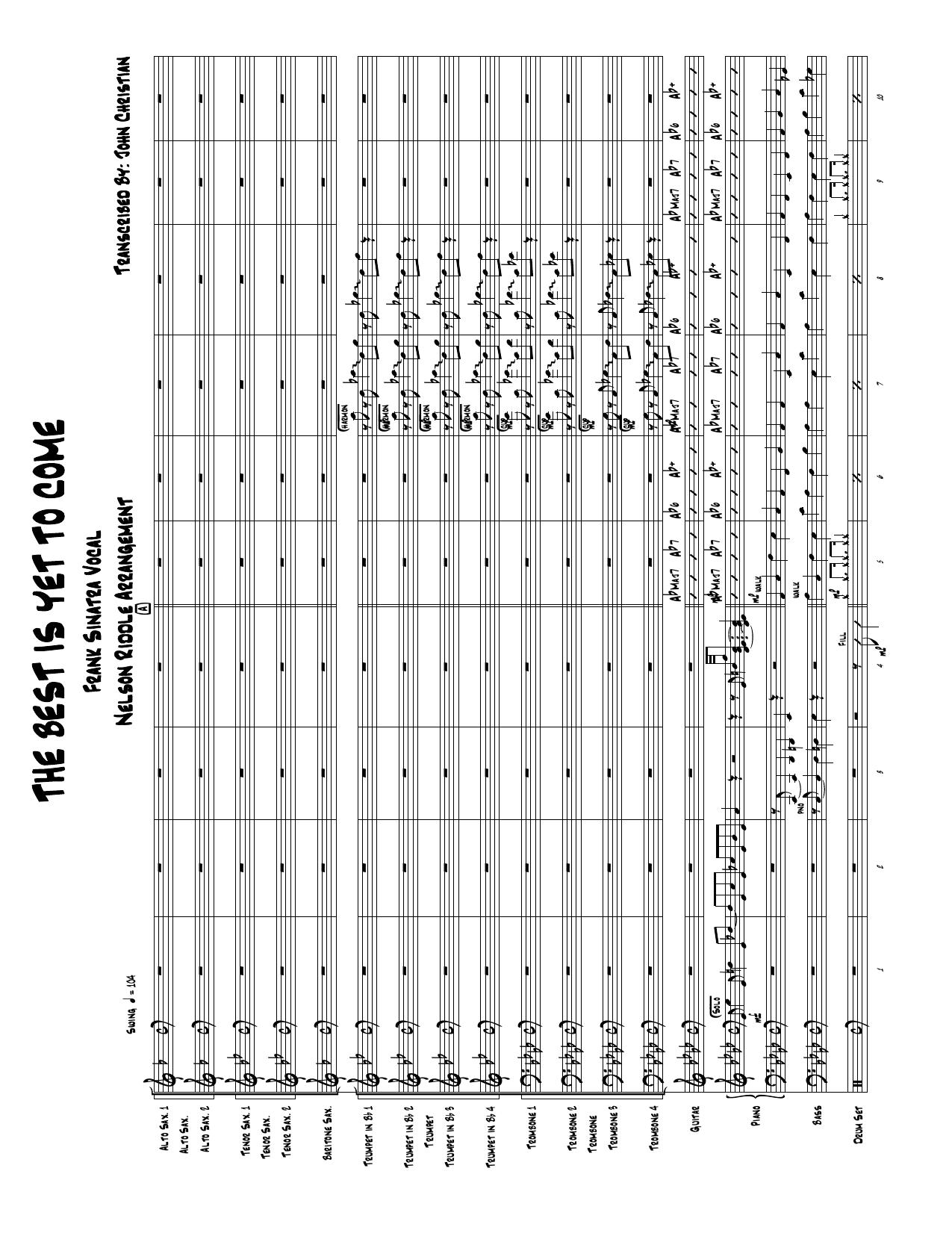
The Best Is Yet To Come (J.Christian) sheet music preview

The Best Is Yet To Come (J.Christian)

Composed by Cy Coleman

Arranged by J.Christian

  • Ensemble: Big Band
  • Pages: 38
  • Instruments (17): Alto Saxophone 1, Alto Saxophone 2, Tenor Saxophone 1, Tenor Saxophone 2, Baritone Saxophone, Trumpet 1, Trumpet 2, Trumpet 3, Trumpet 4, Trombone 1, Trombone 2, Trombone 3, Trombone 4, Guitar, Piano, Bass, Drum Set
  • Difficulty: medium
  • Content: Individual Parts
  • Format: PDF Download (Instant)
  • Price: $24.99

Cy Coleman and Carolyn Leigh’s immortal standard "The Best Is Yet To Come" stands as one of the definitive pillars of the mid-century American songbook, immortalized most famously by Frank Sinatra on his 1964 collaboration with Count Basie, *It Might as Well Be Swing*. Representing the pinnacle of sophisticated, swaggering Las Vegas vocal-jazz style, the composition balances an infectious, forward-driving optimism with cool, blues-infused harmonic sophistication. It is a tune that demands supreme confidence, impeccable time, and an innate understanding of mid-60s swinging big band vernacular. In this masterclass of an adaptation, arranger J.Christian captures the legendary Basie-meets-Sinatra energy while injecting a fresh, contemporary vitality tailored for the modern 17-piece big band. Operating at a breezy, confident medium-up swing tempo in 4/4 time, the chart exudes sophistication and high-octane optimism. The arrangement opens with a snappy, rhythmic brass punch before settling into a relaxed yet intensely driving groove underpinned by a walking bassline and crisp hi-hat accents. The harmonic palette stays true to the sophisticated bebop-adjacent extensions of the original while expanding the brass voicings to create a richer, modern acoustic footprint that fills any auditorium with warmth and punch. J.Christian structures the chart as a showcase of dynamic contrast and sectional interplay. The melody is initially introduced by a sultry, interwoven woodwind soli before the brass sections begin trading sharp, conversational counter-lines. A standout feature of this arrangement is the meticulously crafted saxophone soli, which mimics the fluid, harmonized horn lines of the finest 1960s studio orchestras before launching seamlessly into a blistering, high-energy shout chorus. Technical demands include precise articulation in the trumpet section, agile swing-eighth-note phrasing across all saxophones, and a rhythm section that must maintain an unwavering, feather-light pocket. Solo space is thoughtfully provided for lead horn players to stretch out over standard changes, making it a stellar vehicle for a standout soloist. Advanced high school ensembles with strong section leaders, collegiate jazz orchestras, and professional municipal big bands will find this chart to be an exceptionally rewarding centerpiece for concert programs or festival sets. The arrangement strikes a rare balance: it is challenging enough to push developing players toward professional-grade articulation and ensemble listening, yet accessible enough to pull together efficiently for seasoned professionals looking for a crowd-pleasing showstopper. Executing this chart successfully requires strict adherence to a relaxed yet driving medium-up swing feel; conductors must guard against rushing the tempo, keeping the quarter note locked around 132-144 BPM. The primary technical challenge lies in the uniform execution of short, crisp articulations—particularly the accented off-beats in the brass and the linear, bebop-rooted eighth-note lines in the saxophone section. Ensure the rhythm section maintains an understated, buoyant piano comping style that never crowds the horns. Brass players should utilize standard subtle jazz drop-offs and doits where indicated, but avoid overusing exaggerated effects to preserve the sophisticated, late-night Rat Pack aesthetic. During rehearsal, isolate the sax soli at a slower tempo to lock in intonation and blend before bringing it up to performance speed, and pay close attention to dynamic drop-offs right before the shout chorus to maximize its explosive impact. Q: What specific instrumentation and parts are included in this arrangement? A: This chart is scored for a standard 17-piece big band, comprising 5 saxophones (Alto 1, Alto 2, Tenor 1, Tenor 2, Baritone), 4 trumpets, 4 trombones, and a 4-piece rhythm section (piano, bass, drums, guitar), alongside a comprehensive conductor score across its 38 pages. Q: What is the difficulty level of this J.Christian arrangement? A: It is graded as advanced-intermediate to advanced, making it best suited for accomplished high school, collegiate, and professional big bands that possess strong section cohesion and experienced soloists. Q: What is the musical style and historical context of the piece? A: Written originally by Cy Coleman and popularized by Frank Sinatra with the Count Basie Orchestra, this arrangement honors the mid-1960s swinging big band tradition with a sophisticated, high-energy medium swing feel. Q: What makes this particular arrangement by J.Christian unique? A: It distinguishes itself through its meticulously voiced saxophone soli, a brilliantly structured shout chorus that builds maximum dynamic tension, and modern harmonic enhancements that breathe new life into a classic standard. Q: What is the performance duration and recommended tempo for this chart? A: The arrangement runs approximately 3 to 4 minutes depending on solo lengths, and is designed to sit comfortably at a medium-up swing tempo of around 138 BPM.

Questions and answers

What is included in the The Best Is Yet To Come (J.Christian) PDF?
The verified current file contains a conductor score and individual parts across 38 pages.
How many instruments or parts are listed for The Best Is Yet To Come (J.Christian)?
The verified instrumentation list contains 17 entries for this Big Band arrangement.
Who is credited for The Best Is Yet To Come (J.Christian)?
Composer: Cy Coleman. Arranger: J.Christian.
What difficulty is listed for The Best Is Yet To Come (J.Christian)?
The verified difficulty level is medium.
Can I preview The Best Is Yet To Come (J.Christian) before buying?
Yes. The product page provides a preview generated from the current PDF file.
How is The Best Is Yet To Come (J.Christian) delivered?
After successful payment, the digital PDF is made available for download. The displayed price is $24.99.

Musicians Also Search For

The Best Is Yet To Come J.Christian PDFThe Best Is Yet To Come J.Christian sheet musicThe Best Is Yet To Come arranged by J.ChristianJ.Christian big band chartsJ.Christian jazz arrangements PDFThe Best Is Yet To Come Cy Coleman sheet musicThe Best Is Yet To Come Cy Coleman big band arrangementsCy Coleman big band chartsThe Best Is Yet To Come big band arrangementsThe Best Is Yet To Come big band PDF downloadThe Best Is Yet To Come jazz sheet musicbig band sheet music downloadThe Best Is Yet To Come conductor score PDFThe Best Is Yet To Come individual parts downloadThe Best Is Yet To Come sheet music PDFbuy The Best Is Yet To Come sheet musicdownload The Best Is Yet To Come PDFThe Best Is Yet To Come jazz chartsbest J.Christian big band arrangementsCy Coleman arranged by J.ChristianThe Best Is Yet To Come printable sheet musicbig band repertoire PDF

All arrangements by J.Christian All Cy Coleman sheet music