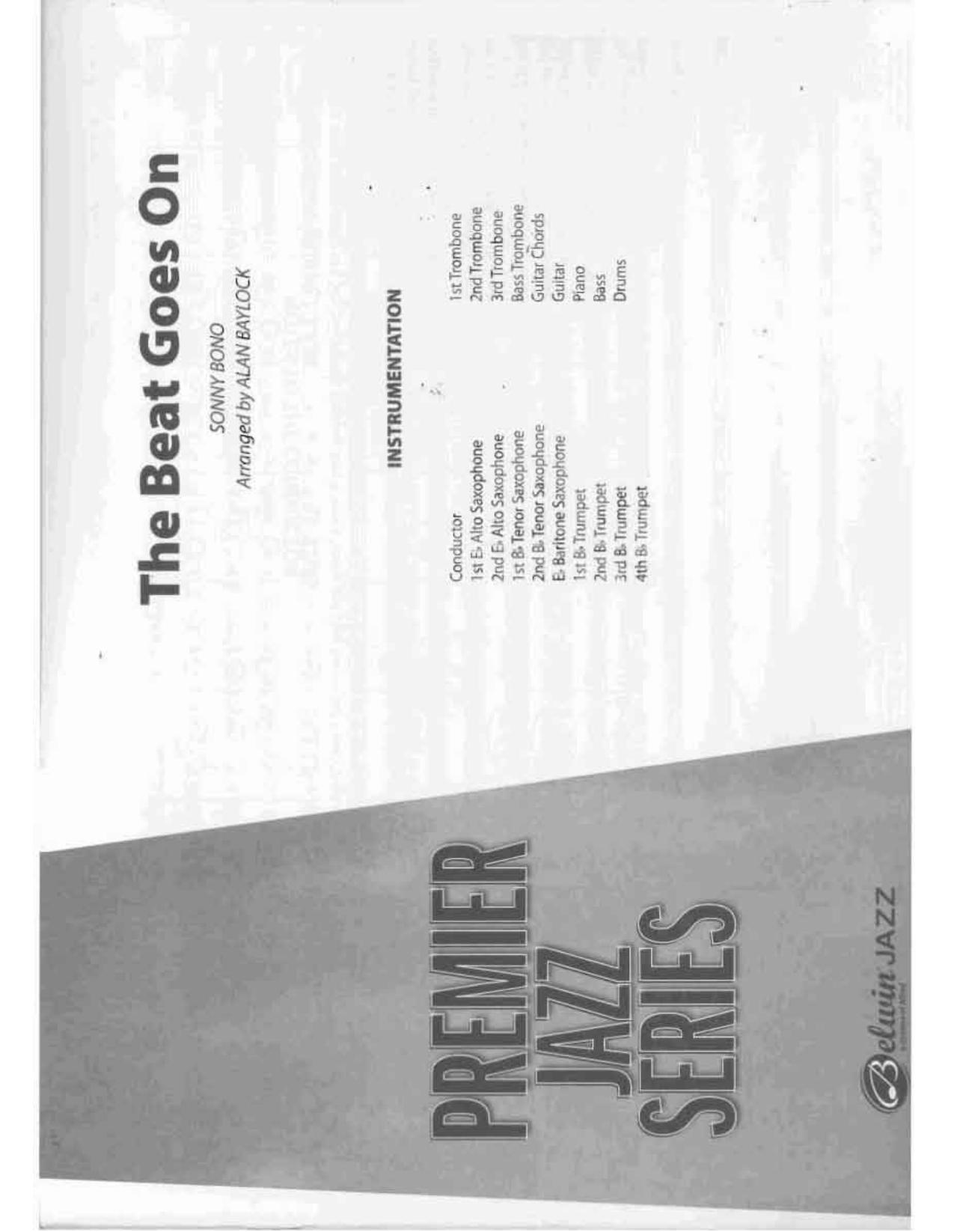
The Beat Goes On (A.Baylock) sheet music preview

The Beat Goes On (A.Baylock)

Composed by Sonny Bono

Arranged by Alan Baylock

  • Ensemble: Big Band
  • Style: Jazz Standard
  • Pages: 79
  • Instruments (17): Alto Saxophone 1, Alto Saxophone 2, Tenor Saxophone 1, Tenor Saxophone 2, Baritone Saxophone, Trumpet 1, Trumpet 2, Trumpet 3, Trumpet 4, Trombone 1, Trombone 2, Trombone 3, Bass Trombone, Guitar, Piano, Bass, Drum Set
  • Difficulty: advanced
  • Content: Individual Parts
  • Format: PDF Download (Instant)
  • Price: $24.99

Sonny Bono's iconic "The Beat Goes On," originally a pop-rock hit for Sonny & Cher in 1967, transcends its initial genre to become a celebrated jazz standard. Its infectious, laid-back groove and memorable melodic hooks perfectly captured the zeitgeist of the late 1960s, a period of significant cultural and musical evolution. The song's enduring appeal lies in its deceptively simple yet sophisticated harmonic progression and its narrative quality, chronicling everyday life against a persistent, driving rhythm. While not initially conceived as a jazz piece, its modal implications and rhythmic flexibility have made it a favorite canvas for jazz interpreters, allowing for creative improvisation and reharmonization. It stands as a testament to the permeability of musical genres, demonstrating how a well-crafted tune can find new life and meaning in different stylistic contexts. Alan Baylock's masterful big band arrangement reimagines this classic with a sophisticated, medium-tempo swing feel, firmly planting it in the modern jazz lexicon. The piece maintains a relaxed, yet propulsive energy throughout, primarily in 4/4 time, though Baylock subtly incorporates rhythmic nuances that hint at its original pop-rock lineage. The overall mood is cool and confident, evoking a sense of effortless swagger. Baylock's signature approach to big band writing shines through in his rich, often dense voicings, particularly in the brass and saxophone sections, which feature extended harmonies that add depth and color without sacrificing clarity. Expect intricate counterpoint and layered textures that build organically, creating a dynamic and engaging sonic landscape. The arrangement opens with the familiar melody, initially carried by the saxophone section, establishing the piece's cool demeanor. Baylock ingeniously develops the thematic material through a series of expertly crafted soli sections, showcasing the full capabilities of each instrumental family. A standout feature is the inclusion of featured solo opportunities, typically for Tenor Saxophone and Trumpet, allowing improvisers to explore the tune's modal underpinnings over Baylock's thoughtful reharmonizations. The arrangement culminates in a powerful, yet controlled shout chorus that builds to an exhilarating climax before returning to a more subdued, reflective closing statement. Technical challenges include precise ensemble articulation, navigating complex rhythmic interplay, and achieving a balanced blend within the rich voicings. The reward lies in performing a piece that is both intellectually stimulating and viscerally satisfying, offering ample opportunity for individual expression within a cohesive ensemble framework. This arrangement is ideally suited for advanced high school, collegiate, community, and professional big bands. Its demands on musicianship, including sight-reading complex rhythms, navigating sophisticated harmonies, and executing precise ensemble figures, make it an excellent vehicle for developing advanced ensemble skills. The featured solos provide valuable experience for improvisers, while the overall musicality and dynamic range offer a fulfilling performance experience for both musicians and audiences. It's a superb choice for a concert opener or as a sophisticated feature number that highlights the band's precision and stylistic versatility. Conductors should emphasize a relaxed, yet driving medium swing feel throughout, ensuring the rhythm section lays down a solid, unhurried foundation. Pay close attention to Baylock's specific articulation markings; precise staccatos and legato phrases are crucial for clarity in the dense voicings. The brass sections will need to carefully balance their extended harmonies to avoid overblowing, focusing on blend and intonation, particularly in the layered soli passages. For the saxophone section, achieving a unified sound in the melody and soli sections is paramount. Soloists should be encouraged to explore the modal qualities of the chord changes, maintaining the cool, confident character of the piece. Rehearsal time should be dedicated to isolating and balancing the inner voices of the shout chorus to ensure maximum impact without sacrificing musicality. No special mutes are explicitly required, but plunger mutes could be tastefully incorporated by brass soloists if desired. Q: What instruments are included in this arrangement? A: This is a standard 17-instrument big band arrangement, including Alto Saxophone 1 & 2, Tenor Saxophone 1 & 2, Baritone Saxophone, Trumpet 1-4, Trombone 1-4, Piano, Bass, Guitar, and Drums. Q: What is the difficulty level of "The Beat Goes On (A.Baylock)"? A: This arrangement is rated as advanced, suitable for advanced high school, collegiate, community, and professional jazz ensembles due to its complex harmonies, intricate ensemble passages, and demands on stylistic interpretation. Q: What is the musical style and historical context of this piece? A: This is a big band jazz arrangement of "The Beat Goes On," originally a pop-rock hit by Sonny & Cher from 1967. Alan Baylock reinterprets it with a sophisticated, modern medium-swing jazz feel. Q: What makes Alan Baylock's arrangement of "The Beat Goes On" unique? A: Baylock's treatment is characterized by his rich, extended harmonies, intricate soli sections, and a sophisticated medium-swing groove that transforms the pop standard into a compelling modern jazz vehicle, complete with featured solo opportunities. Q: What is the approximate performance duration and tempo of this arrangement? A: The performance duration typically ranges from 4:30 to 5:30 minutes, depending on the length of improvised solos. The tempo is a consistent, relaxed medium swing.

Musicians Also Search For

The Beat Goes On Alan Baylock PDFThe Beat Goes On Alan Baylock sheet musicThe Beat Goes On arranged by Alan BaylockAlan Baylock big band chartsAlan Baylock jazz arrangements PDFThe Beat Goes On Sonny Bono sheet musicThe Beat Goes On Sonny Bono big band arrangementSonny Bono big band chartsThe Beat Goes On big band arrangementThe Beat Goes On big band PDF downloadThe Beat Goes On jazz ensemble sheet musicbig band sheet music instant downloadThe Beat Goes On conductor score PDFThe Beat Goes On individual parts downloadThe Beat Goes On sheet music with partsThe Beat Goes On Jazz Standard chartJazz Standard big band arrangementsbuy The Beat Goes On sheet music onlinedownload The Beat Goes On PDFThe Beat Goes On jazz chartbest Alan Baylock big band arrangementsSonny Bono songs arranged by Alan BaylockThe Beat Goes On printable sheet musicbig band repertoire PDF

All arrangements by Alan Baylock All Sonny Bono sheet music