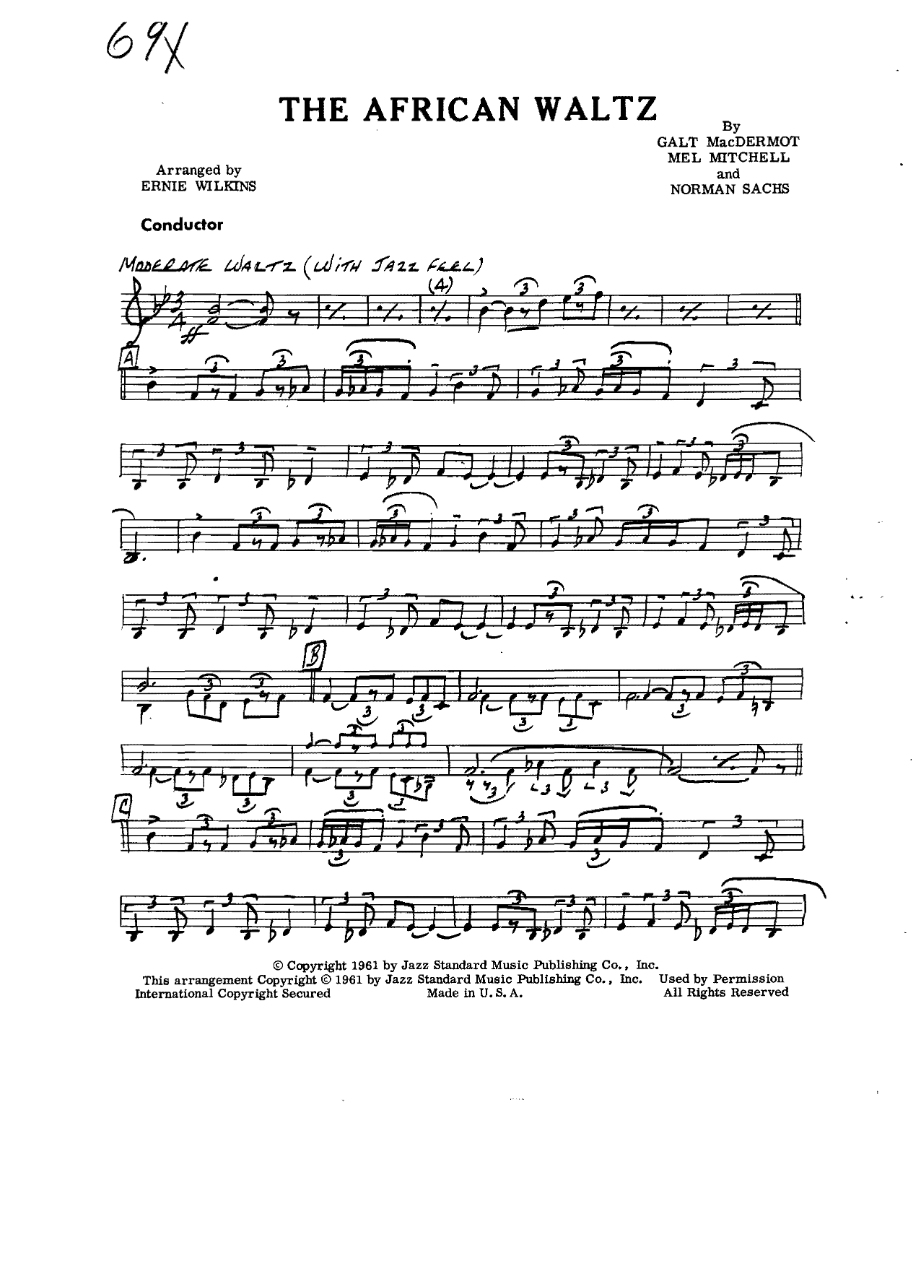
The African Waltz (E.Wilkins)
Composed by Galt MacDermot
Arranged by E. Wilkins
- Ensemble: Big Band Dance
- Style: Waltz
- Pages: 42
- Instruments (17): Alto Saxophone 1, Alto Saxophone 2, Tenor Saxophone 1, Tenor Saxophone 2, Baritone Saxophone, Trumpet 1, Trumpet 2, Trumpet 3, Trumpet 4, Trombone 1, Trombone 2, Trombone 3, Bass Trombone, Piano, Bass, Drums, Guitar
- Difficulty: medium
- Content: Individual Parts
- Format: PDF Download (Instant)
- Price: $24.99
Galt MacDermot's "The African Waltz" burst onto the jazz scene, gaining significant traction in the early 1960s. While MacDermot is perhaps best known for his work on the musical *Hair*, this composition showcases his eclectic influences and knack for crafting memorable, rhythmically compelling melodies. The piece quickly became a favorite among jazz musicians and audiences alike, largely due to its distinctive 3/4 time signature and infectious, driving groove that blends West African rhythmic sensibilities with post-bop jazz harmonies. It represents a fascinating cross-section of global music influences entering the mainstream jazz idiom of the era, offering a refreshing alternative to the prevalent swing and bebop forms. The original recordings, particularly by artists like John Dankworth, helped popularize its unique character, establishing it as a notable, if somewhat niche, jazz standard. E. Wilkins' big band dance arrangement of "The African Waltz" masterfully captures the original's vibrant energy while expanding its sonic palette for a full 17-piece ensemble. Wilkins, known for his sophisticated yet accessible charts, approaches this piece with a keen understanding of its rhythmic core. The arrangement maintains the original's medium-up waltz tempo, typically around 140-150 bpm, ensuring the infectious 3/4 feel remains at the forefront. Wilkins employs rich, often close-voiced harmonies in the saxophone and brass sections, creating a full, resonant sound that propels the melody forward. Expect dynamic contrasts, with powerful brass soli sections punctuated by intricate saxophone lines, all underpinned by a driving rhythm section. The overall mood is exhilarating and celebratory, evoking a sense of rhythmic dance and sophisticated joy. The arrangement features the iconic melody prominently, initially presented by the saxophone section in a unison or harmonized setting, before being passed to the brass for a contrasting texture. Wilkins provides ample opportunity for improvisation, with designated solo sections typically for tenor saxophone and trumpet, allowing soloists to explore the piece's modal and blues-inflected harmonic landscape. Technical challenges include maintaining rhythmic precision in the driving 3/4 feel, especially across the ensemble, and executing the dynamic shifts and articulation nuances that give the arrangement its character. The brass section will need strong embouchures for sustained, powerful phrases, while the saxophones require agility for their melodic and soli passages. The rewarding aspect lies in the collective energy generated by the ensemble, culminating in a powerful shout chorus that brings the arrangement to a thrilling close. This arrangement is ideally suited for college-level jazz ensembles, advanced community big bands, and professional groups. While high school bands with strong lead players and a solid rhythm section could tackle it, the intricate voicings, sustained energy requirements, and improvisational demands make it more appropriate for musicians with a higher level of technical proficiency and ensemble experience. Its unique rhythmic feel and sophisticated harmonic language offer an excellent educational opportunity for exploring non-standard time signatures in a jazz context, making it a valuable addition to any big band's repertoire. "The African Waltz" demands a precise and energetic approach to its 3/4 medium-up waltz feel, typically around 140-150 bpm. The rhythm section must establish a strong, consistent pulse with a clear emphasis on the "one," while allowing for a subtle swing inflection within the triplet subdivision. Drummers should focus on a driving, yet light, cymbal pattern that supports the waltz feel without becoming heavy-handed. Articulation is key: brass stabs should be crisp and unified, while saxophone lines require a blend of legato and detached phrasing to maintain clarity. There are no specific mute requirements beyond standard cup and straight mutes for brass, to be used at the discretion of the conductor for dynamic shaping. Rehearsal time should be dedicated to locking in the rhythmic groove across all sections, particularly during the ensemble soli passages, and ensuring dynamic contrasts are clearly defined to build excitement towards the final shout chorus. Encourage soloists to embrace the modal character and rhythmic drive of the piece. Q: What instruments are included in this arrangement? A: This big band dance arrangement is scored for 17 instruments: Alto Saxophone 1, Alto Saxophone 2, Tenor Saxophone 1, Tenor Saxophone 2, Baritone Saxophone, Trumpet 1, Trumpet 2, Trumpet 3, Trumpet 4, Trombone 1, Trombone 2, Trombone 3, Bass Trombone, Piano, Bass, Drums, and Guitar. Q: What is the difficulty level of "The African Waltz (E.Wilkins)"? A: This arrangement is considered advanced intermediate to advanced, suitable for college-level, advanced community, or professional jazz ensembles due to its rhythmic precision demands, intricate voicings, and improvisational opportunities. Q: What is the musical style and historical context of this piece? A: "The African Waltz" is a jazz waltz composed by Galt MacDermot in the early 1960s. It blends traditional jazz harmonies with a distinctive 3/4 time signature and rhythmic elements influenced by West African music, representing a unique cross-cultural fusion of the era. Q: What makes E. Wilkins' arrangement of "The African Waltz" unique? A: E. Wilkins' treatment is characterized by rich, often close-voiced harmonies, dynamic contrasts between powerful brass soli and intricate saxophone lines, and a driving rhythmic section that maintains the original's infectious 3/4 groove while expanding its sonic palette for a full big band. Q: What is the typical performance duration and tempo for this arrangement? A: The typical performance duration for this arrangement is approximately 4-5 minutes, performed at a medium-up waltz tempo, usually around 140-150 beats per minute.
Musicians Also Search For
The African Waltz E. Wilkins PDF • The African Waltz E. Wilkins sheet music • The African Waltz arranged by E. Wilkins • E. Wilkins big band dance charts • E. Wilkins jazz arrangements PDF • The African Waltz Galt MacDermot sheet music • The African Waltz Galt MacDermot big band dance arrangement • Galt MacDermot big band dance charts • The African Waltz big band dance arrangement • The African Waltz big band dance PDF download • The African Waltz jazz ensemble sheet music • big band dance sheet music instant download • The African Waltz individual parts download • The African Waltz sheet music with parts • The African Waltz Waltz chart • Waltz big band dance arrangements • buy The African Waltz sheet music online • download The African Waltz PDF • The African Waltz jazz chart • best E. Wilkins big band dance arrangements • Galt MacDermot songs arranged by E. Wilkins • The African Waltz printable sheet music • big band dance repertoire PDF