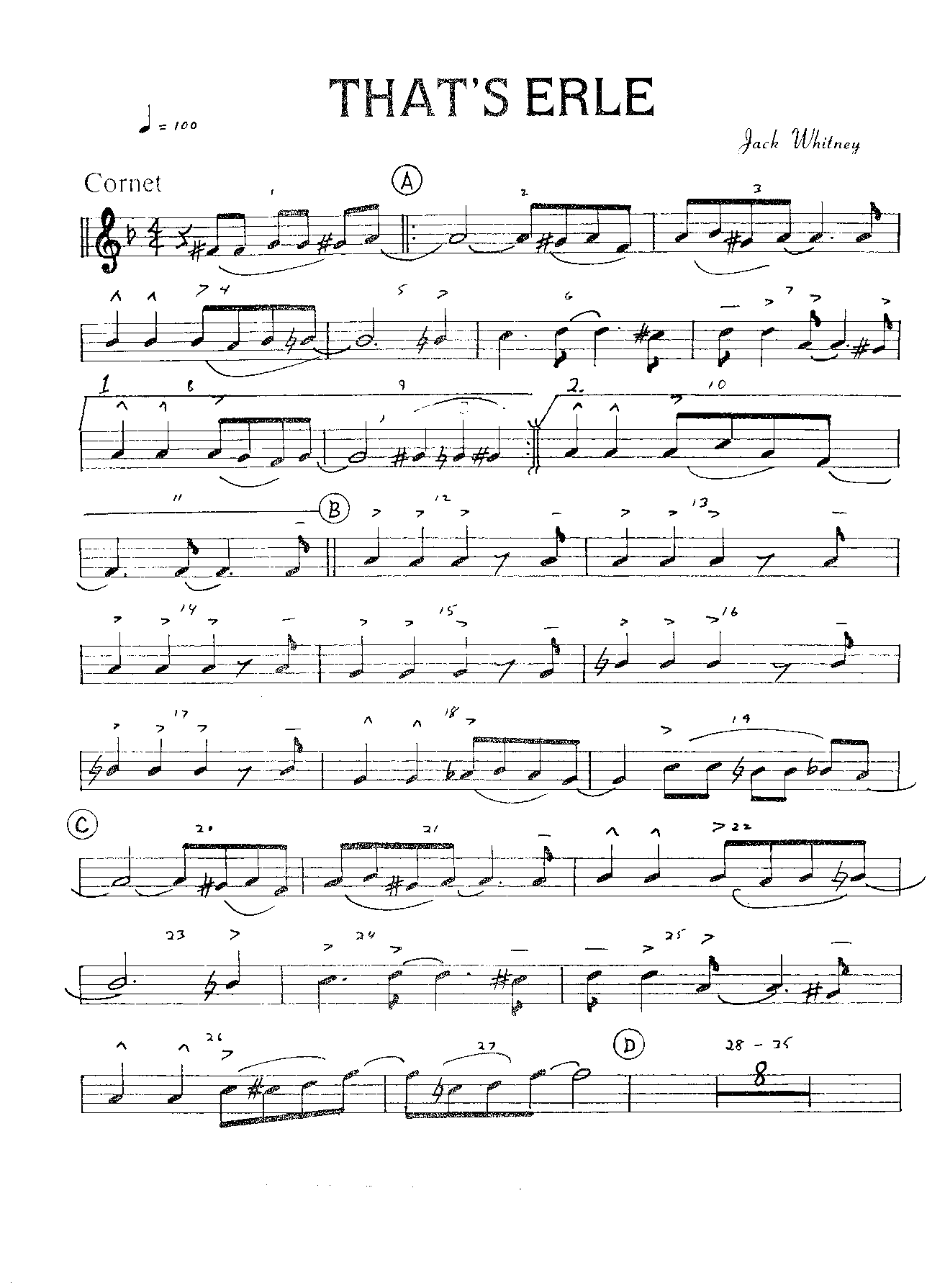
That's Erle (J.Whitney) sheet music preview

That's Erle (J.Whitney)

Composed by Jack Whitney

Arranged by Jack Whitney

  • Ensemble: Dixieland Band
  • Style: Dixieland
  • Pages: 15
  • Instruments (8): Cornet, Clarinet, Tenor Saxophone, Trombone, Guitar, Piano, Bass Tuba, Drums
  • Difficulty: easy
  • Content: Individual Parts
  • Format: PDF Download (Instant)
  • Price: $18.99

"That's Erle," an original composition by Jack Whitney, stands as a vibrant testament to the enduring spirit of Dixieland jazz. While not a historical standard, this piece is crafted with an authentic reverence for the genre's golden age, evoking the joyous, improvisational energy that defined early New Orleans jazz. Composed and arranged by Whitney, it captures the essence of the 1920s and 30s, a period characterized by collective improvisation, syncopated rhythms, and a celebratory, often boisterous, musical dialogue. This piece embodies the Dixieland tradition of ensemble interplay, where each instrument contributes to a rich, polyphonic texture, reminiscent of the recordings that brought figures like Louis Armstrong, Jelly Roll Morton, and the Original Dixieland Jazz Band to prominence. Musically, "That's Erle" is an up-tempo Dixieland romp, typically performed in a bright, driving 2/4 feel, though it can also be interpreted with a strong 4/4 swing pulse. The primary key is a bright B-flat Major, lending itself to the brassy exuberance characteristic of the style. The mood is unequivocally ebullient and infectious, designed to convey a sense of carefree revelry and spontaneous joy. It's a piece that demands attention with its energetic drive and evokes the lively atmosphere of a speakeasy or a New Orleans street parade. The melodic lines are catchy and memorable, providing excellent springboards for the collective improvisation that is the hallmark of Dixieland. Jack Whitney's arrangement of his own composition showcases his deep understanding of Dixieland idiom. He masterfully balances written passages with ample space for traditional collective improvisation. The arrangement features clear melodic statements, often carried initially by the trumpet, before opening up into classic Dixieland "breaks" and "rides." Whitney's approach emphasizes the distinct roles of each instrument: the trumpet leading the melody, the clarinet weaving intricate counter-melodies, the trombone providing harmonic fills and tailgate smears, and the rhythm section laying down a solid, driving foundation. There are no extended shout choruses or complex modulations typical of later jazz styles; instead, the focus remains on the authentic, interwoven texture. The arrangement also includes specific dynamic markings and articulations that guide the ensemble towards an authentic performance. Performing "That's Erle" is a highly rewarding experience, offering both structured guidance and creative freedom. The melody is initially presented by the trumpet, with subsequent choruses featuring the clarinet and trombone taking the lead in turn, often with collective improvisation from the other horns. Key technical challenges include maintaining a consistent, driving tempo, executing precise ensemble hits, and navigating the often intricate counterpoint during collective improvisation sections. The piece demands strong individual musicianship, particularly in melodic interpretation and improvisational flair. It is ideally suited for high school, college, community, and semi-professional Dixieland bands looking for an authentic and energetic addition to their repertoire. Its clear structure, combined with opportunities for individual expression, makes it an excellent teaching tool for understanding Dixieland roles and a crowd-pleaser in any performance setting. "That's Erle" thrives on a bright, driving tempo, ideally around quarter note = 180-200 BPM, maintaining a crisp 2/4 feel that propels the music forward. Conductors should emphasize a light, articulate approach from the brass and woodwinds, avoiding overly heavy attacks. The rhythm section needs to establish a rock-solid, swinging foundation, with the banjo or guitar providing rhythmic drive and the tuba or bass anchoring the harmony. Technical challenges include precise execution of the ensemble figures, especially during the "breaks," and ensuring clear melodic leadership shifts between the trumpet, clarinet, and trombone. Encourage musicians to listen intently to each other during collective improvisation sections, aiming for a conversational, interwoven texture rather than individual dominance. Specific techniques like trombone smears and clarinet glissandos should be executed with flair and authenticity. Rehearsal time should focus on rhythmic precision, dynamic contrast, and developing a cohesive, spontaneous sound within the collective improvisation sections. Q: What instruments are included in this arrangement of "That's Erle"? A: This arrangement is scored for a standard Dixieland band instrumentation, typically including Trumpet, Clarinet, Trombone, Banjo/Guitar, Tuba/Bass, and Drums. The parts are clearly laid out for each of these instruments. Q: What is the difficulty level of "That's Erle (J.Whitney)"? A: This arrangement is rated as Medium difficulty. It requires solid instrumental technique, a good understanding of Dixieland style, and the ability to improvise melodically within the genre's harmonic framework. Q: What musical style and historical context does "That's Erle" represent? A: "That's Erle" is an original composition by Jack Whitney, written in the classic Dixieland style. It evokes the lively, collective improvisation and celebratory feel of early New Orleans jazz from the 1920s and 1930s. Q: What makes Jack Whitney's arrangement of "That's Erle" unique? A: Whitney's arrangement is unique in its authentic balance of written ensemble passages with ample, clearly indicated sections for traditional collective improvisation. It provides a structured yet flexible framework that encourages genuine Dixieland interplay, showcasing his deep understanding of the style. Q: What is the typical performance duration and tempo for "That's Erle"? A: "That's Erle" is an up-tempo piece, typically performed at a brisk quarter note = 180-200 BPM. Depending on the number and length of improvised choruses, a performance usually lasts between 2.5 and 4 minutes.

Questions and answers

What is included in the That's Erle (J.Whitney) PDF?
The verified current file contains individual parts across 15 pages.
How many instruments or parts are listed for That's Erle (J.Whitney)?
The verified instrumentation list contains 8 entries for this Dixieland Band arrangement.
Who is credited for That's Erle (J.Whitney)?
Composer: Jack Whitney. Arranger: Jack Whitney.
What difficulty is listed for That's Erle (J.Whitney)?
The verified difficulty level is easy.
What style is listed for That's Erle (J.Whitney)?
The catalog lists the style as Dixieland.
Can I preview That's Erle (J.Whitney) before buying?
Yes. The product page provides a preview generated from the current PDF file.
How is That's Erle (J.Whitney) delivered?
After successful payment, the digital PDF is made available for download. The displayed price is $18.99.

Musicians Also Search For

That's Erle Jack Whitney PDFThat's Erle Jack Whitney sheet musicThat's Erle arranged by Jack WhitneyJack Whitney dixieland band chartsJack Whitney jazz arrangements PDFThat's Erle Jack Whitney dixieland band arrangementsThat's Erle dixieland band arrangementsThat's Erle dixieland band PDF downloadThat's Erle jazz sheet musicdixieland band sheet music downloadThat's Erle individual parts downloadThat's Erle sheet music PDFThat's Erle Dixieland chartsDixieland dixieland band arrangementsbuy That's Erle sheet musicdownload That's Erle PDFThat's Erle jazz chartsbest Jack Whitney dixieland band arrangementsThat's Erle printable sheet musicdixieland band repertoire PDF

All arrangements by Jack Whitney All Jack Whitney sheet music