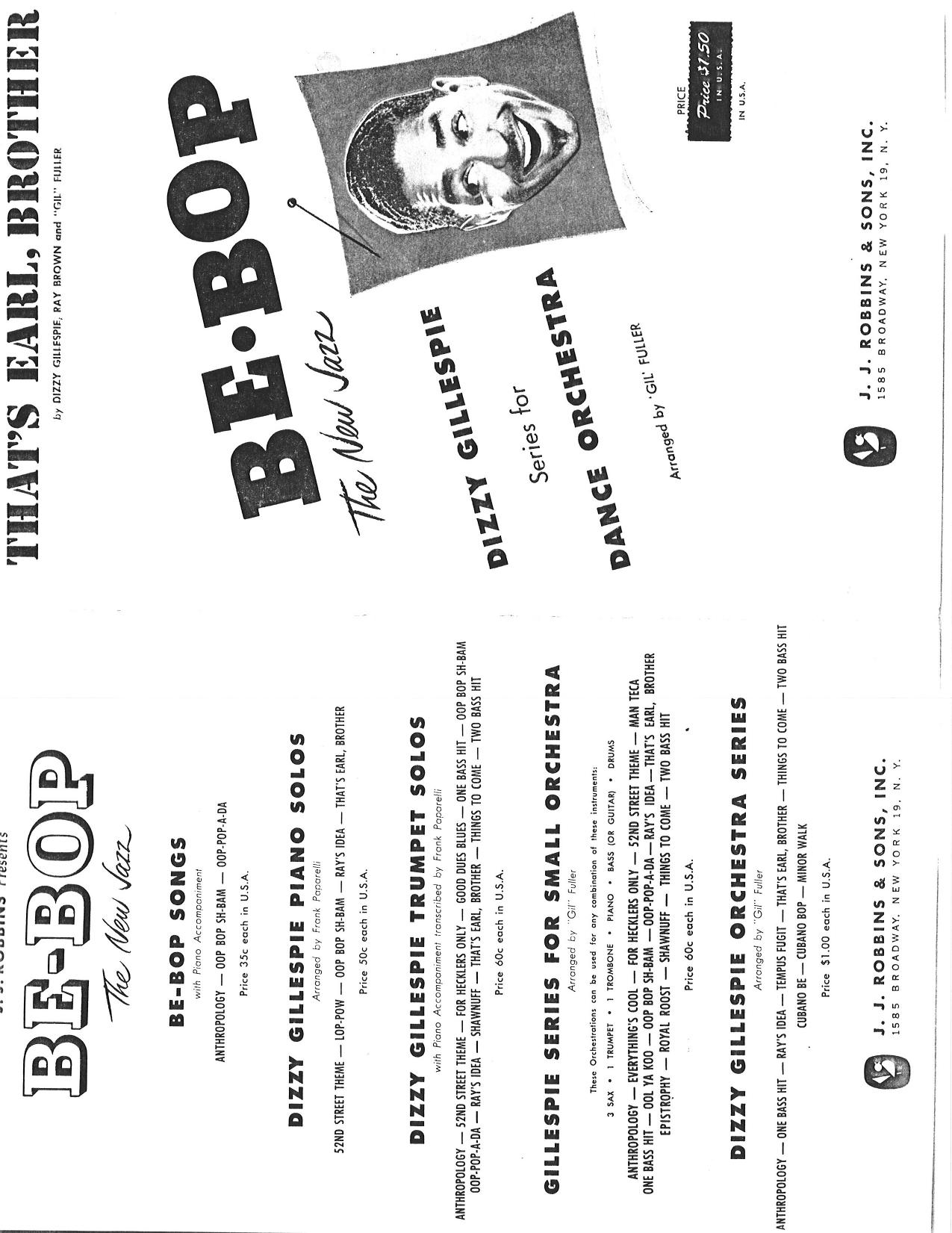
That's Earl, Brother (G.Fuller)
Composed by Gil Fuller
Arranged by Gil Fuller-D.GILLESPIE
- Ensemble: Big Band
- Pages: 17
- Instruments (15): 1st Saxophone Eb Alto, 2nd Saxophone Bb Tenor, 3rd Saxophone Eb Alto, 4th Saxophone Bb Tenor, 5th Saxophone Eb Baritone, 1st Trumpet in Bb, 2nd Trumpet in Bb, 3rd Trumpet in Bb, 1st Trombone, 2nd Trombone, 3rd Trombone, Drums, Bass, Piano, Guitar
- Difficulty: easy
- Content: Individual Parts
- Format: PDF Download (Instant)
- Price: $24.99
Bebop’s revolutionary mid-1940s landscape birthed some of the most intricate and electrifying writing in jazz history, and "That’s Earl, Brother" stands as a prime monument of that era. Originally penned by arranger and composer Gil Fuller alongside the legendary Dizzy Gillespie, this composition captures the high-wire energy, harmonic sophistication, and blistering tempos that defined the birth of modern jazz. Named in playful tribute to bandleader Earl Hines—in whose orchestra Gillespie and Fuller had spent formative years—the tune quickly established itself as a bebop staple, bridging the gap between large-ensemble swing and the avant-garde small-group language pioneered at Minton's Playhouse. Driven by an irresistible up-tempo swing feel in 4/4 time, the music crackles with relentless momentum and fierce intellectual vitality. The mood is exuberant, defiant, and relentlessly driving, evoking the smoky, late-night atmosphere of 52nd Street. From the opening rhythmic hits to the final sustained chord, the arrangement demands absolute precision and mental agility. The harmonic framework utilizes advanced bebop extensions, altering standard chord changes with sharp chromatic passing tones and unexpected modal shifts that keep both performers and listeners on the edge of their seats. Gil Fuller’s distinctive arranging blueprint shines through the sophisticated voicings and linear counterpoint that characterize this chart. Rather than relying on simple block-chord harmonization, Fuller weaves intricate horn lines that mimic the agility of small-group bop heads, distributing thematic material across the 8-instrument ensemble with crystalline clarity. The saxophone section (alto, tenor, and baritone) is deployed with woodwind-like dexterity, executing blistering unisons and tight harmonies that double or complement the brass. A standout shout chorus serves as the structural climax, building tension through layered syncopation and dynamic contrast before resolving into a high-octane head reprise. Executing this chart requires advanced technical proficiency, particularly in terms of articulation, finger agility, and stylistic uniformity at brisk tempos. The melody is predominantly carried by the frontline horns, with intricate interplay between the trumpet and saxophone voices. Featured solo spaces allow proficient improvisers to stretch out over standard rhythm changes or the tune's specific harmonically dense roadmap. Advanced high school, collegiate, and professional jazz ensembles will find this arrangement deeply rewarding, as it provides an authentic masterclass in early-bop big band orchestration while testing the ensemble's stamina, intonation, and rhythmic cohesion. Achieving success with this arrangement begins with establishing a relentless, forward-moving medium-up to fast swing tempo that never drags. The primary technical challenge lies in the execution of rapid eighth-note bebop lines; musicians must utilize a crisp, articulated tongue-legato style, placing weight on the off-beat accents to preserve the authentic stylistic feel. Conductors should pay meticulous attention to the dynamic balance during dense ensemble passages, ensuring that inner-voice countermelodies in the trombone and tenor sax do not obscure the primary melodic line. Rehearsals should isolate the fast unison soli sections at a slower tempo before gradually ramping up to performance speed. Encourage the rhythm section—especially the drummer—to "feather" the bass drum and drive the ensemble with a crisp ride-cymbal pulse, avoiding heavy downbeats that can anchor the floating, fleet-footed nature of the bop idiom. Q: What specific instruments and parts are included in this arrangement? A: This chart is scored for an 8-instrument ensemble featuring Alto Saxophone, Tenor Saxophone, Baritone Saxophone, Trumpet, Trombone, and a standard rhythm section framework. Q: What is the difficulty level of this arrangement? A: This arrangement is rated as advanced, making it best suited for collegiate ensembles, professional groups, and highly accomplished high school jazz bands with strong section players. Q: What historical era does "That’s Earl, Brother" represent? A: It represents the mid-1940s bebop era, capturing the transition from large-group swing to the modern, harmonically complex language championed by Dizzy Gillespie and Gil Fuller. Q: What makes this specific Gil Fuller arrangement unique? A: It uniquely adapts small-group bebop linear complexity into a tight 8-instrument big band format, utilizing intricate horn counterpoint and sophisticated harmonic voicings instead of standard block chords. Q: What is the recommended tempo and performance feel for this piece? A: The arrangement is performed at a brisk, driving up-tempo swing feel in 4/4 time, requiring high endurance, precise articulation, and agile time-keeping from all performers.
Questions and answers
- What is included in the That's Earl, Brother (G.Fuller) PDF?
- The verified current file contains individual parts across 17 pages.
- How many instruments or parts are listed for That's Earl, Brother (G.Fuller)?
- The verified instrumentation list contains 15 entries for this Big Band arrangement.
- Who is credited for That's Earl, Brother (G.Fuller)?
- Composer: Gil Fuller. Arranger: Gil Fuller-D.GILLESPIE.
- What difficulty is listed for That's Earl, Brother (G.Fuller)?
- The verified difficulty level is easy.
- Can I preview That's Earl, Brother (G.Fuller) before buying?
- Yes. The product page provides a preview generated from the current PDF file.
- How is That's Earl, Brother (G.Fuller) delivered?
- After successful payment, the digital PDF is made available for download. The displayed price is $24.99.
Musicians Also Search For
That's Earl, Brother Gil Fuller-D.GILLESPIE PDF • That's Earl, Brother Gil Fuller-D.GILLESPIE sheet music • That's Earl, Brother arranged by Gil Fuller-D.GILLESPIE • Gil Fuller-D.GILLESPIE big band charts • Gil Fuller-D.GILLESPIE jazz arrangements PDF • That's Earl, Brother Gil Fuller sheet music • That's Earl, Brother Gil Fuller big band arrangements • Gil Fuller big band charts • That's Earl, Brother big band arrangements • That's Earl, Brother big band PDF download • That's Earl, Brother jazz sheet music • big band sheet music download • That's Earl, Brother individual parts download • That's Earl, Brother sheet music PDF • buy That's Earl, Brother sheet music • download That's Earl, Brother PDF • That's Earl, Brother jazz charts • best Gil Fuller-D.GILLESPIE big band arrangements • Gil Fuller arranged by Gil Fuller-D.GILLESPIE • That's Earl, Brother printable sheet music • big band repertoire PDF