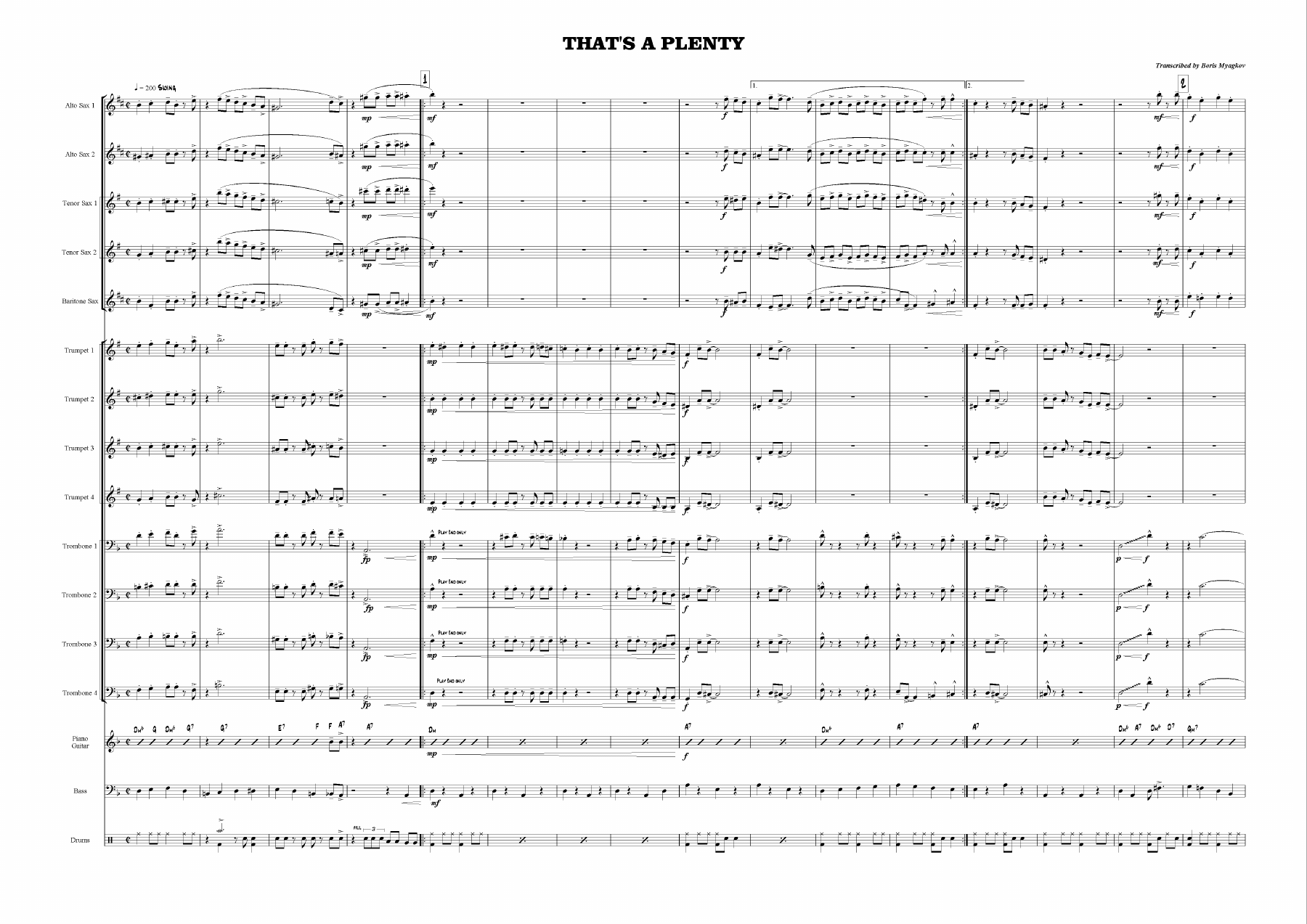
That's A Plenty (B.Myagkov) sheet music preview

That's A Plenty (B.Myagkov)

Composed by Lew Pollack

Arranged by Boris Myagkov

  • Ensemble: Big Band
  • Style: Jazz Standard
  • Pages: 38
  • Instruments (17): Alto Sax 1, Alto Sax 2, Tenor Sax 1, Tenor Sax 2, Baritone Sax, Trumpet 1, Trumpet 2, Trumpet 3, Trumpet 4, Trombone 1, Trombone 2, Trombone 3, Trombone 4, Piano, Guitar, Bass, Drums
  • Difficulty: medium
  • Content: Individual Parts
  • Format: PDF Download (Instant)
  • Price: $24.99

"That's A Plenty," a timeless jazz standard originally penned by Lew Pollack in 1914, stands as a vibrant cornerstone of early jazz and Dixieland repertoire. Emerging from the ragtime and early jazz era, it quickly became a staple for its infectious energy and memorable melodic lines, embodying the buoyant spirit of the burgeoning jazz scene in the early 20th century. While many early jazz bands popularized it, the tune gained widespread recognition through recordings by artists such as the New Orleans Rhythm Kings and later, through its enduring presence in traditional jazz and swing ensembles. Its distinctive, driving feel and call-and-response structure have cemented its place as a perennial favorite, celebrated for its historical significance and its capacity to ignite any performance with unbridled joy. Boris Myagkov’s big band arrangement of "That's A Plenty" masterfully reinterprets this classic, infusing it with contemporary big band sensibilities while honoring its Dixieland roots. Set at a brisk, driving medium-up swing tempo in 4/4, the arrangement maintains the original's bright, optimistic mood, primarily in the key of B-flat major. Myagkov's distinctive approach is evident in his sophisticated voicings, which provide lush harmonic textures without sacrificing the tune's inherent clarity and punch. Expect dynamic soli sections that showcase the full power of the saxophone and brass sections, punctuated by crisp, articulate ensemble figures. The arrangement cleverly uses call-and-response motifs, reminiscent of the original's conversational nature, but elevated with modern big band orchestration. The arrangement opens with a spirited ensemble statement, immediately establishing its energetic character. The melody is skillfully passed between the lead trumpet and alto saxophone, ensuring clarity and allowing individual sections to shine. A featured tenor saxophone solo provides an opportunity for improvisation, grounded by a rhythmically engaging background. Following this, a powerful shout chorus builds intensity, culminating in a dynamic full-ensemble finale that is both exhilarating and satisfying. Technical challenges include maintaining precise articulation at the brisk tempo, navigating intricate brass figures, and achieving a cohesive, driving swing feel across all sections. The rewarding aspect lies in the sheer exuberance of the piece and the opportunity for the band to deliver a truly uplifting and historically rich performance. This arrangement is ideally suited for advanced high school, collegiate, community, and professional big bands. Its blend of historical reverence and modern big band technique offers a valuable educational experience for younger ensembles, while providing ample musical depth and challenge for more seasoned groups. The detailed scoring and thoughtful orchestration ensure that a well-rehearsed ensemble will achieve a professional-sounding performance, making it a standout addition to any concert program or jazz festival set. Conductors should emphasize a consistent, driving medium-up swing feel throughout, ensuring the rhythm section provides a solid, propulsive foundation. Articulation is paramount, particularly for the brass section, where crisp, short notes are essential for clarity and punch in the ensemble figures and soli sections. Encourage saxophones to maintain a bright, unified tone, especially during their soli passages. The tenor saxophone solo should be approached with a focus on melodic invention within the swing idiom, supported by a responsive and dynamic rhythm section. Pay close attention to the dynamic contrasts, building intensity towards the shout chorus and the final ensemble hits. Rehearsal time should be dedicated to syncing the intricate rhythmic interplay between sections and ensuring precise cut-offs. No special techniques like plunger mutes or doits are explicitly notated, allowing the ensemble to focus on fundamental big band execution. Q: What instruments and parts are included in this arrangement? A: This arrangement is scored for a standard 17-piece big band, including Alto Saxophone 1, Alto Saxophone 2, Tenor Saxophone 1, Tenor Saxophone 2, Baritone Saxophone, Trumpet 1, Trumpet 2, Trumpet 3, Trumpet 4, Trombone 1, Trombone 2, Trombone 3, Trombone 4, Piano, Bass, Drums, and Guitar. It also includes a full conductor score, totaling 38 pages. Q: What is the difficulty level of "That's A Plenty (B.Myagkov)"? A: This arrangement is considered advanced, suitable for high school, collegiate, community, and professional big bands. It requires strong technical proficiency, precise articulation, and a solid understanding of the swing idiom from all sections. Q: What is the musical style and historical context of this arrangement? A: This is a big band arrangement of "That's A Plenty," a classic jazz standard composed by Lew Pollack in 1914. It represents the early jazz and Dixieland era, reimagined with modern big band orchestration and a driving medium-up swing feel. Q: What makes Boris Myagkov's arrangement of "That's A Plenty" unique? A: Myagkov's arrangement uniquely blends the historical charm of the original Dixieland tune with sophisticated big band voicings, dynamic soli sections, and a powerful shout chorus. It maintains the tune's infectious energy while providing a fresh, contemporary orchestral treatment. Q: What is the approximate performance duration and tempo of this piece? A: The arrangement is designed for a brisk, driving medium-up swing tempo in 4/4. While exact duration can vary with interpretation, a typical performance would be approximately 3-4 minutes, depending on the length of the improvised tenor saxophone solo.

Questions and answers

What is included in the That's A Plenty (B.Myagkov) PDF?
The verified current file contains a conductor score and individual parts across 38 pages.
How many instruments or parts are listed for That's A Plenty (B.Myagkov)?
The verified instrumentation list contains 17 entries for this Big Band arrangement.
Who is credited for That's A Plenty (B.Myagkov)?
Composer: Lew Pollack. Arranger: Boris Myagkov.
What difficulty is listed for That's A Plenty (B.Myagkov)?
The verified difficulty level is medium.
What style is listed for That's A Plenty (B.Myagkov)?
The catalog lists the style as Jazz Standard.
Can I preview That's A Plenty (B.Myagkov) before buying?
Yes. The product page provides a preview generated from the current PDF file.
How is That's A Plenty (B.Myagkov) delivered?
After successful payment, the digital PDF is made available for download. The displayed price is $24.99.

Musicians Also Search For

That's A Plenty Boris Myagkov PDFThat's A Plenty Boris Myagkov sheet musicThat's A Plenty arranged by Boris MyagkovBoris Myagkov big band chartsBoris Myagkov jazz arrangements PDFThat's A Plenty Lew Pollack sheet musicThat's A Plenty Lew Pollack big band arrangementsLew Pollack big band chartsThat's A Plenty big band arrangementsThat's A Plenty big band PDF downloadThat's A Plenty jazz sheet musicbig band sheet music downloadThat's A Plenty conductor score PDFThat's A Plenty individual parts downloadThat's A Plenty sheet music PDFThat's A Plenty Jazz Standard chartsJazz Standard big band arrangementsbuy That's A Plenty sheet musicdownload That's A Plenty PDFThat's A Plenty jazz chartsbest Boris Myagkov big band arrangementsLew Pollack arranged by Boris MyagkovThat's A Plenty printable sheet musicbig band repertoire PDF

All arrangements by Boris Myagkov All Lew Pollack sheet music