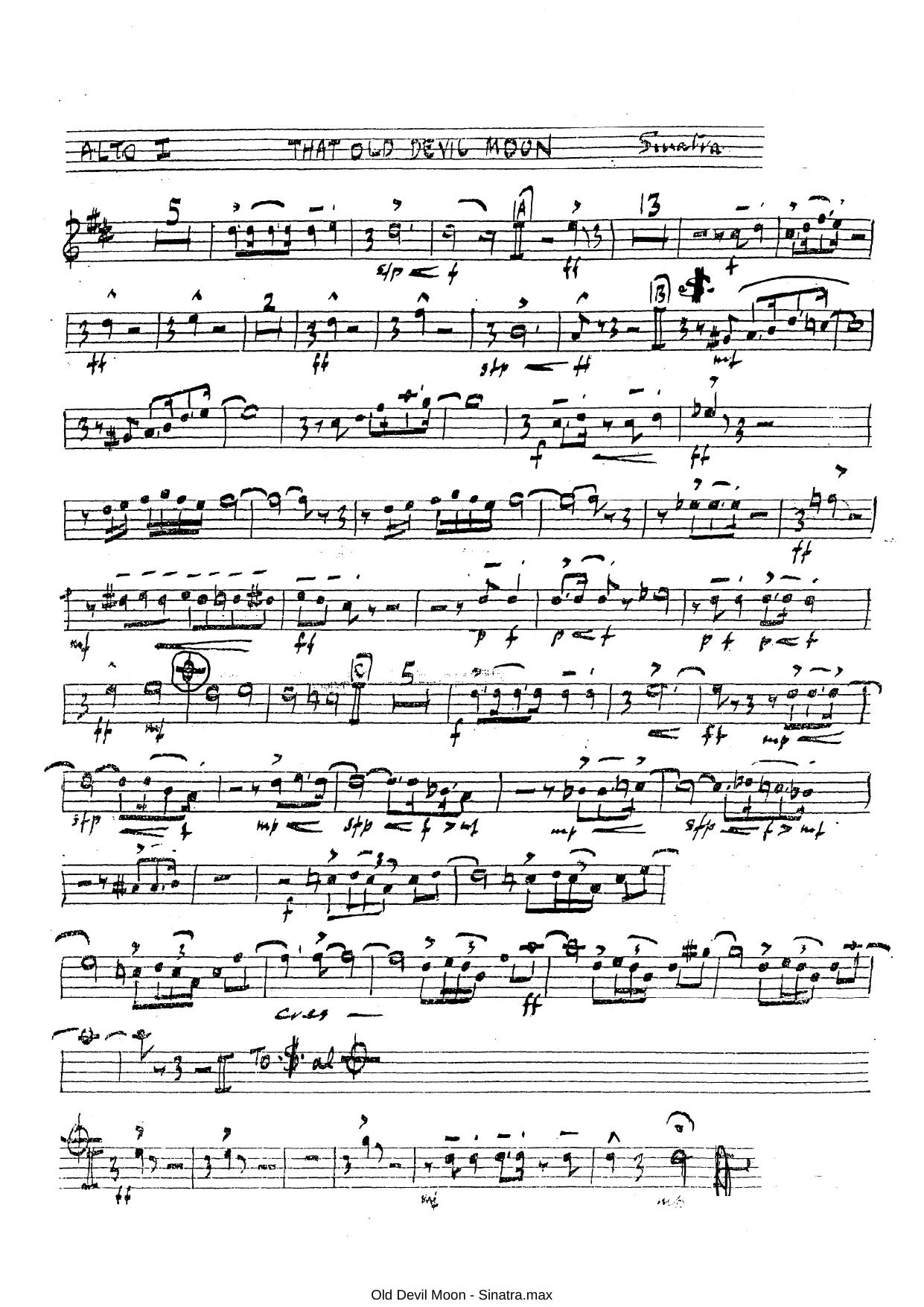
That Old Devil Moon (J.Farley) sheet music preview

That Old Devil Moon (J.Farley)

Composed by Burton Lane

Arranged by John Farley

  • Ensemble: Big Band
  • Pages: 17
  • Instruments (16): Alto Saxophone 1, Alto Saxophone 2, Tenor Saxophone 1, Tenor Saxophone 2, Baritone Saxophone, Trumpet 1, Trumpet 2, Trumpet 3, Trumpet 4, Trombone 1, Trombone 2, Trombone 3, Trombone 4, Piano/Guitar, Bass, Drums
  • Difficulty: easy
  • Content: Individual Parts
  • Format: PDF Download (Instant)
  • Price: $24.99

Burton Lane and E.Y. "Yip" Harburg introduced "Old Devil Moon" in the 1947 Broadway fantasy musical *Finian's Rainbow*, where it quickly transcended its theatrical origins to become a cornerstone of the modern jazz canon. Driven by a distinctive, hypnotic harmonic framework and a memorable modal-leaning bridge, the tune attracted jazz royalty from its inception. Milestone interpretations by Miles Davis, Chet Baker, and Sonny Rollins cemented its status as an essential vehicle for both modal exploration and swinging momentum. The composition bridges the gap between classic Broadway sophistication and the adventurous harmonic expansions of the post-war jazz era, offering improvisers a rich playground of suspended chords and driving modal shifts. John Farley’s sophisticated big band interpretation transforms this timeless standard into a high-energy powerhouse, reimagining the classic melody through a lens of contemporary harmonic color and relentless rhythmic drive. Set in a driving medium-up swing tempo (around 184 BPM), the arrangement opens with an atmospheric, tension-building vamp in the rhythm section before the horns enter with razor-sharp, angular voicings that hint at modern modal jazz while honoring the original's Broadway roots. Farley employs dense, extended tertian harmonies—utilizing sharp 11ths and altered dominants—to give the brass and saxophone sections a rich, contemporary bite. The arrangement balances intricate counterpoint with explosive ensemble power, particularly during the dynamic secondary bridge where the harmonic rhythm accelerates, ratcheting up the tension just before a cascading saxophone soli. Melodic duties are shared fluidly across the ensemble, initiating a rich dialogue between the muted trumpet and the tenor saxophone before opening up into expansive, harmonized horn lines. Solo space is thoughtfully allocated, providing an ideal feature for an adventurous tenor saxophonist or trumpeter over a robust AABA form changes background. Technical demands center on clean articulation, precise rhythmic unison during fast syncopated figures, and stylistic versatility in maintaining a buoyant, forward-leaning swing feel across all sections. The climax arrives in a tour-de-force shout chorus that deploys classic call-and-response figures between brass and reeds, punctuated by artful dynamic drops that keep the audience on the edge of their seats before resolving into a roaring, high-octane coda. Tailored specifically for advanced high school, collegiate, and professional jazz orchestras, this 17-page chart delivers substantial artistic reward for ensembles seeking to challenge their section reading and stylistic cohesion. The scoring honors the traditional big band footprint while infusing it with fresh, imaginative arrangement choices that make it an unforgettable centerpiece for any festival program, competition set, or headline concert performance. Conductors should approach John Farley’s chart with a strict focus on rhythmic precision and dynamic contrast. The baseline tempo should anchor firmly around 184 BPM; rushing the medium-up swing feel will compromise the clarity of the dense upper-structure voicings in the brass. Saxophones must prioritize a light, horizontal articulation on the up-tempo eighth-note lines to maintain buoyancy, avoiding heavy tongue accents that bog down the groove. Pay close attention to the dynamic markings leading into the shout chorus; the sudden drops from *forte* to *subito piano* require absolute restraint from the rhythm section and horns alike to maximize the subsequent crescendo. Brass players should utilize cup or harmon mutes where indicated to create textural variety during the head, ensuring proper intonation on altered dominant chords. Rehearsal time is best spent isolating the intricate modal transitions in the bridge, ensuring the ensemble shifts seamlessly between swinging straight-ahead feels and punchy, accented ensemble hits. Q: What instrumentation and parts are included in this arrangement? A: Scored for an 8-instrument big band ensemble configuration, the chart includes dedicated parts for Alto Saxophone, Tenor Saxophone, Trumpet, Trombone, and a complete rhythm section featuring Piano, Bass, Drums, and Guitar. Q: What is the difficulty level of this chart? A: This arrangement is graded as advanced, making it best suited for accomplished high school jazz ensembles, university jazz orchestras, and professional big bands that require sophisticated reading skills and strong section cohesion. Q: What is the historical and stylistic context of the piece? A: Originally penned by Burton Lane and E.Y. Harburg for the 1947 Broadway musical *Finian's Rainbow*, this arrangement reframes the beloved standard within a contemporary swinging big band style reminiscent of post-bop modernism. Q: What makes John Farley’s arrangement unique? A: Farley elevates the standard through inventive extended harmonies, an angular secondary bridge, a cascading saxophone soli, and a powerful, high-contrast shout chorus that reimagines the familiar melody with modern harmonic color. Q: What is the performance duration and recommended tempo? A: The arrangement runs approximately 4.5 to 5 minutes in length and is designed to be performed at a driving medium-up swing tempo of roughly 184 BPM.

Questions and answers

What is included in the That Old Devil Moon (J.Farley) PDF?
The verified current file contains individual parts across 17 pages.
How many instruments or parts are listed for That Old Devil Moon (J.Farley)?
The verified instrumentation list contains 16 entries for this Big Band arrangement.
Who is credited for That Old Devil Moon (J.Farley)?
Composer: Burton Lane. Arranger: John Farley.
What difficulty is listed for That Old Devil Moon (J.Farley)?
The verified difficulty level is easy.
Can I preview That Old Devil Moon (J.Farley) before buying?
Yes. The product page provides a preview generated from the current PDF file.
How is That Old Devil Moon (J.Farley) delivered?
After successful payment, the digital PDF is made available for download. The displayed price is $24.99.

Musicians Also Search For

That Old Devil Moon John Farley PDFThat Old Devil Moon John Farley sheet musicThat Old Devil Moon arranged by John FarleyJohn Farley big band chartsJohn Farley jazz arrangements PDFThat Old Devil Moon Burton Lane sheet musicThat Old Devil Moon Burton Lane big band arrangementsBurton Lane big band chartsThat Old Devil Moon big band arrangementsThat Old Devil Moon big band PDF downloadThat Old Devil Moon jazz sheet musicbig band sheet music downloadThat Old Devil Moon individual parts downloadThat Old Devil Moon sheet music PDFbuy That Old Devil Moon sheet musicdownload That Old Devil Moon PDFThat Old Devil Moon jazz chartsbest John Farley big band arrangementsBurton Lane arranged by John FarleyThat Old Devil Moon printable sheet musicbig band repertoire PDF

All arrangements by John Farley All Burton Lane sheet music