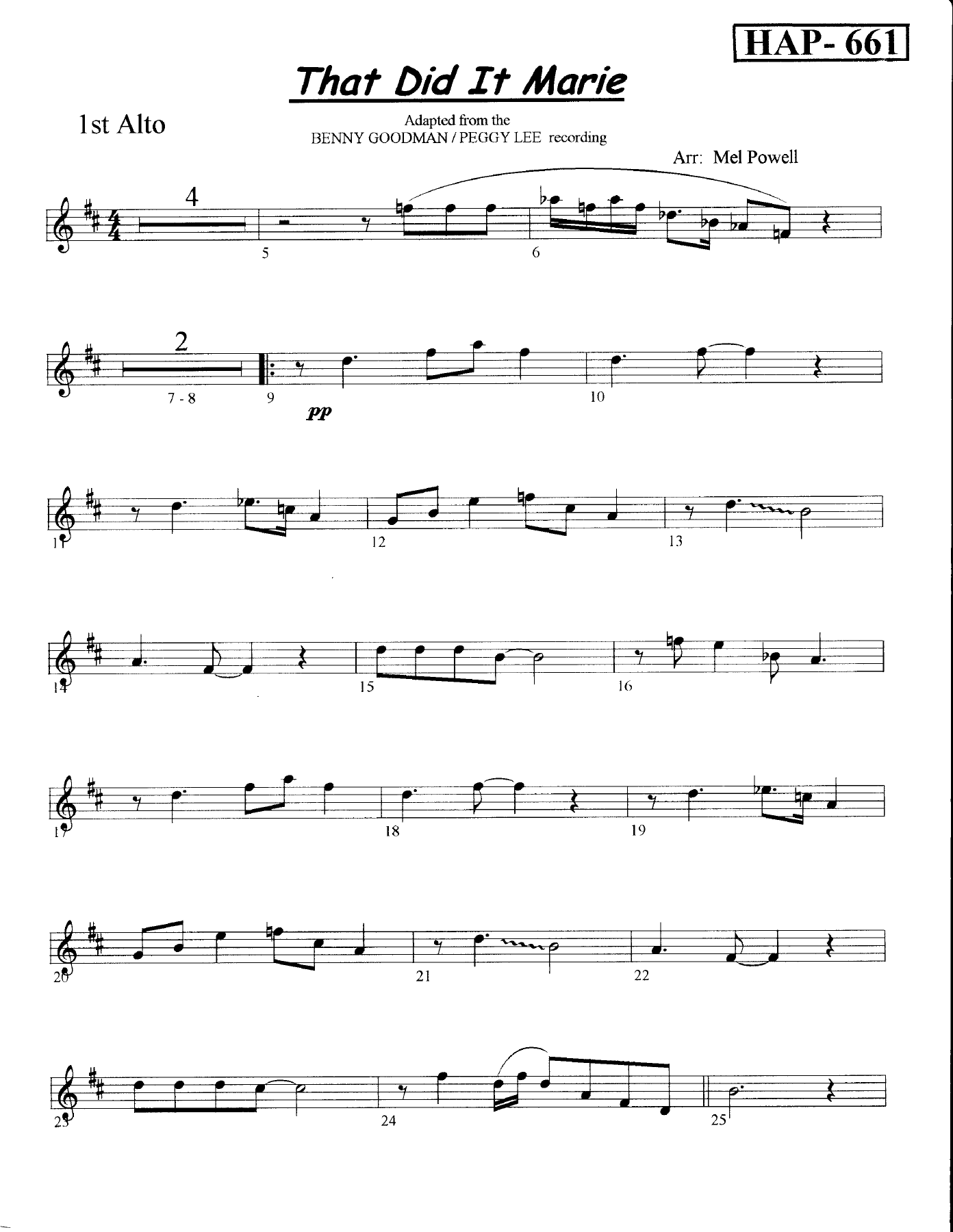
That Did It Marie (M.Powell)
Composed by Mel Powell
Arranged by M. Powell
- Ensemble: Big Band
- Style: Jazz Standard
- Pages: 21
- Instruments (17): Alto Saxophone 1, Alto Saxophone 2, Tenor Saxophone 1, Tenor Saxophone 2, Baritone Saxophone, Trumpet 1, Trumpet 2, Trumpet 3, Trumpet 4, Trombone 1, Trombone 2, Trombone 3, Bass Trombone, Guitar, Piano, Bass, Drums
- Difficulty: medium
- Content: Individual Parts
- Format: PDF Download (Instant)
- Price: $24.99
"That Did It Marie," originally penned by the brilliant pianist and composer Mel Powell, stands as a testament to the sophisticated swing era that blossomed in the 1930s and 40s. Powell, a prodigious talent who rose to prominence as Benny Goodman's pianist, crafted compositions that blended melodic ingenuity with harmonic richness, often pushing the boundaries of traditional swing. While not as universally recognized as some of his Goodman-era contemporaries, "That Did It Marie" embodies the vibrant, often intricate, sound of a period defined by big band innovation and virtuosity. It represents a cornerstone of the post-stride, pre-bebop piano-led small group and big band repertoire, showcasing Powell's distinctive voice before his later pivot to avant-garde classical music. The piece captures the effervescent spirit of a time when jazz was America's popular music, demanding both precision and spirited improvisation from its performers. M. Powell's arrangement of "That Did It Marie" breathes new life into this classic, presenting it as a medium-up swing chart in a bright, driving 4/4 feel. The arrangement is characterized by its infectious energy and a sophisticated harmonic palette, primarily residing in the key of F Major, which allows for both clarity and warmth. The overall mood is one of buoyant optimism and understated elegance, reminiscent of the Basie or Goodman orchestras, yet with a distinct contemporary edge in its voicing. M. Powell, known for his meticulous attention to detail and ability to craft charts that are both challenging and immensely rewarding, employs a masterful blend of tight ensemble writing and strategic open spaces for soloists. Expect rich, often dense, saxophone soli passages that showcase intricate counterpoint, balanced by powerful brass figures that punctuate and propel the arrangement forward. The arranger's distinctive approach is evident in the dynamic interplay between sections and the thoughtful development of melodic themes. The melody is initially presented by the alto saxophone, often doubled or harmonized with the trumpet section, establishing a clear, articulate lead. This soon gives way to a series of expertly crafted soli sections, where the saxophones weave complex lines, demanding precision and blend. A standout feature is the inclusion of a compelling shout chorus that builds steadily, culminating in a powerful, full-ensemble statement. While specific solo sections are designated for tenor saxophone and trumpet, the arrangement also offers opportunities for creative fills and ad-libs throughout. Technically, performers will encounter challenges in maintaining a consistent, driving swing feel at a medium-up tempo, navigating intricate rhythmic figures, and executing precise articulations and dynamics. The reward lies in performing a piece that is both historically significant and musically exhilarating, offering a genuine big band experience. This arrangement is ideally suited for advanced high school, college, community, and professional big bands. Its demands on ensemble precision, individual musicianship, and stylistic understanding make it an excellent vehicle for developing sophisticated performance skills. The intricate voicings and dynamic contrasts require a mature approach to blend and balance, while the solo opportunities provide a platform for improvisation within a classic swing context. Bands seeking to expand their repertoire with a piece that is both challenging and deeply rooted in jazz tradition will find "That Did It Marie" to be an invaluable addition, offering a rewarding journey through the heart of big band swing. Conductors should establish a firm, medium-up swing tempo (around 180-200 bpm) from the outset, emphasizing a light, driving 4/4 feel without rushing. Pay close attention to the articulation markings, particularly the short, crisp brass figures and the legato phrasing within the saxophone soli sections. The saxophone section must strive for impeccable blend and intonation during the intricate soli passages, ensuring each voice is heard clearly while contributing to the overall texture. Brass players should practice dynamic control, especially in the shout chorus, building intensity gradually while avoiding overblowing. Soloists should be encouraged to channel the spirit of classic swing improvisation, focusing on melodic development and rhythmic drive. Rehearsal time should be dedicated to perfecting the ensemble hits and cut-offs, ensuring a unified and precise attack and release across all sections. Q: What instruments are included in this arrangement? A: This big band arrangement is scored for 17 instruments: Alto Saxophone 1, Alto Saxophone 2, Tenor Saxophone 1, Tenor Saxophone 2, Baritone Saxophone, Trumpet 1, Trumpet 2, Trumpet 3, Trumpet 4, Trombone 1, Trombone 2, Trombone 3, Bass Trombone, Piano, Bass, Drums, and Guitar. Q: What is the difficulty level of "That Did It Marie (M.Powell)"? A: This arrangement is considered advanced, suitable for college, community, and professional big bands. It demands strong individual musicianship, precise ensemble playing, and a solid understanding of swing articulation and phrasing. Q: What musical style and historical context does this arrangement represent? A: "That Did It Marie" is a jazz standard rooted in the sophisticated swing era of the 1930s and 40s, originally composed by Mel Powell. This arrangement by M. Powell captures that classic big band sound with a fresh, contemporary approach to voicings and dynamics. Q: What makes M. Powell's arrangement of "That Did It Marie" unique? A: M. Powell's arrangement stands out for its intricate saxophone soli sections, powerful and well-developed shout chorus, and sophisticated harmonic voicings. It balances challenging ensemble writing with strategic solo opportunities, offering a fresh perspective on a classic piece. Q: What is the typical performance duration and tempo for this piece? A: The typical performance duration for "That Did It Marie (M.Powell)" is approximately 4-5 minutes, depending on the length of improvised solos. It is designed to be performed at a medium-up swing tempo, generally in the range of 180-200 beats per minute.
Musicians Also Search For
That Did It Marie M. Powell PDF • That Did It Marie M. Powell sheet music • That Did It Marie arranged by M. Powell • M. Powell big band charts • M. Powell jazz arrangements PDF • That Did It Marie Mel Powell sheet music • That Did It Marie Mel Powell big band arrangement • Mel Powell big band charts • That Did It Marie big band arrangement • That Did It Marie big band PDF download • That Did It Marie jazz ensemble sheet music • big band sheet music instant download • That Did It Marie individual parts download • That Did It Marie sheet music with parts • That Did It Marie Jazz Standard chart • Jazz Standard big band arrangements • buy That Did It Marie sheet music online • download That Did It Marie PDF • That Did It Marie jazz chart • best M. Powell big band arrangements • Mel Powell songs arranged by M. Powell • That Did It Marie printable sheet music • big band repertoire PDF