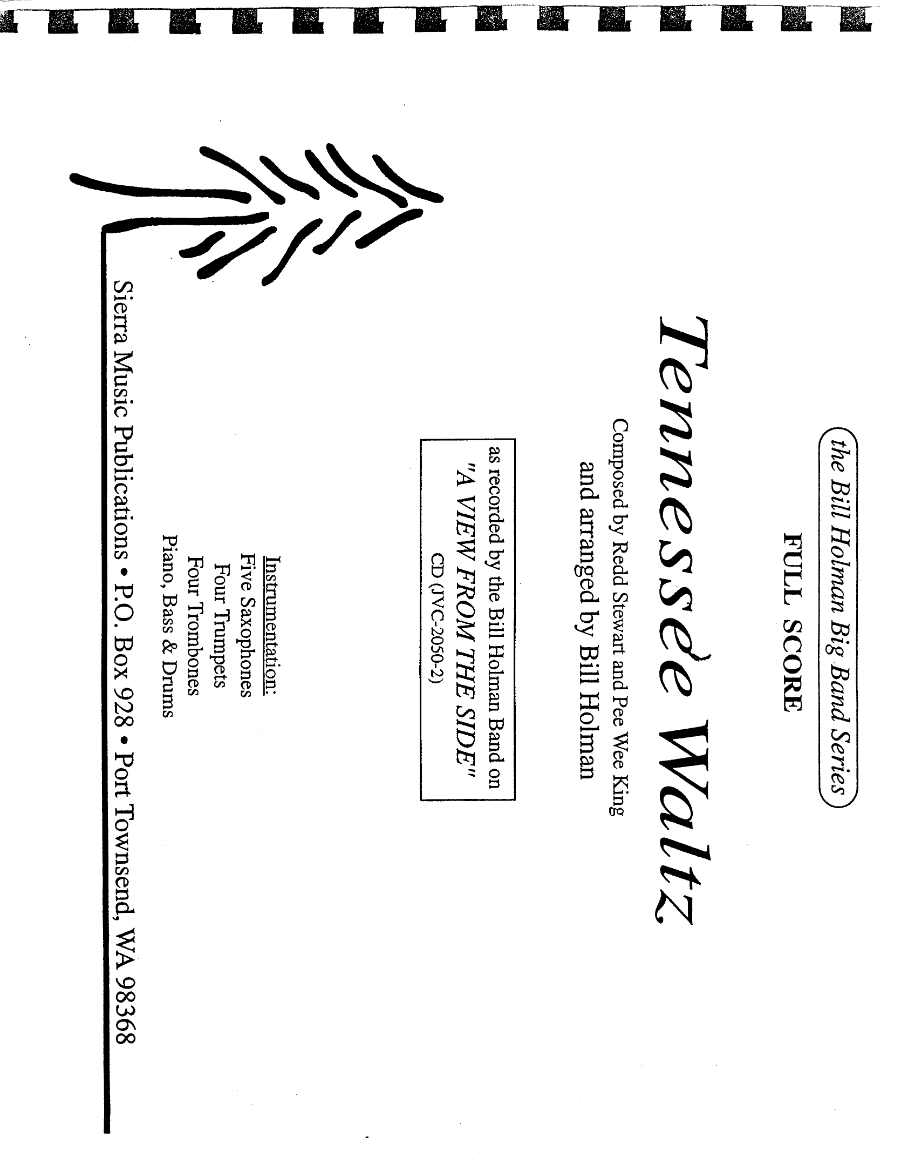
Tennessee Waltz (B.Holman) sheet music preview

Tennessee Waltz (B.Holman)

Composed by Pee Wee King

Arranged by Bill Holman

  • Ensemble: Big Band
  • Pages: 152
  • Instruments (16): Alto Saxophone 1, Alto Saxophone 2, Tenor Saxophone 1, Tenor Saxophone 2, Baritone Saxophone, Trumpet 1, Trumpet 2, Trumpet 3, Trumpet 4, Trombone 1, Trombone 2, Trombone 3, Trombone 4, Piano, Bass, Drums
  • Difficulty: advanced
  • Content: Individual Parts
  • Format: PDF Download (Instant)
  • Price: $24.99

Originally penned in 1946 by Pee Wee King with lyrics by Redd Stewart, the "Tennessee Waltz" stands as one of the most enduring melodic gems of American popular music, achieving cross-genre immortality when Patti Page's 1950 vocal recording sold millions of copies. While firmly rooted in country-music soil, its poignant, swaying three-quarter time signature and aching harmonic simplicity invited early and frequent crossover into the jazz idiom. Jazz artists recognized underneath its rustic exterior a sophisticated, cyclical harmonic structure ripe for reinterpretation. It bridges the gap between mid-century Americana and sophisticated modal and vertical jazz exploration, proving that a timeless melody can anchor almost any advanced harmonic vocabulary without losing its emotional core. Legendary west-coast arranger Bill Holman transforms this familiar country waltz into a masterclass of modern big band architecture, casting it in a driving, innovative medium-up groove that recontextualizes the 3/4 meter. The emotional landscape shifts from rural melancholy to urban sophistication, replacing rustic simplicity with luminous, extended harmonies, shifting metric accents, and ingenious counterpoint. Holman avoids predictable choruses, instead wrapping the iconic melody in shimmering brass voicings and rolling saxophone solis that ripple across the ensemble. The mood oscillates between introspective, lyrical passages and high-octane, harmonically dense bursts of collective energy, evoking the breezy, intellectual cool of the West Coast jazz movement while retaining an underlying, irresistible swing momentum. Holman’s signature compositional fingerprints are stamped across every page of this 152-page manuscript, showcasing his genius for linear writing, unpredictable rhythmic displacement, and rich, non-tertian chord voicings. Rather than locking the band into a static rhythmic vamp, Holman treats the rhythm section and horns as independent conversational voices, utilizing ingenious voicing-by-fourth techniques and chromatic voice-leading that make familiar chord progressions sound entirely fresh. The melody is distributed creatively across the winds, with the tenor saxophone and trumpet frequently taking center stage before the full ensemble erupts into a meticulously crafted shout chorus. Solos are allotted to featured players with open-ended background figures that build relentless tension, showcasing Holman's unrivaled ability to maintain structural transparency even within dense, multi-layered textures. Advanced collegiate, community, and professional big bands will find this chart an exhilarating addition to their repertoire, while ambitious high school ensembles with strong section players can tackle it with careful rehearsal. The technical challenges lie primarily in the nimble execution of Holman’s labyrinthine chromatic lines, precise dynamic control within extreme registers, and maintaining an unwavering, buoyant groove across metric shifts. Performers and audiences alike will find the chart deeply rewarding for its sheer structural brilliance, offering a masterclass in how a brilliant arranger can take a standard three-chord waltz and elevate it into a towering work of modern orchestral jazz art. Navigating Bill Holman’s sophisticated treatment of "Tennessee Waltz" requires absolute rhythmic precision and a deep understanding of linear independence. The conductor must ensure that the ensemble maintains a light, forward-moving feel, even during densely voiced chord clusters; avoid letting the 3/4 meter feel heavy or square. Key technical challenges include executing rapid, intertwined counter-melodies across the sax and brass sections without letting inner voices overpower the lead. Horn players should practice their chromatic passages slowly with a metronome, focusing on uniform articulation and smooth air support. Balance is paramount: Holman often places crucial harmonic tension in the trombone and lower saxophone registers, meaning these sections must project clearly beneath higher trumpet lines. Pay close attention to dynamic markings, as sudden shifts from whispered subtone textures to blazing ensemble tuttis define the dramatic arc of the chart. No specialized extreme mutes are mandatory, but clean execution of ghost notes, subtle falls, and precise cut-offs will ensure the West Coast idiom shines through authentically. Q: What instruments and parts are included in this arrangement? A: Scored for a flexible 8-instrument big band instrumentation, the charts specifically feature Alto Saxophone, Tenor Saxophone, Baritone Saxophone, Trumpet, Trombone, alongside a full rhythm section, totaling 152 pages of comprehensive manuscript. Q: What is the difficulty level of this Bill Holman arrangement? A: This chart is pitched at an advanced collegiate, professional, or high-level community big band level due to its complex chromatic voice-leading, dense extended harmonies, and intricate ensemble synchronization requirements. Q: How does this arrangement fit into the jazz style and historical context? A: It brilliantly merges the rustic, traditional 1946 melody of Pee Wee King's country standard with the sophisticated, intellectual West Coast cool-jazz sensibilities pioneered by Bill Holman in the mid-to-late 20th century. Q: What makes this specific arrangement unique compared to other versions of the tune? A: Holman completely re-imagines the traditional waltz feel through avant-garde linear counterpoint, ingenious voicing-by-fourths, and unexpected harmonic substitutions that transform a simple folk melody into a modern jazz masterwork. Q: What is the approximate performance duration and tempo feel of the piece? A: While performance time varies depending on open solo sections, the arrangement typically runs around 4 to 5 minutes, driven by a buoyant, medium-up 3/4 jazz swing groove.

Questions and answers

What is included in the Tennessee Waltz (B.Holman) PDF?
The verified current file contains a conductor score and individual parts across 152 pages.
How many instruments or parts are listed for Tennessee Waltz (B.Holman)?
The verified instrumentation list contains 16 entries for this Big Band arrangement.
Who is credited for Tennessee Waltz (B.Holman)?
Composer: Pee Wee King. Arranger: Bill Holman.
What difficulty is listed for Tennessee Waltz (B.Holman)?
The verified difficulty level is advanced.
Can I preview Tennessee Waltz (B.Holman) before buying?
Yes. The product page provides a preview generated from the current PDF file.
How is Tennessee Waltz (B.Holman) delivered?
After successful payment, the digital PDF is made available for download. The displayed price is $24.99.

Musicians Also Search For

Tennessee Waltz Bill Holman PDFTennessee Waltz Bill Holman sheet musicTennessee Waltz arranged by Bill HolmanBill Holman big band chartsBill Holman jazz arrangements PDFTennessee Waltz Pee Wee King sheet musicTennessee Waltz Pee Wee King big band arrangementsPee Wee King big band chartsTennessee Waltz big band arrangementsTennessee Waltz big band PDF downloadTennessee Waltz jazz sheet musicbig band sheet music downloadTennessee Waltz conductor score PDFTennessee Waltz individual parts downloadTennessee Waltz sheet music PDFbuy Tennessee Waltz sheet musicdownload Tennessee Waltz PDFTennessee Waltz jazz chartsbest Bill Holman big band arrangementsPee Wee King arranged by Bill HolmanTennessee Waltz printable sheet musicbig band repertoire PDF

All arrangements by Bill Holman All Pee Wee King sheet music