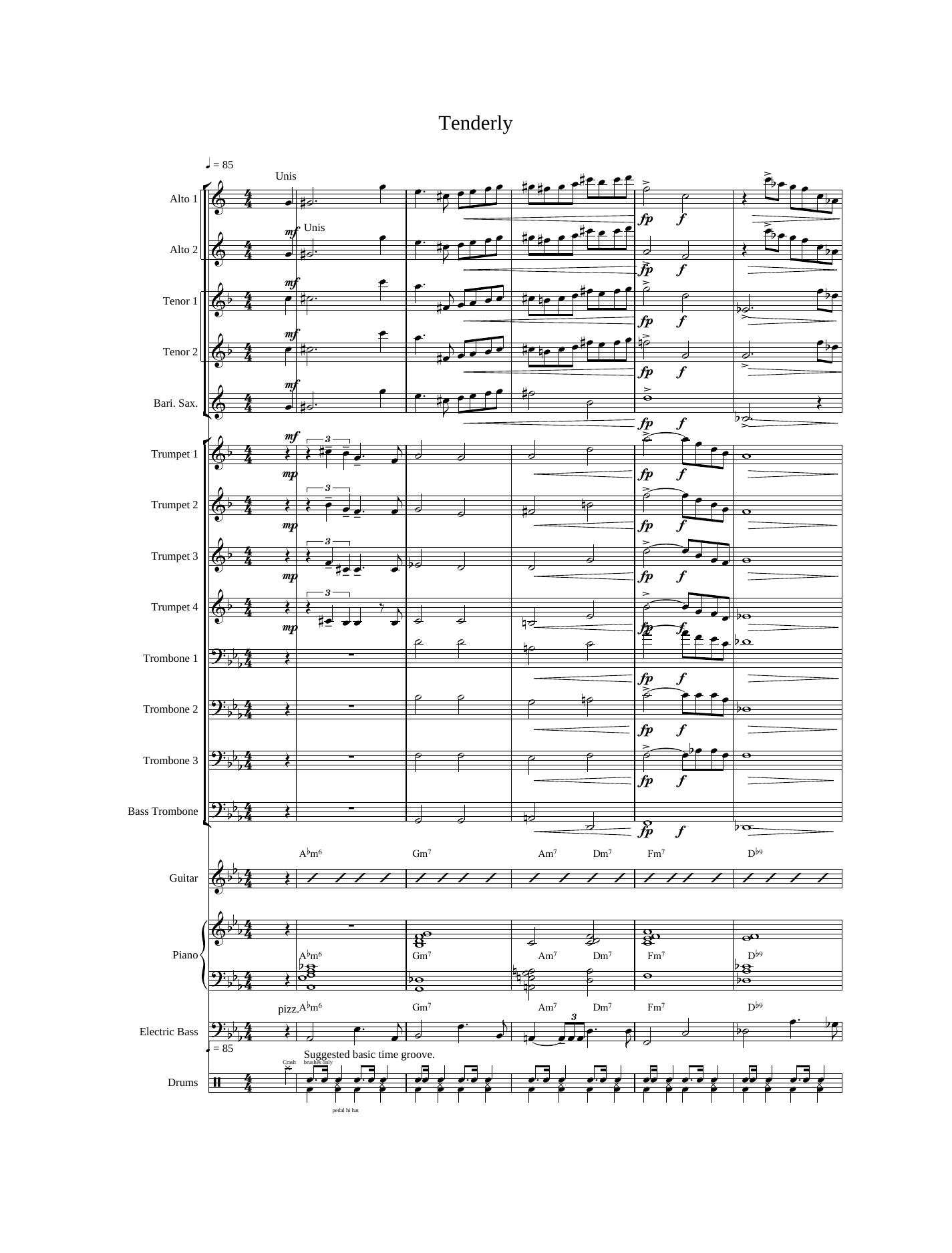
Tenderly sheet music preview

Tenderly

Composed by Walter Gross

Arranged by Unknown

  • Ensemble: Big Band
  • Style: Jazz Standard
  • Pages: 47
  • Instruments (17): Alto 1, Alto 2, Tenor 1, Tenor 2, Bari. Sax., Trumpet 1, Trumpet 2, Trumpet 3, Trumpet 4, Trombone 1, Trombone 2, Trombone 3, Bass Trombone, Guitar, Piano, Electric Bass, Drums
  • Difficulty: medium
  • Content: Individual Parts
  • Format: PDF Download (Instant)
  • Price: $24.99

Composed by Walter Gross in 1946 with lyrics subsequently added by Jack Lawrence, "Tenderly" stands as one of the most enduring and harmonically rich ballads in the Great American Songbook. Originally introduced by pianist and bandleader Art Mooney, the composition achieved legendary status through Sarah Vaughan’s 1947 definitive vocal recording and subsequent instrumental interpretations by giants like Chet Baker, Bill Evans, and Oscar Peterson. Its sweeping, loping melody and sophisticated chord progression made it an instant vehicle for jazz exploration, transitioning seamlessly from a popular ballad into an essential jazz standard that tests a musician's command of rubato phrasing, lush harmonic textures, and sustained emotional resonance. This comprehensive big band setting frames the timeless melody as a lush, evocative ballad characterized by a flowing, rubato-leaning 4/4 feel that settles into a gentle, supportive swing groove. Evoking the smoky, sophisticated ambiance of a late-night jazz club, the mood shifts fluidly from introspective vulnerability to soaring, brass-heavy expansiveness. The arrangement opens with an atmospheric chordal introduction before handing the primary melody to the lead alto saxophone, supported by warm, harmon muted brass voicings that create a dense, shimmering cushion of sound. Rich extended harmonies—featuring dominant-13th chords, altered dominants, and chromatic voice-leading—provide a modern harmonic palette while strictly honoring the romantic nostalgia of the original composition. Throughout the chart, the arranger utilizes classic big band developmental devices, including a lush sax soli that reinterprets the secondary bridge with interwoven counterpoint, and a restrained, dynamically controlled shout chorus that builds tension without sacrificing the intimate character of the piece. Featured solo space is thoughtfully integrated, allowing a lead tenor saxophone or trumpet to stretch out over flowing chord changes before the ensemble re-enters with a dramatic, harmonized modulation. Technical challenges lie primarily in breath control, intonation within tight section voicings, and maintaining a consistent, languid pulse across the ensemble during ultra-slow rubato phrases. The rhythm section is tasked with providing an understated, floating pulse, utilizing brushed snare work and walking basslines that hint at forward momentum without ever rushing the emotional pacing. Advanced high school ensembles with strong section leaders, as well as collegiate and professional big bands, will find this arrangement an ideal vehicle for developing ballad-playing maturity, dynamic sensitivity, and collective listening skills. Because it relies heavily on nuance, blend, and tonal warmth rather than sheer velocity, it serves as a masterclass in ensemble balance and expressive phrasing. Performing this chart rewards the band with a deeply satisfying emotional arc, offering audiences a refreshing, highly polished take on a beloved mid-century masterpiece. Conductors approaching this arrangement must prioritize breath support and long, horizontal phrasing to prevent the tempo from dragging during exposed ballad sections. The ideal tempo sits around a comfortable slow ballad pulse (approximately 68–72 BPM), requiring the rhythm section to maintain an active, breathing subdivision beneath the horns. Saxophone sections should focus intensely on blend and intonation during the rich chordal solis, ensuring that vibrato is matched in width and speed across all chairs. Brass players must exercise extreme dynamic control; muted passages in the trumpets and trombones should be voiced with warmth rather than a harsh edge. Rehearsals should begin by isolating the rhythm section to lock in the subtle rubato shifts and feel changes before layering in the horn sections. Pay close attention to the dynamic peaks leading into the shout chorus, ensuring the ensemble peaks at a rich mezzo-forte rather than forcing the sound and losing the piece's intrinsic intimacy. Q: What instrumentation and parts are included in this big band arrangement? A: This chart is scored for a standard 17-instrument big band lineup, consisting of 5 saxophones (2 altos, 2 tenors, 1 baritone), 4 trumpets, 4 trombones, and a 4-piece rhythm section (piano, guitar, bass, and drums), spanning a comprehensive 47-page manuscript. Q: What is the difficulty level of this arrangement? A: This arrangement is graded as advanced-intermediate to advanced, primarily due to the high demands placed on intonation, breath control, sustained dynamic balance, and subtle phrasing required for effective ballad performance. Q: What is the historical style and musical context of this chart? A: Rooted in the post-WWII big band era and the evolution of the jazz ballad standard, this arrangement captures the lush, sophisticated harmonic language popularized by mid-century jazz masters and vocal stylists like Sarah Vaughan. Q: What makes this specific arrangement of "Tenderly" unique? A: It distinguishes itself through its masterful balance of dense, modern extended harmonies, an intricate saxophone soli, and a thoughtfully paced dynamic arc that transforms a familiar standard into a fresh, deeply expressive concert centerpiece. Q: What is the performance duration and recommended tempo for this piece? A: The arrangement runs approximately 4 to 5 minutes depending on the length of improvised solo sections, and should be performed at a relaxed, flowing ballad tempo of around 68 to 72 beats per minute.

Questions and answers

What is included in the Tenderly PDF?
The verified current file contains a conductor score and individual parts across 47 pages.
How many instruments or parts are listed for Tenderly?
The verified instrumentation list contains 17 entries for this Big Band arrangement.
Who is credited for Tenderly?
Composer: Walter Gross. Arranger: Unknown.
What difficulty is listed for Tenderly?
The verified difficulty level is medium.
What style is listed for Tenderly?
The catalog lists the style as Jazz Standard.
Can I preview Tenderly before buying?
Yes. The product page provides a preview generated from the current PDF file.
How is Tenderly delivered?
After successful payment, the digital PDF is made available for download. The displayed price is $24.99.

Musicians Also Search For

Tenderly Unknown PDFTenderly Unknown sheet musicTenderly arranged by UnknownUnknown big band chartsUnknown jazz arrangements PDFTenderly Walter Gross sheet musicTenderly Walter Gross big band arrangementsWalter Gross big band chartsTenderly big band arrangementsTenderly big band PDF downloadTenderly jazz sheet musicbig band sheet music downloadTenderly conductor score PDFTenderly individual parts downloadTenderly sheet music PDFTenderly Jazz Standard chartsJazz Standard big band arrangementsbuy Tenderly sheet musicdownload Tenderly PDFTenderly jazz chartsbest Unknown big band arrangementsWalter Gross arranged by UnknownTenderly printable sheet musicbig band repertoire PDF

All arrangements by Unknown All Walter Gross sheet music