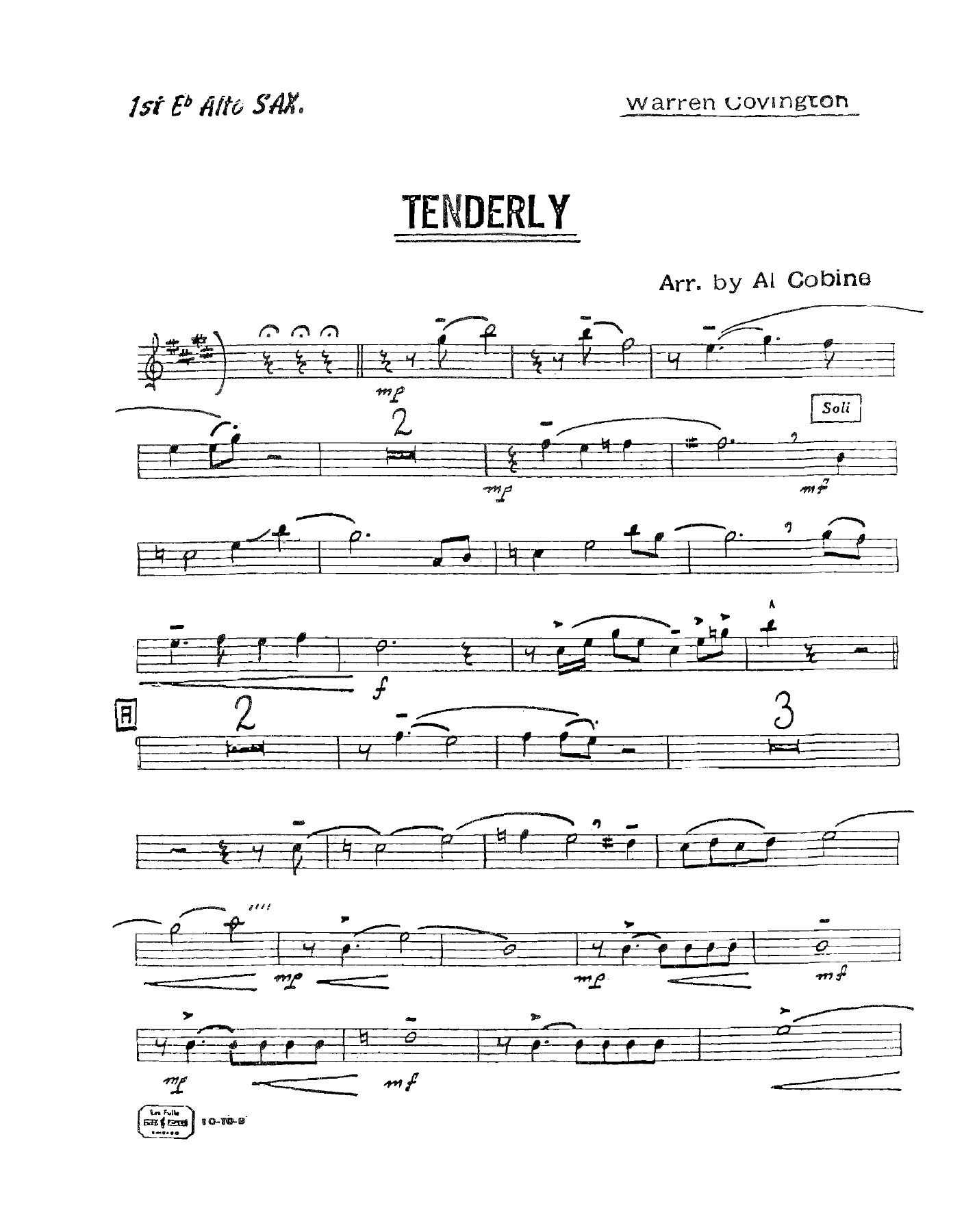
Tenderly (Al.Cobine)
Composed by Walter Gross
Arranged by Al.Cobine
- Ensemble: Big Band
- Style: Jazz Standard
- Pages: 34
- Instruments (17): Alto Saxophone 1, Alto Saxophone 2, Tenor Saxophone 1, Tenor Saxophone 2, Baritone Saxophone, Trumpet 1, Trumpet 2, Trumpet 3, Trumpet 4, Trombone 1, Trombone 2, Trombone 3, Bass Trombone, Guitar, Piano, Bass, Drums
- Difficulty: medium
- Content: Individual Parts
- Format: PDF Download (Instant)
- Price: $24.99
Walter Gross's timeless ballad "Tenderly," originally composed in 1946, stands as a cornerstone of the jazz standard repertoire. Its elegant melody and sophisticated harmonic progression quickly captivated audiences, becoming synonymous with the post-WWII era's romantic sensibilities. Initially a hit for Sarah Vaughan in 1947, "Tenderly" gained further renown through iconic interpretations by vocalists like Rosemary Clooney and instrumentalists such as Chet Baker and Oscar Peterson. The piece embodies the lush, melodic beauty characteristic of mid-20th century popular song, seamlessly transitioning into the jazz idiom where its flexible structure allows for rich improvisation and nuanced arrangement. Its enduring popularity stems from its evocative title, memorable theme, and the emotional depth it consistently conveys, making it a perennial favorite for both performers and listeners. Al.Cobine's big band arrangement of "Tenderly" masterfully reimagines this beloved standard as a medium-slow swing ballad, set in the key of F major. The arrangement immediately establishes a mood of sophisticated intimacy, characterized by warm, resonant voicings and a flowing rhythmic pulse. Cobine's signature approach often involves a meticulous balance between traditional big band textures and contemporary harmonic colors, and this chart is no exception. Expect rich, often dense, saxophone section writing that provides a plush harmonic bed, contrasted with lyrical brass lines that articulate the melody with grace. The overall energy is one of controlled passion and melodic introspection, building subtly through dynamic shifts rather than overt power. The arrangement opens with a beautifully voiced saxophone choir presenting the main theme, establishing the tender, reflective character. This is followed by the melody being passed to a featured solo instrument, likely a tenor saxophone or trumpet, allowing for expressive interpretation. Cobine's harmonic palette is particularly noteworthy, employing extended harmonies and subtle reharmonizations that add depth and interest without straying from the original's emotional core. A standout feature is a meticulously crafted saxophone soli section that showcases the section's blend and precision, followed by a dynamically layered shout chorus that builds to a tasteful climax before returning to a more subdued, reflective closing statement. The technical challenges lie primarily in achieving a cohesive ensemble sound, maintaining precise intonation within complex voicings, and executing the nuanced dynamic swells and decays inherent in ballad playing. This arrangement is ideally suited for college-level jazz ensembles, advanced community bands, and professional groups seeking a sophisticated and rewarding ballad chart. Its demands on blend, balance, and musical maturity make it an excellent vehicle for developing expressive ensemble playing. While individual soloists will find ample opportunity for improvisation over the standard changes, the true artistry of this arrangement lies in its ensemble sections, particularly the intricate saxophone soli and the carefully orchestrated shout chorus. Performing this arrangement offers the reward of presenting a classic standard with fresh, engaging textures, allowing the band to showcase its collective musicality and emotional depth. Conductors should emphasize a consistent, medium-slow swing feel throughout, ensuring the rhythm section maintains a relaxed yet propulsive groove. Pay close attention to the dynamic markings, as much of the arrangement's emotional impact relies on subtle shifts from *piano* to *mezzo forte*. Intonation within the saxophone section's close voicings is paramount; dedicate rehearsal time to slow, sustained passages to ensure clarity and blend. Brass players should focus on warm, controlled tones, particularly in lyrical passages, avoiding overly aggressive attacks. There are no specific mute requirements beyond standard cup and straight mutes for brass, to be used judiciously for textural variety. Rehearsal of the saxophone soli should focus on rhythmic precision and unified articulation to achieve the desired seamless flow. Encourage soloists to approach their improvisation with melodic sensitivity, complementing the arrangement's overall tender mood. Q: What instruments and parts are included in this arrangement? A: This big band arrangement includes parts for 17 instruments: Alto Saxophone 1, Alto Saxophone 2, Tenor Saxophone 1, Tenor Saxophone 2, Baritone Saxophone, Trumpet 1, Trumpet 2, Trumpet 3, Trumpet 4, Trombone 1, Trombone 2, Trombone 3, Trombone 4, Piano, Bass, Drums, and Guitar. Q: What is the difficulty level of "Tenderly (Al.Cobine)"? A: This arrangement is rated as medium-advanced, suitable for college-level jazz ensembles, advanced community bands, and professional groups. It requires strong ensemble blend, precise intonation, and mature musicality. Q: What is the musical style and historical context of this piece? A: "Tenderly" is a classic jazz standard composed by Walter Gross in 1946, representing the romantic ballad style of the mid-20th century. Al.Cobine's arrangement presents it as a sophisticated medium-slow swing ballad. Q: What makes Al.Cobine's arrangement of "Tenderly" unique? A: Cobine's treatment is distinguished by its rich, often dense, harmonic voicings, a beautifully crafted saxophone soli section, and a dynamically layered shout chorus that builds to a tasteful climax, all while maintaining the original's emotional core. Q: What is the typical performance duration and tempo for this arrangement? A: The performance duration typically ranges from 4 to 5 minutes, depending on the length of improvised solos. The tempo is a medium-slow swing, around 80-90 beats per minute.
Musicians Also Search For
Tenderly Al.Cobine PDF • Tenderly Al.Cobine sheet music • Tenderly arranged by Al.Cobine • Al.Cobine big band charts • Al.Cobine jazz arrangements PDF • Tenderly Walter Gross sheet music • Tenderly Walter Gross big band arrangement • Walter Gross big band charts • Tenderly big band arrangement • Tenderly big band PDF download • Tenderly jazz ensemble sheet music • big band sheet music instant download • Tenderly individual parts download • Tenderly sheet music with parts • Tenderly Jazz Standard chart • Jazz Standard big band arrangements • buy Tenderly sheet music online • download Tenderly PDF • Tenderly jazz chart • best Al.Cobine big band arrangements • Walter Gross songs arranged by Al.Cobine • Tenderly printable sheet music • big band repertoire PDF