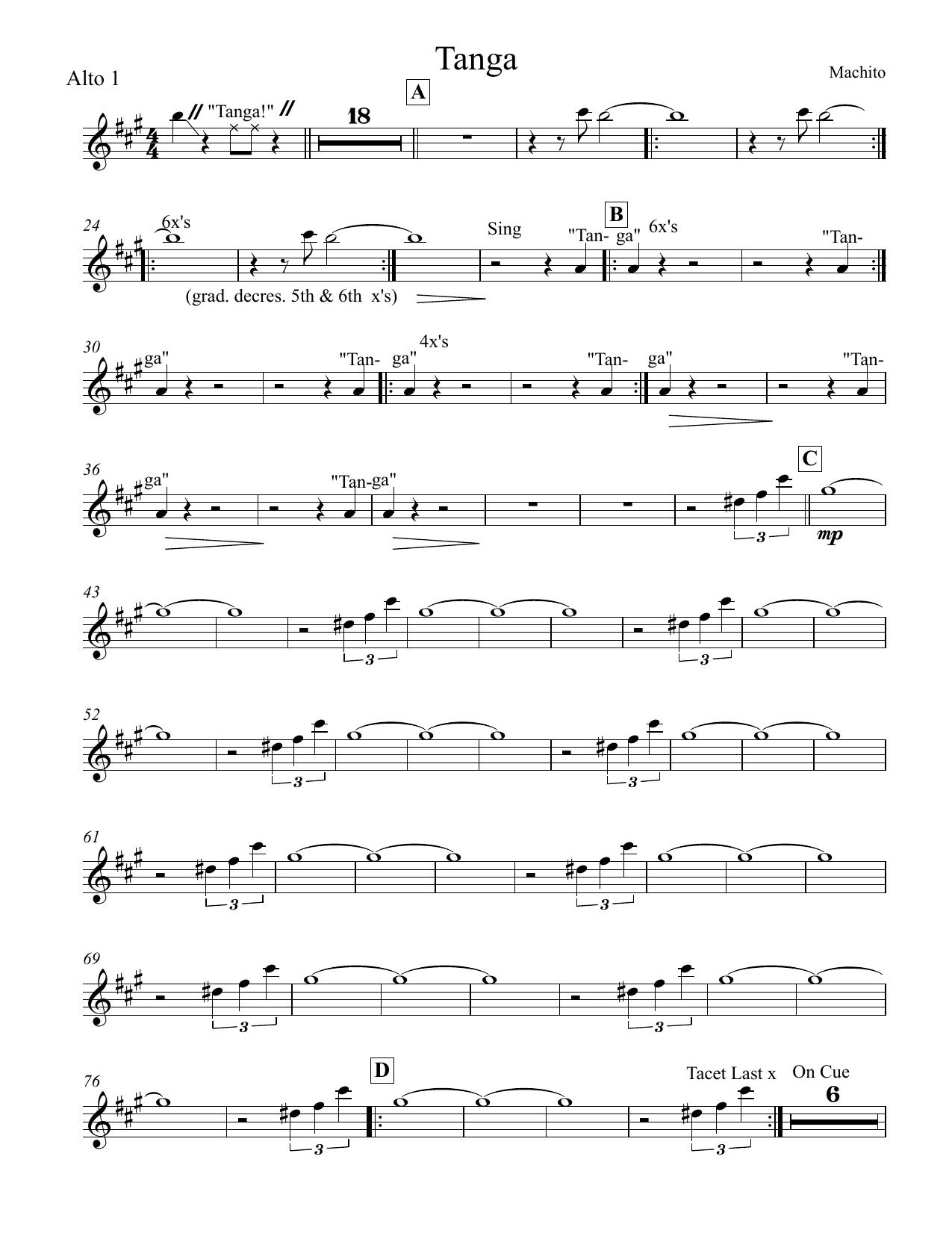
Tanga (Machito)
Composed by Machito
Arranged by Machito
- Ensemble: Big Band
- Style: Jazz Standard
- Pages: 41
- Instruments (16): Alto 1, Alto 2, Tenor 1, Tenor 2, Baritone Saxophone, Trumpet 1, Trumpet 2, Trumpet 3, Trumpet 4, Tenor Trombone 1, Tenor Trombone 2, Tenor Trombone 3, Bass Trombone, Piano, String Bass, Percussion
- Difficulty: medium
- Content: Individual Parts
- Format: PDF Download (Instant)
- Price: $24.99
Composed by the legendary bandleader and maraca player Frank "Machito" Grillo with musical direction from his brother-in-law Mario Bauzá, "Tanga" holds a monumental place in music history as the very first Latin jazz tune, recorded initially in 1943 by Machito and his Afro-Cuban Sax Orchestra. This seminal composition bridge-built the direct lineage between authentic Cuban folkloric rhythms—specifically the guaguancó and 6/8 Afro-Cuban bell patterns—and the harmonic sophistication of modern American bebop. Emerging straight out of New York City's vibrant mid-century jazz club scene, "Tanga" laid the structural cornerstone for the entire genre of Afro-Cuban jazz, famously inspiring collaborations between Dizzy Gillespie and Chano Pozo. It stands today as an enduring jazz standard and an essential testing ground for any modern big band exploring the intersection of complex jazz harmonies and driving, polyrhythmic percussion. Driven by an infectious, high-energy Afro-Cuban montuno groove in 4/4 time, "Tanga" pulses with relentless forward momentum, sharp rhythmic accents, and an electrifying, celebratory mood. The chart opens with a bold, rhythmic statement anchored by the rhythm section, immediately establishing theclave-based tension that propels the entire arrangement. Bright brass stabs cut through dense saxophone counterlines, creating a vibrant sonic landscape that evokes the sweaty, electric atmosphere of a packed Palladium Ballroom. The arrangement transitions seamlessly between driving modal vamp sections and roaring ensemble passages, maintaining a persistent, high-octane intensity that commands both audience attention and absolute rhythmic precision from every section of the band. As both composer and defining interpreter, Machito’s approach to this arrangement prizes rhythmic authenticity balanced against modern jazz voicings. The chart features interlocking horn soli sections where the saxophones and brass trade syncopated, bebop-infused lines that mimic horn-driven montunos, while the rhythm section lays down an unyielding, layered percussion foundation. Rather than treating Latin elements as exotic ornamentation, this arrangement integrates clave consciousness directly into standard big band section writing. Extended harmonies and sharp chromatic shifts surface during transitional interludes, showcasing Bauzá’s signature knack for marrying Dizzy Gillespie-esque harmonic extensions with traditional Cuban dance forms. The primary melodic weight is shared dynamically between the saxophone section and the lead trumpet, punctuated by aggressive, staccato ensemble hits. Improvisational opportunities are a core feature, offering expansive solo space for tenor saxophone and trumpet over cyclical, modal harmonic vamps that allow soloists to stretch out melodically. Technical challenges center heavily on rhythmic accuracy; the horns must negotiate intricate off-beat phrasing that sits squarely across the bar line, requiring players to internalize the underlying clave rather than relying solely on standard swing subdivisions. The most rewarding moments materialize during the explosive ensemble shout choruses, where the full 16-piece band locks into a unified, thunderous roar that bridges traditional big band power with undeniable Latin heat. Advanced college ensembles, professional repertory big bands, and elite community jazz orchestras will find this chart exceptionally well-suited to their capabilities. Because the arrangement demands absolute rhythmic synchronization between the rhythm section and the horn players—particularly regarding syncopated, cross-rhythm figures—it serves as a masterclass in ensemble cohesion. It requires a rhythm section deeply comfortable with Afro-Cuban styles and horn sections capable of executing rapid-fire bebop articulations with crisp, clean separation. Navigating "Tanga" successfully requires meticulous attention to the macro-rhythm of the Afro-Cuban clave. The primary technical hurdle for most standard big bands lies in shifting away from a traditional triplet swing mindset and locking into a straight, driving eighth-note Latin feel. Conductor focus should be placed heavily on the rhythm section; the conga, timbale, and bass players must establish an unyielding groove before any horns enter. Horn players should practice their syncopated figures slowly with a metronome clicking on beats two and four, or explicitly practicing against a backing clave track to eradicate any tendency to rush the off-beats. Articulation is paramount—keep background figures short, dry, and punchy, allowing the moving lines to shimmer without muddying the texture. During the open solo sections, rhythm section players should dynamically contour their accompaniment, building tension gradually beneath the soloists to set up the powerful ensemble re-entries. Q: What instruments and parts are included in this arrangement? A: This arrangement is scored for a standard 16-instrument big band, consisting of 2 alto saxophones, 2 tenor saxophones, 1 baritone saxophone, 4 trumpets, 4 trombones, piano, bass, drums, and auxiliary percussion, plus a comprehensive conductor score across 41 total pages. Q: What is the difficulty level of this chart? A: This arrangement is graded as advanced, primarily due to the intricate syncopation, stamina requirements, and the specific rhythmic discipline needed to execute authentic Afro-Cuban jazz phrasing. Q: What is the historical context and style of "Tanga"? A: Composed by Machito in 1943, "Tanga" is widely recognized as the first true Latin jazz composition, merging traditional Afro-Cuban rhythms with the advanced harmonies of the bebop era. Q: What makes this specific arrangement unique? A: It reflects the authentic performance practices of Machito's Afro-Cuban Sax Orchestra, prioritizing interlocking horn montunos and integrated modal vamps over generic Latin-styled big band clichés. Q: What is the performance duration and tempo feel? A: The arrangement runs approximately 5 to 7 minutes depending on solo extensions, anchored by a brisk, driving tempo feel with straight eighth-note Latin grooves rather than traditional swing subdivisions.
Questions and answers
- What is included in the Tanga (Machito) PDF?
- The verified current file contains a conductor score and individual parts across 41 pages.
- How many instruments or parts are listed for Tanga (Machito)?
- The verified instrumentation list contains 16 entries for this Big Band arrangement.
- Who is credited for Tanga (Machito)?
- Composer: Machito. Arranger: Machito.
- What difficulty is listed for Tanga (Machito)?
- The verified difficulty level is medium.
- What style is listed for Tanga (Machito)?
- The catalog lists the style as Jazz Standard.
- Can I preview Tanga (Machito) before buying?
- Yes. The product page provides a preview generated from the current PDF file.
- How is Tanga (Machito) delivered?
- After successful payment, the digital PDF is made available for download. The displayed price is $24.99.
Musicians Also Search For
Tanga Machito PDF • Tanga Machito sheet music • Tanga arranged by Machito • Machito big band charts • Machito jazz arrangements PDF • Tanga Machito big band arrangements • Tanga big band arrangements • Tanga big band PDF download • Tanga jazz sheet music • big band sheet music download • Tanga conductor score PDF • Tanga individual parts download • Tanga sheet music PDF • Tanga Jazz Standard charts • Jazz Standard big band arrangements • buy Tanga sheet music • download Tanga PDF • Tanga jazz charts • best Machito big band arrangements • Tanga printable sheet music • big band repertoire PDF