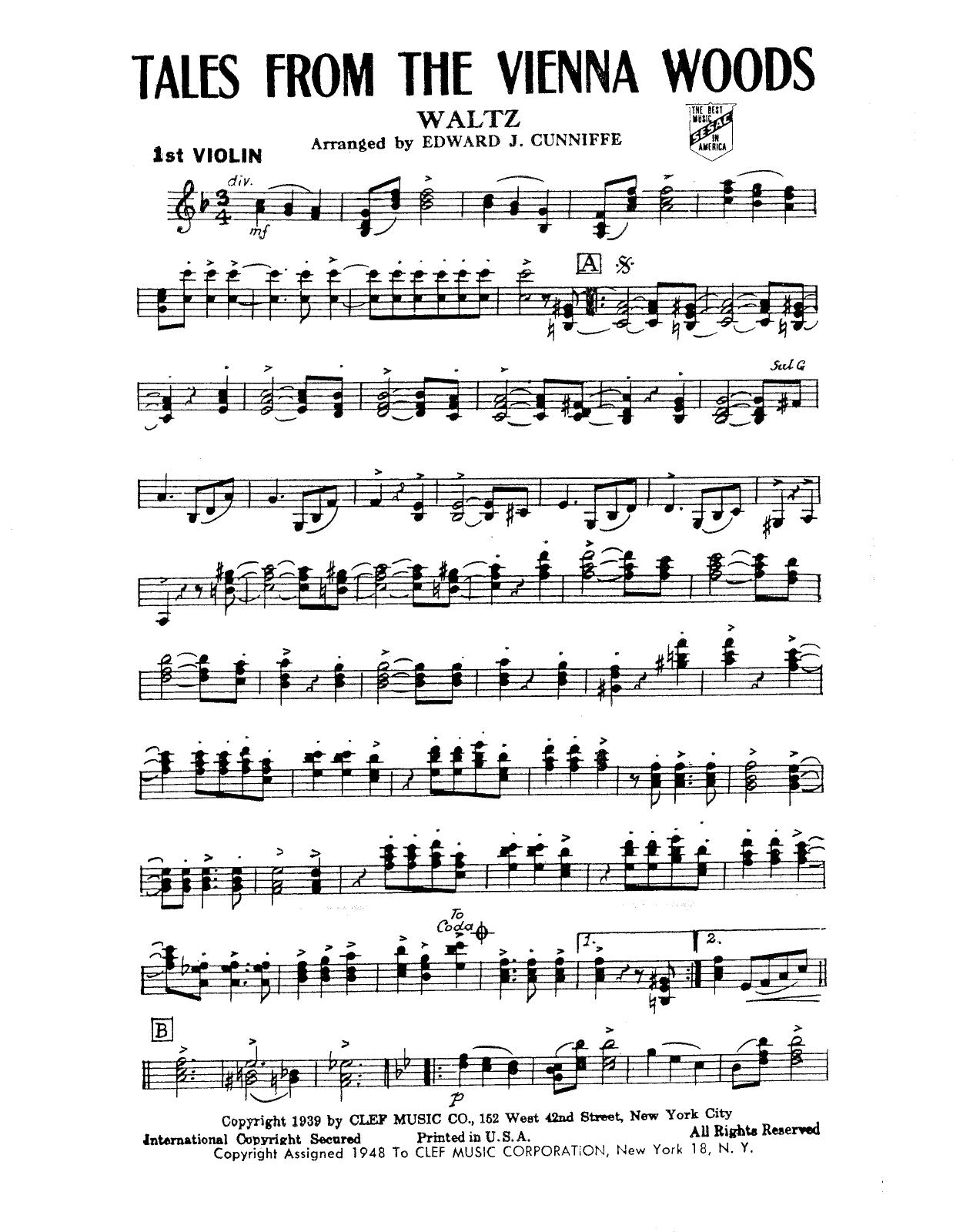
Tales From The Vienna Woods (E.Gunniff)
Composed by Johann Strauss II
Arranged by E.Gunniff
- Ensemble: Big Band
- Style: Jazz Standard
- Pages: 31
- Instruments (15): 1st Violin, 1st Eb Alto Saxophone, 3rd Eb Alto Saxophone, 2nd Bb Tenor Saxophone, 4th Bb Tenor Saxophone, 5th Eb Baritone Saxophone, 1st Bb Trumpet, 2nd Bb Trumpet, 3rd Bb Trumpet, 1st Trombone, 2nd Trombone, Guitar, Piano, Bass, Drums
- Difficulty: medium
- Content: Individual Parts
- Format: PDF Download (Instant)
- Price: $24.99
Johann Strauss II’s legendary 1868 concert waltz *Tales from the Vienna Woods* undergoes a brilliant metamorphosis in this sophisticated big band adaptation. Originally conceived as a quintessential expression of Viennese high-society romanticism—complete with zither solos and evocative portrayals of rustic Austrian landscapes—the thematic material proves remarkably malleable in the hands of jazz arrangers. By translating traditional 3/4 waltz time into an infectious, swinging 4/4 jazz vehicle, this chart bridges the gap between nineteenth-century classical mastery and twentieth-century American big band tradition, echoing the innovative crossover concepts explored by legendary bandleaders who sought to elevate classical masterworks through syncopated rhythms and extended harmonies. Opening with a moody, atmospheric introduction before locking into a supple, driving medium-swing groove, the arrangement balances nostalgic charm with sharp, modern harmonic color. E.Gunniff’s creative scoring infuses Strauss’s iconic, lilting melodies with sophisticated altered dominants, rich saxophone voicings, and punchy brass counterlines. The mood shifts fluidly from playful, walking-bass driven refrains to soaring, high-energy brass passages that evoke the grandeur of a grand ballroom filtered through the lens of a mid-century jazz club. The underlying tension between the courtly European melodies and the gritty, driving pulse of the jazz rhythm section creates a captivating aesthetic dynamic that immediately engages both connoisseurs and casual listeners. E.Gunniff approaches the source material with profound respect for the original themes while injecting fresh life through clever metric modulation, textured reed solis, and dynamic ensemble interplay. The 15-instrument orchestration cleverly distributes melodic responsibility across the entire ensemble, ensuring that the 1st Violin, woodwinds, and brass sections share the spotlight. Lush, chordal movement drives the middle developmental sections, leading organically into a robust, high-octane shout chorus that showcases the full power of the brass section. Subtle dynamic shading and clever use of dynamic contrast prevent the heavy thematic material from feeling over-orchestrated, maintaining a crisp, transparent big band texture throughout. Advanced high school, collegiate, and professional jazz orchestras will find this 31-page arrangement an exhilarating challenge and a brilliant programming choice. The technical demands require clean articulation across all sections, precise intonation on dense chordal structures, and a rhythm section capable of maintaining an effortless, buoyant swing feel beneath complex harmonic changes. Featured solo opportunities allow standout performers to stretch out over traditional changes derived from Strauss’s timeless motifs, making it a guaranteed crowd-pleaser for festival performances, formal concerts, or recorded repertoires. Navigating this chart successfully requires a firm grasp of stylistic duality; players must honor the lyrical, sweeping phrasing native to Strauss while executing the sharp, articulation-conscious demands of contemporary big band swing. The conductor should establish a comfortable medium-swing tempo that allows the eighth-note lines to breathe without rushing the dense harmonic shifts. Pay close attention to the dynamic markings in the introductory rubato section before locking rigidly into the macro-pulse of the swing groove. The reed section must balance their dense chordal solis carefully against the lead alto and 1st violin lines to ensure clarity of melody. Brass players should approach high register entrances with controlled resonance rather than brute force, maintaining warmth in the muted passages and brilliance in the open shout choruses. Rhythm section players need to lock tightly together—the pianist should use sparse, harmonically rich comping to avoid cluttering the texture, while the bassist drives the quarter-note pulse with forward momentum. Regular sectionals focusing on intonation during the modulatory transitional passages will pay massive dividends in performance cohesion. Q: What specific instrumentation and parts are included in this arrangement? A: The chart is scored for a 15-instrument big band ensemble, featuring a 1st Violin part alongside a standard jazz reed section (including 1st Alto, 3rd Alto, 2nd Tenor, and 4th Tenor saxophones), complemented by full brass and rhythm section instrumentation across its 31 pages. Q: What is the overall difficulty level of this arrangement? A: This arrangement is best suited for advanced high school, collegiate, and professional big bands due to its sophisticated harmonic structures, dense scoring, and requirement for precise ensemble articulation. Q: What is the musical style and historical context of this piece? A: It is a creative big band jazz standard adaptation of Johann Strauss II's famous 1868 classical waltz, seamlessly blending traditional European romanticism with a swinging 4/4 American jazz sensibility. Q: What makes E.Gunniff's treatment of this composition unique? A: The arrangement stands out through its brilliant transformation of waltz themes into a swinging groove, utilizing lush reed solis, clever metric shifts, and a powerful shout chorus that bridges classical elegance with modern jazz harmony. Q: What is the performance duration and tempo feel of the arrangement? A: The piece is built around a driving, infectious medium-swing feel in 4/4 time, with a typical performance duration of approximately 4 to 5 minutes depending on the length of improvised solos.
Questions and answers
- What is included in the Tales From The Vienna Woods (E.Gunniff) PDF?
- The verified current file contains individual parts across 31 pages.
- How many instruments or parts are listed for Tales From The Vienna Woods (E.Gunniff)?
- The verified instrumentation list contains 15 entries for this Big Band arrangement.
- Who is credited for Tales From The Vienna Woods (E.Gunniff)?
- Composer: Johann Strauss II. Arranger: E.Gunniff.
- What difficulty is listed for Tales From The Vienna Woods (E.Gunniff)?
- The verified difficulty level is medium.
- What style is listed for Tales From The Vienna Woods (E.Gunniff)?
- The catalog lists the style as Jazz Standard.
- Can I preview Tales From The Vienna Woods (E.Gunniff) before buying?
- Yes. The product page provides a preview generated from the current PDF file.
- How is Tales From The Vienna Woods (E.Gunniff) delivered?
- After successful payment, the digital PDF is made available for download. The displayed price is $24.99.
Musicians Also Search For
Tales From The Vienna Woods E.Gunniff PDF • Tales From The Vienna Woods E.Gunniff sheet music • Tales From The Vienna Woods arranged by E.Gunniff • E.Gunniff big band charts • E.Gunniff jazz arrangements PDF • Tales From The Vienna Woods Johann Strauss II sheet music • Tales From The Vienna Woods Johann Strauss II big band arrangements • Johann Strauss II big band charts • Tales From The Vienna Woods big band arrangements • Tales From The Vienna Woods big band PDF download • Tales From The Vienna Woods jazz sheet music • big band sheet music download • Tales From The Vienna Woods individual parts download • Tales From The Vienna Woods sheet music PDF • Tales From The Vienna Woods Jazz Standard charts • Jazz Standard big band arrangements • buy Tales From The Vienna Woods sheet music • download Tales From The Vienna Woods PDF • Tales From The Vienna Woods jazz charts • best E.Gunniff big band arrangements • Johann Strauss II arranged by E.Gunniff • Tales From The Vienna Woods printable sheet music • big band repertoire PDF