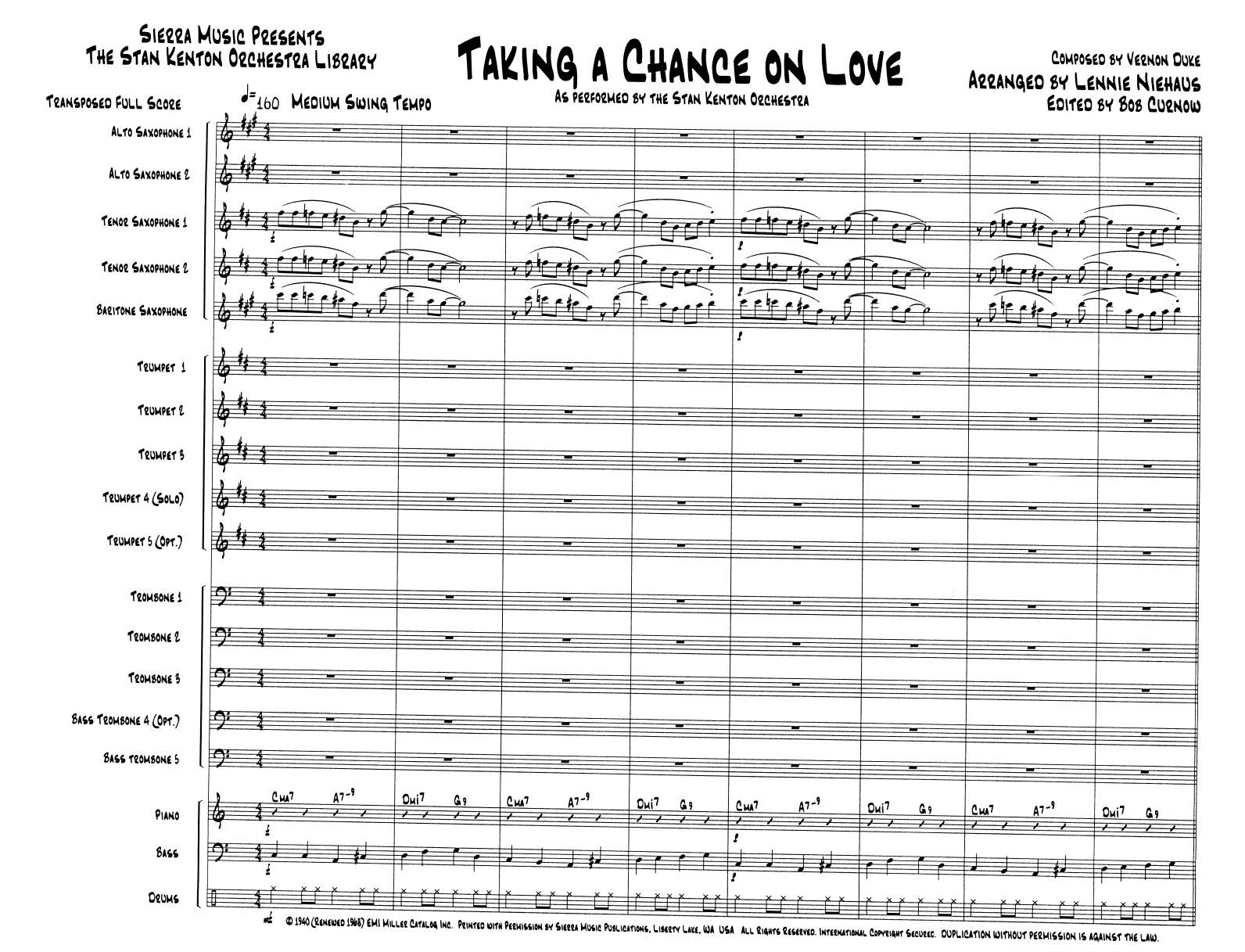
Taking A Chance On Love (L.Niehaus) sheet music preview

Taking A Chance On Love (L.Niehaus)

Composed by Vernon Duke

Arranged by Lennie Niehaus

  • Ensemble: Big Band
  • Pages: 46
  • Instruments (18): Alto Saxophone 1, Alto Saxophone 2, Tenor Saxophone 1, Tenor Saxophone 2, Baritone Saxophone, Trumpet 1, Trumpet 2, Trumpet 3, Trumpet 4, Trumpet 5, Trombone 1, Trombone 2, Trombone 3, Bass Trombone 4, Bass Trombone 5, Piano, Bass, Drums
  • Difficulty: medium
  • Content: Individual Parts
  • Format: PDF Download (Instant)
  • Price: $24.99

Vernon Duke’s timeless 1940 composition "Taking A Chance On Love," with lyrics by John Latouche and Ted Fetter, first achieved widespread acclaim through its inclusion in the Broadway musical *Cabin in the Sky* and Ethel Waters’ iconic recordings. Cemented further as an essential jazz standard by artists like Benny Goodman and Frank Sinatra, the tune embodies the optimistic, effervescent spirit of the golden era of American popular song. Its enduring appeal lies in its infectious melody and harmonically rich progression, making it a natural canvas for jazz interpretation across generations. Lennie Niehaus’s masterwork big band arrangement infuses this classic standard with a sophisticated West Coast cool aesthetic, characterized by crystal-clear counterpoint, breezy medium-swing tempos, and meticulously crafted saxophone solis. Niehaus, celebrated for his extensive work with the Stan Kenton Orchestra and his prolific film scoring career, applies his signature ear for linear jazz writing to the 18-piece ensemble. The mood is bright, sophisticated, and driving, propelled by an irresistible mid-tempo swing feel that encourages relaxed phrasing and crisp articulation from the entire band. The arrangement opens with a crisp, inviting intro that immediately establishes the buoyant groove before handing the primary melody to the reed section, bolstered by subtle, harmonically rich brass background figures. Niehaus constructs a brilliant sax soli that highlights the interplay between the two alto and two tenor voices, framed by a biting baritone saxophone anchor. The chart features designated solo space for key frontline players, allowing individual expression over standard changes while maintaining a tight ensemble framework. The climax builds toward a textbook Niehaus shout chorus—cleverly voiced, rhythmically engaging, and demanding disciplined dynamic control rather than brute volume, culminating in a sparkling, high-energy finish. Advanced high school, collegiate, and professional jazz ensembles will find this chart an ideal vehicle for developing stylistic polish, section blending, and swing precision. Because Niehaus avoids cluttered writing in favor of transparent, West Coast-style voicings, any intonation or balance issues within the sections will be immediately exposed, making it an exceptional educational tool as well as a high-impact concert piece. Musicians and audiences alike will appreciate the sophisticated harmonic turns and infectious optimism embedded in every measure of this stellar arrangement. Achieving the authentic West Coast jazz feel of this arrangement requires rigorous attention to light, articulated swing eighth notes, avoiding heavy or sluggish phrasing. The tempo should remain a steady, comfortable medium swing; pushing the metronome too far forward will cause the intricate linear writing in the saxophones to lose its characteristic laid-back elegance. Conductors must ensure the rhythm section locks into a transparent, driving pocket—the drummer should utilize a crisp ride-cymbal pattern with light hi-hat chokes on beats two and four, while the bass walks with a clean, unforced acoustic weight. Key technical challenges center around the dynamic balance during the contrapuntal horn lines and the breath control required for the extended saxophone soli. Brass players should approach mutes (if opted for in stylistic variations) and dynamic contrasts with precision, ensuring that background figures never step on the featured soloists or the lead melody. Rehearsal time should be initially dedicated to sectional work, isolating the inner voices of the chord structures before bringing the full ensemble together to balance the shout chorus. Q: What instruments and parts are included in this arrangement? A: This chart is scored for a standard 18-piece big band instrumentation, featuring Alto Saxophone 1, Alto Saxophone 2, Tenor Saxophone 1, Tenor Saxophone 2, Baritone Saxophone, a full brass section, and a complete rhythm section, along with a comprehensive conductor score spanning 46 pages. Q: What is the difficulty level of this Lennie Niehaus arrangement? A: This arrangement is ideally suited for advanced high school, collegiate, and professional jazz ensembles that possess strong reading skills, good section intonation, and a solid grasp of medium-swing phrasing. Q: What is the stylistic background of this piece? A: Based on Vernon Duke's 1940 standard, this arrangement reimagines the tune through the sophisticated, linear West Coast jazz lens characteristic of arranger Lennie Niehaus's celebrated writing style. Q: What makes this specific arrangement unique? A: It stands out due to Niehaus's transparent, horn-driven voicings, a tightly crafted saxophone soli, and an inventive shout chorus that prioritizes harmonic cleverness and crisp articulation over sheer volume. Q: What is the performance duration and tempo feel of the piece? A: The arrangement is set in a buoyant, medium-swing tempo feel in 4/4 time, making it a versatile and engaging centerpiece for any standard jazz ensemble concert program lasting approximately three to four minutes.

Questions and answers

What is included in the Taking A Chance On Love (L.Niehaus) PDF?
The verified current file contains a conductor score and individual parts across 46 pages.
How many instruments or parts are listed for Taking A Chance On Love (L.Niehaus)?
The verified instrumentation list contains 18 entries for this Big Band arrangement.
Who is credited for Taking A Chance On Love (L.Niehaus)?
Composer: Vernon Duke. Arranger: Lennie Niehaus.
What difficulty is listed for Taking A Chance On Love (L.Niehaus)?
The verified difficulty level is medium.
Can I preview Taking A Chance On Love (L.Niehaus) before buying?
Yes. The product page provides a preview generated from the current PDF file.
How is Taking A Chance On Love (L.Niehaus) delivered?
After successful payment, the digital PDF is made available for download. The displayed price is $24.99.

Musicians Also Search For

Taking A Chance On Love Lennie Niehaus PDFTaking A Chance On Love Lennie Niehaus sheet musicTaking A Chance On Love arranged by Lennie NiehausLennie Niehaus big band chartsLennie Niehaus jazz arrangements PDFTaking A Chance On Love Vernon Duke sheet musicTaking A Chance On Love Vernon Duke big band arrangementsVernon Duke big band chartsTaking A Chance On Love big band arrangementsTaking A Chance On Love big band PDF downloadTaking A Chance On Love jazz sheet musicbig band sheet music downloadTaking A Chance On Love conductor score PDFTaking A Chance On Love individual parts downloadTaking A Chance On Love sheet music PDFbuy Taking A Chance On Love sheet musicdownload Taking A Chance On Love PDFTaking A Chance On Love jazz chartsbest Lennie Niehaus big band arrangementsVernon Duke arranged by Lennie NiehausTaking A Chance On Love printable sheet musicbig band repertoire PDF

All arrangements by Lennie Niehaus All Vernon Duke sheet music