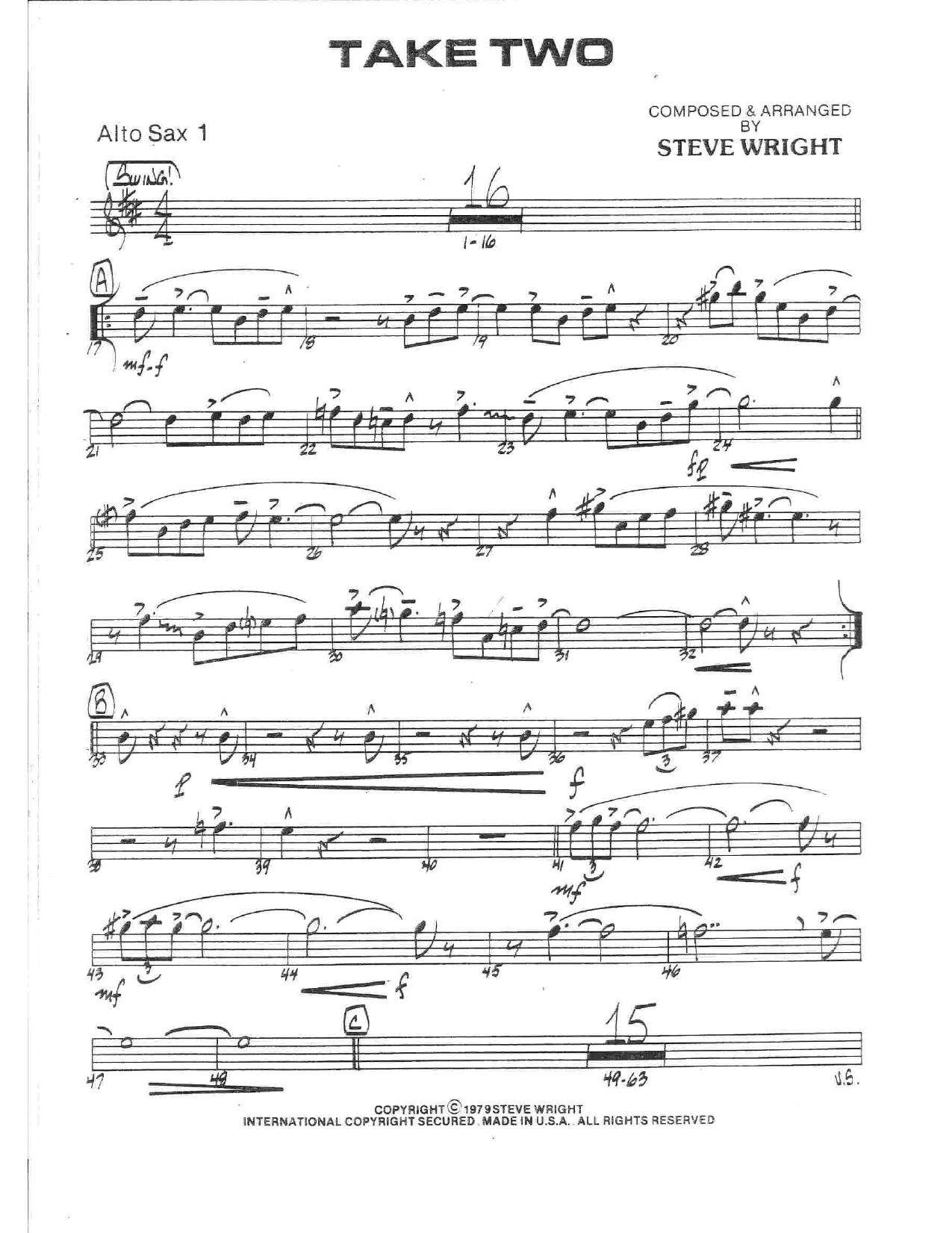
Take Two (S.Wright) sheet music preview

Take Two (S.Wright)

Composed by S.Wright

Arranged by S.Wright

  • Ensemble: Big Band
  • Style: Jazz Standard
  • Pages: 46
  • Instruments (16): Alto Sax 1, Alto Sax 2, Tenor Sax 1, Tenor Sax 2, Baritone Sax, Trumpet 1, Trumpet 2, Trumpet 3, Trumpet 4, Trombone 1, Trombone 2, Trombone 3, Trombone 4, Piano & Guitar, Bass, Drums
  • Difficulty: medium
  • Content: Individual Parts
  • Format: PDF Download (Instant)
  • Price: $24.99

Bebop innovation and hard-bop drive converge in "Take Two," an original composition by S.Wright that captures the sophisticated harmonic palette and relentless energy of the mid-20th-century modern jazz movement. Emerging from an era where big bands were challenged to adapt small-group improvisational complexity into large-ensemble orchestration, this piece stands out as a masterclass in contemporary big band writing. While paying homage to the classic, high-octane writing styles of legends like Thad Jones and Bill Holman, S.Wright infuses the composition with a distinct contemporary edge, blending angular melodic lines with rich, extended chord structures that push the traditional big band boundaries. Driven by an infectious, buoyant medium-up swing groove in 4/4 time, "Take Two" opens with a brisk, attention-commanding brass figure before launching into a sophisticated head statement shared by the alto and tenor saxophones. The mood is upbeat, intellectually stimulating, and relentlessly driving, evoking the smoky atmosphere of 1960s New York jazz clubs while maintaining a crisp, polished modern aesthetic. The harmony shifts fluidly between modal vamp sections and dense, chromatic chord progressions that create an underlying sense of restless momentum. As the chart progresses, the tension builds steadily through a series of interlocking horn solis, culminating in a powerhouse shout chorus that demands absolute precision, dynamic control, and flawless articulation from the entire ensemble. S.Wright’s arrangement treats the standard big band architecture with inventive flair, giving every section a chance to shine rather than relying solely on traditional lead trumpet dominance. The saxophones navigate intricate, bebop-infused lines that require agile fingerwork and a unified sectional concept, while the trombones provide crucial counter-melodies and warm, trombone-choir voicings that anchor the middle register. The rhythm section acts as the primary engine, requiring a drummer with a strong command of modern swing phrasing, crisp ride-cymbal definition, and tasteful interactive comping. Solo opportunities are provided for tenor saxophone and trumpet, allowing featured improvisers plenty of room to stretch out over accessible yet stimulating chord changes. Advanced high school ensembles with strong section leaders, as well as collegiate and professional big bands, will find "Take Two" an exceptionally rewarding addition to their repertoire. The chart rewards meticulous rehearsal, particularly in balancing the inner-voice harmonies during the softer transitional passages and maintaining a relaxed, driving pulse during the up-tempo shout chorus. Conductor and band alike will appreciate how the chart balances rigorous technical demands with an undeniable crowd-pleasing energy, making it an ideal choice for festival competition sets, formal concerts, or recorded performances. Navigating "Take Two" successfully requires a disciplined approach to swing articulation and rhythmic precision, particularly at the specified medium-up tempo of quarter note equals 212 BPM. The primary technical challenge lies in executing the fast, bebop-inspired unison lines cleanly across the saxophone and trumpet sections; players must prioritize light, forward-moving tongue placement and uniform breath support to avoid heavy accents on weak beats. The rhythm section plays a pivotal role in maintaining the groove without rushing. The drummer should lock in a persistent, driving ride-cymbal pattern while keeping hi-hat chicks crisp on beats two and four, avoiding over-filling during ensemble transitional phrases. Bassists are encouraged to walk a strong, quarter-note acoustic line that clearly outlines the root movements and harmonic alterations without muddying the texture. Brass players should utilize appropriate mutes or careful dynamic shading during the background figures to ensure the featured soloists remain prominent. Rehearsals should initially be broken down at a slower tempo to lock in intonation on the extended upper-structure chords, gradually working up to performance speed while preserving clean, articulate style throughout every section. Q: What instruments and parts are included in this big band arrangement? A: The complete 17-instrument instrumentation consists of 5 saxophones (Alto 1, Alto 2, Tenor 1, Tenor 2, Baritone), standard brass featuring 4 trumpets and 4 trombones, and a full rhythm section comprising piano, guitar, acoustic bass, and drums, spread across a comprehensive 46-page score and parts set. Q: What is the difficulty level of "Take Two"? A: This arrangement is graded as advanced, making it best suited for college music programs, advanced high school jazz ensembles, and professional community big bands with skilled improvisers and strong section players. Q: What is the style and historical context of this piece? A: Written in a modern jazz and hard-bop style, "Take Two" reflects the sophisticated writing traditions of mid-century and contemporary big bands, blending traditional swing sensibilities with intricate, bebop-derived harmonies. Q: What makes this S.Wright arrangement unique? A: It features distinctive, interlocking horn solis, rich extended chord voicings that avoid predictable resolutions, and an egalitarian distribution of melodic material across all sections rather than focusing solely on the lead trumpet. Q: What is the performance duration and recommended tempo for this chart? A: The piece runs approximately 4.5 to 5 minutes in length when performed at the recommended medium-up swing tempo of quarter note equals 212 BPM.

Questions and answers

What is included in the Take Two (S.Wright) PDF?
The verified current file contains individual parts across 46 pages.
How many instruments or parts are listed for Take Two (S.Wright)?
The verified instrumentation list contains 16 entries for this Big Band arrangement.
Who is credited for Take Two (S.Wright)?
Composer: S.Wright. Arranger: S.Wright.
What difficulty is listed for Take Two (S.Wright)?
The verified difficulty level is medium.
What style is listed for Take Two (S.Wright)?
The catalog lists the style as Jazz Standard.
Can I preview Take Two (S.Wright) before buying?
Yes. The product page provides a preview generated from the current PDF file.
How is Take Two (S.Wright) delivered?
After successful payment, the digital PDF is made available for download. The displayed price is $24.99.

Musicians Also Search For

Take Two S.Wright PDFTake Two S.Wright sheet musicTake Two arranged by S.WrightS.Wright big band chartsS.Wright jazz arrangements PDFTake Two S.Wright big band arrangementsTake Two big band arrangementsTake Two big band PDF downloadTake Two jazz sheet musicbig band sheet music downloadTake Two individual parts downloadTake Two sheet music PDFTake Two Jazz Standard chartsJazz Standard big band arrangementsbuy Take Two sheet musicdownload Take Two PDFTake Two jazz chartsbest S.Wright big band arrangementsTake Two printable sheet musicbig band repertoire PDF

All arrangements by S.Wright All S.Wright sheet music