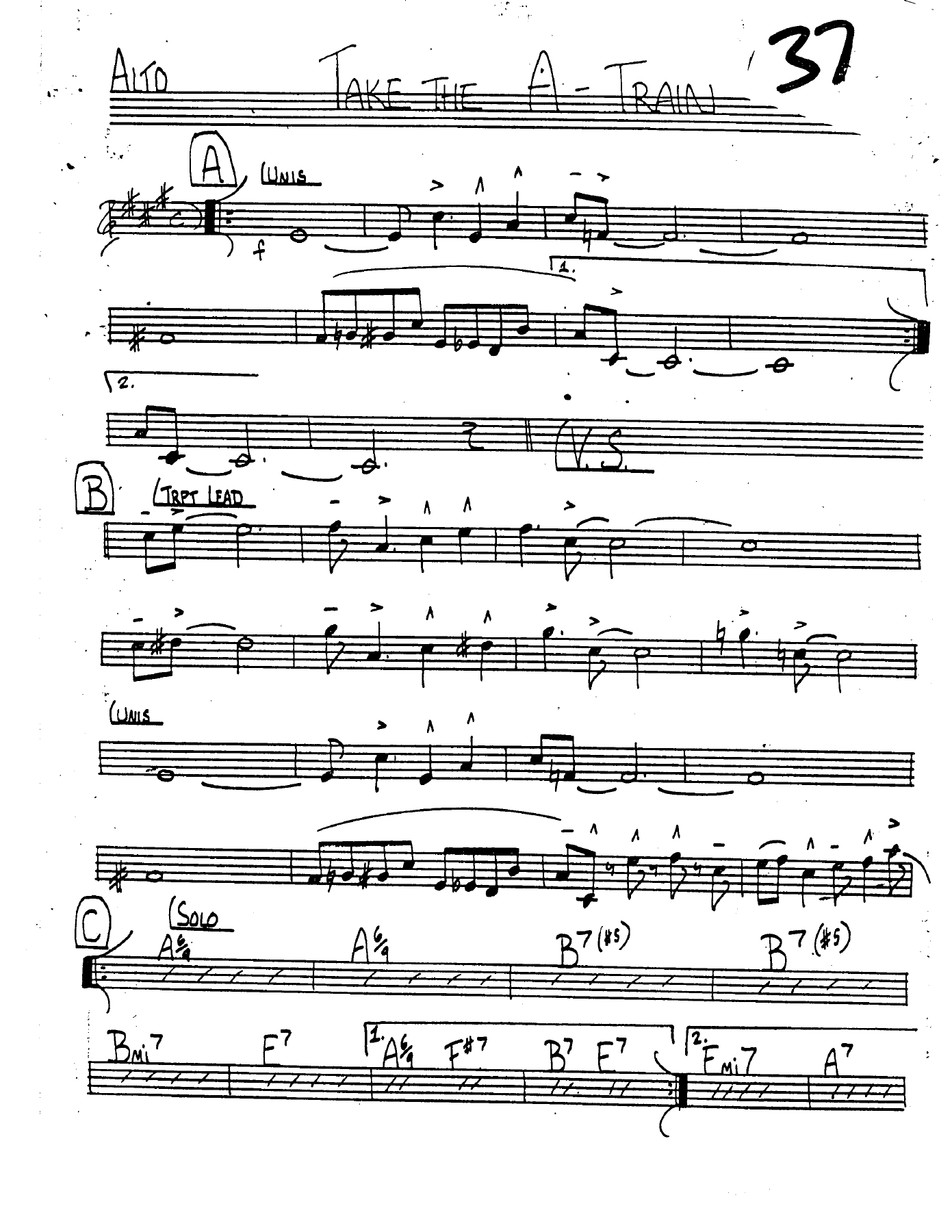
Take The A Train (T.Kubis)
Composed by Billy Strayhorn
Arranged by Tom Kubis
- Ensemble: Small Ensemble
- Style: Jazz Standard
- Pages: 24
- Instruments (10): Alto Saxophone, Tenor Saxophone, Baritone Saxophone, Trumpet I, Trumpet II, Trombone, Guitar, Piano, Bass, Drums
- Difficulty: easy
- Content: Individual Parts
- Format: PDF Download (Instant)
- Price: $12.99
"Take The A Train," originally composed by the brilliant Billy Strayhorn in 1939, stands as an enduring emblem of the Swing Era and the vibrant jazz scene of New York City. The piece became the iconic signature tune for the Duke Ellington Orchestra in 1941, a necessity born from an ASCAP licensing dispute that prevented Ellington from playing his own compositions on radio. Strayhorn, a key collaborator with Ellington, penned the tune after receiving subway directions to Ellington's Harlem home, which famously began with "Take the A Train." This jazz standard, known for its bright, propulsive swing feel and its AABA structure, quickly captured the energy and sophistication of its time, establishing itself as a cornerstone of the jazz repertoire. Its melodic and harmonic ingenuity, particularly its chord progression, which shares similarities with "Exactly Like You," has made it a favorite for improvisation and arrangement across generations. Tom Kubis's small ensemble arrangement of this classic delivers a fresh, contemporary perspective while honoring its swing roots. Kubis, renowned for defining the modern big band sound with his crisp, swinging passages and innovative harmonic and rhythmic approaches, brings his signature style to this smaller instrumentation. His arrangements are characterized by finely crafted written sections that flow with urgency and drive, often featuring tight ensemble voicings and energetic shout choruses that energize soloists. While specific details for *this* particular small ensemble arrangement of "Take The A Train" are not explicitly detailed in general searches, Kubis's typical approach would involve sophisticated reharmonizations, intricate counterpoint, and dynamic contrasts, ensuring a vibrant and engaging performance. His writing often emphasizes a "horn player's perspective," making parts both challenging and rewarding to execute. This arrangement likely maintains the original's medium-up swing tempo and bright, optimistic mood, potentially exploring different keys or modulations to add harmonic interest, a common Kubis technique. The melody, traditionally carried by various sections in big band settings, would here be distributed among the smaller ensemble, possibly featuring a lead voice with rich accompanying harmonies. Expect featured solo sections, offering improvisational opportunities over the familiar changes, which are a hallmark of Kubis's charts. Technical challenges would stem from Kubis's demanding ensemble passages, requiring precision in articulation, blend, and rhythmic accuracy. The reward lies in performing a truly dynamic and modern interpretation of a beloved standard, showcasing both individual and collective musicianship. This arrangement is ideally suited for advanced high school, college, community, or professional small jazz ensembles seeking a challenging yet highly gratifying piece that pushes musical boundaries while remaining deeply rooted in the jazz tradition. Approaching "Take The A Train (T.Kubis)" requires meticulous attention to articulation and rhythmic precision to achieve the characteristic "crisp and swinging" feel inherent in Tom Kubis's writing. Maintain a medium-up swing tempo, ensuring a consistent and driving pulse throughout, but allow for subtle rhythmic flexibility in solo sections. Emphasize clean attacks and releases, particularly in the tightly voiced ensemble passages, to achieve optimal blend and clarity. Pay close attention to Kubis's dynamic markings; wide dynamic contrasts are a trademark of his style and are crucial for the arrangement's impact. Rehearsal should focus on balancing the intricate counterpoint and ensuring that all voices contribute to the overall harmonic richness without overpowering the lead lines. For soloists, encourage creative improvisation that respects the harmonic structure while exploring modern melodic concepts. No special techniques like plunger mutes or exaggerated falls are typically indicated in Kubis's charts unless explicitly marked, prioritizing clean, precise jazz articulation. Q: What instruments are included in this small ensemble arrangement? A: This 24-page arrangement for small ensemble typically includes parts for a selection of lead instruments (e.g., trumpet, saxophone) with accompanying harmony parts and a full rhythm section (piano, bass, drums). Specific instrumentation may vary slightly but generally adheres to a standard small jazz group format. Q: What is the difficulty level of this arrangement? A: Tom Kubis arrangements are generally considered advanced, often rated Grade 5 (Difficult) for big band, and this small ensemble version maintains a similar level of challenge. It is suitable for advanced high school, college, community, or professional jazz ensembles. Q: What is the musical style and historical context of "Take The A Train"? A: "Take The A Train" is a quintessential jazz standard from the Swing Era, composed by Billy Strayhorn in 1939 and made famous by the Duke Ellington Orchestra. It embodies the energetic and sophisticated big band sound of the 1940s. Q: What makes Tom Kubis's arrangement of "Take The A Train" unique? A: Tom Kubis is known for his modern, crisp, and swinging arrangements that feature sophisticated voicings, dynamic contrasts, and intricate ensemble passages. His treatment brings a contemporary edge to this classic, making it both challenging and rewarding for performers. Q: What is the typical performance duration and tempo for this piece? A: While the exact duration can vary with improvised solos, a typical performance of "Take The A Train" in a medium-up swing tempo would likely range from approximately 3 to 5 minutes. The tempo should be brisk and driving, reflecting the original's energetic character.
Questions and answers
- What is included in the Take The A Train (T.Kubis) PDF?
- The verified current file contains individual parts across 24 pages.
- How many instruments or parts are listed for Take The A Train (T.Kubis)?
- The verified instrumentation list contains 10 entries for this Small Ensemble arrangement.
- Who is credited for Take The A Train (T.Kubis)?
- Composer: Billy Strayhorn. Arranger: Tom Kubis.
- What difficulty is listed for Take The A Train (T.Kubis)?
- The verified difficulty level is easy.
- What style is listed for Take The A Train (T.Kubis)?
- The catalog lists the style as Jazz Standard.
- Can I preview Take The A Train (T.Kubis) before buying?
- Yes. The product page provides a preview generated from the current PDF file.
- How is Take The A Train (T.Kubis) delivered?
- After successful payment, the digital PDF is made available for download. The displayed price is $12.99.
Musicians Also Search For
Take The A Train Tom Kubis PDF • Take The A Train Tom Kubis sheet music • Take The A Train arranged by Tom Kubis • Tom Kubis small ensemble charts • Tom Kubis jazz arrangements PDF • Take The A Train Billy Strayhorn sheet music • Take The A Train Billy Strayhorn small ensemble arrangements • Billy Strayhorn small ensemble charts • Take The A Train small ensemble arrangements • Take The A Train small ensemble PDF download • Take The A Train jazz sheet music • small ensemble sheet music download • Take The A Train individual parts download • Take The A Train sheet music PDF • Take The A Train Jazz Standard charts • Jazz Standard small ensemble arrangements • buy Take The A Train sheet music • download Take The A Train PDF • Take The A Train jazz charts • best Tom Kubis small ensemble arrangements • Billy Strayhorn arranged by Tom Kubis • Take The A Train printable sheet music • small ensemble repertoire PDF