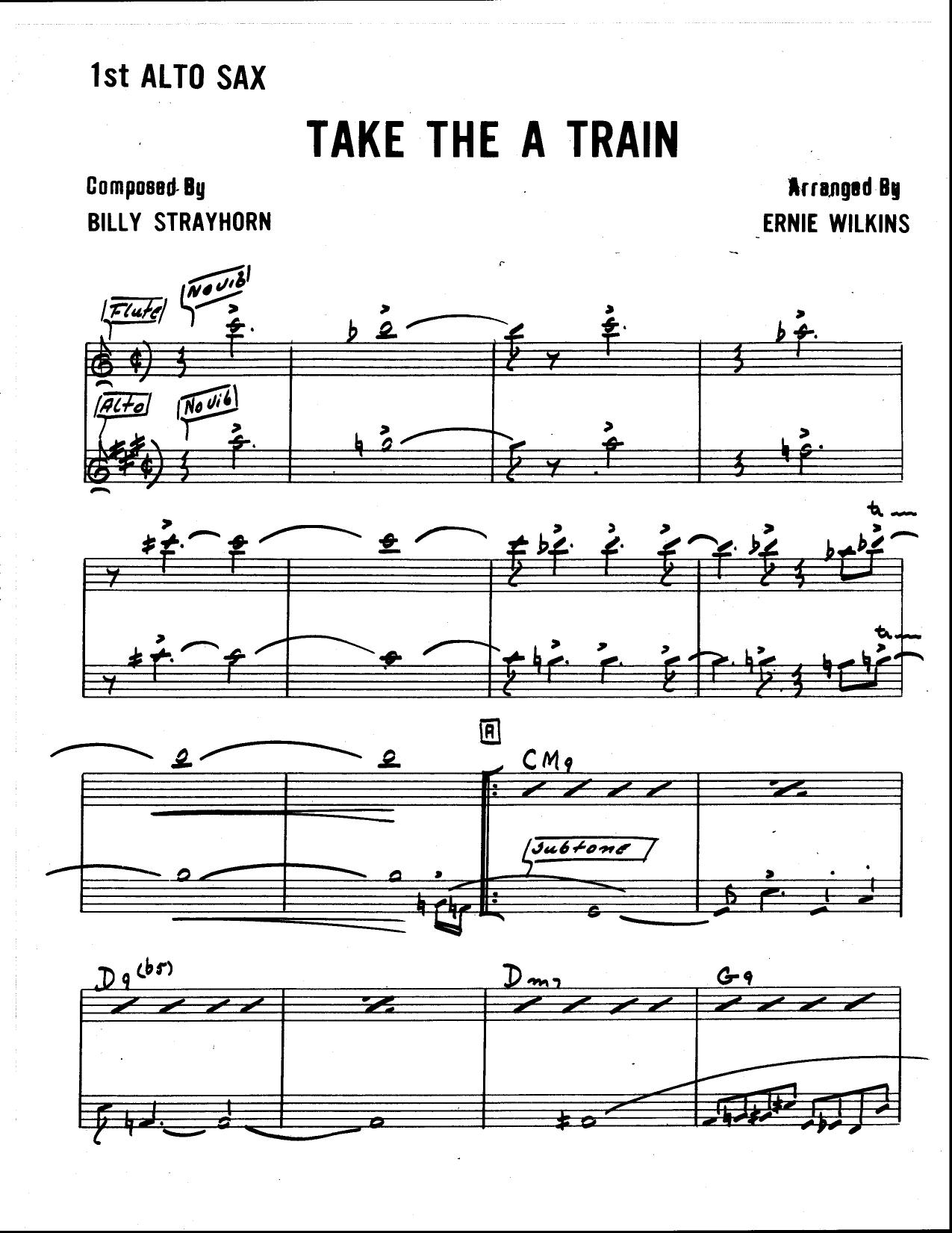
Take The 'A' Train (E.Wilkins)
Composed by Billy Strayhorn
Arranged by Ernie Wilkins
- Ensemble: Big Band
- Pages: 46
- Instruments (18): 1st Alto Saxophone (doubles Flute), 2nd Alto Saxophone, 1st Tenor Saxophone (doubles Clarinet/Soprano Saxophone), 2nd Tenor Saxophone, 5th Baritone Saxophone, Solo Trumpet, 1st Trumpet, 2nd Trumpet, 3rd Trumpet, 4th Trumpet, 1st Trombone, 2nd Trombone, 3rd Trombone, 4th Trombone, Guitar, Piano, Bass, Drums
- Difficulty: medium
- Content: Individual Parts
- Format: PDF Download (Instant)
- Price: $24.99
Billy Strayhorn’s iconic "Take The 'A' Train" stands as one of the definitive masterpieces of the big band era, famously serving as the theme song for the Duke Ellington Orchestra after its composition in 1939. Built upon a clever chromatic motif and a driving, train-like rhythmic momentum, this tune epitomizes the sophistication and swing of 20th-century American jazz. While the original recording cemented its status as an immortal jazz standard, master arranger Ernie Wilkins brings his own formidable mid-century modern sensibilities to the chart, reshaping Strayhorn's classic blueprint into a powerhouse vehicle for contemporary ensemble performance. Ernie Wilkins’s treatment injects the standard with a muscular, high-energy swing feel driven by punchy brass interjections and sophisticated post-swing harmony. Operating at a brisk, buoyant medium-up tempo, the arrangement crackles with anticipation from the opening bars, establishing an infectious groove in 4/4 time. Wilkins avoids a straightforward head arrangement, instead utilizing cascading saxophone solis and brilliantly voiced brass counterlines that continually shift the listener's perspective. The mood is celebratory, sophisticated, and relentlessly swinging, evoking the electric atmosphere of a packed mid-century New York jazz club while offering plenty of modern harmonic bite through extended chord extensions and clever reharmonizations. Throughout the chart, the melodic weight is cleverly distributed across the ensemble rather than relying solely on the trumpets or saxophones. The woodwinds carry intricate, interlocking bebop-infused lines that demand crisp articulation and immaculate section balance, while the brass section handles aggressive, Stravinsky-esque rhythmic stabs that punctuate the arrangement. A standout feature of Wilkins’s score is the dynamic shout chorus, which builds organically from a simmering, muted background texture into a roaring, full-ensemble climax. Solo space is provided for key instrumentalists, allowing featured improvisers to stretch out over standard changes energized by Wilkins's vibrant background figures. Advanced high school, collegiate, and professional big bands will find this arrangement an exceptionally rewarding addition to their repertoire. Because of its demanding rhythmic figures, fast ensemble unisons, and the endurance required in the brass registers, it requires a mature ensemble with strong section discipline and a deeply ingrained jazz swing feel. Conductors will appreciate how Wilkins paces the chart, balancing dense, harmonically rich ensemble passages with wide-open spaces for rhythm section drive and improvisational expression, making it a guaranteed showstopper for any serious concert program. Mastering Ernie Wilkins's dynamic arrangement of "Take The 'A' Train" requires precision, stamina, and a deep understanding of mid-century big band stylistic conventions. The tempo should be locked into a bright, driving medium-swing feel—do not let the tempo drag or rush, as the rhythmic momentum relies entirely on the rhythm section's steady pulse and the horns' triplet feel. Technically, the primary challenges lie in the fast, synchronized woodwind unisons and the aggressive brass stabs. The saxophones must execute their fast bebop lines with light, articulate tongue-strokes, ensuring that sixteenth-note passages remain clean and unaccented on the wrong beats. Brass players should pay careful attention to marked articulations (staccatos, roof accents, and smooth slurs) to capture the signature Wilkins punch. Mutes are employed strategically to create dynamic contrast; ensure the trumpet and trombone sections have their harmon and plunger mutes ready for quick transitions. Rehearsal should begin by separating the rhythm section to lock in the foundational comping and bassline groove before introducing the horns. When working with the full ensemble, isolate the complex shout chorus and practice it at a slower tempo to build internal section blend before bringing it up to performance speed. Q: What instruments and parts are included in this 46-page arrangement? A: This chart is scored for an 8-instrument reduced big band framework, specifically featuring Alto Saxophone, Tenor Saxophone, Baritone Saxophone, Trumpet, Trombone, and a fully integrated rhythm section (Piano, Bass, Drums). Q: What is the difficulty level of this Ernie Wilkins arrangement? A: This arrangement is graded as advanced, making it best suited for college ensembles, advanced high school jazz bands, and professional groups due to its fast tempos, complex unisons, and demands on section endurance. Q: What is the stylistic approach of this specific version? A: While rooted in the classic Duke Ellington/Billy Strayhorn swing tradition, this arrangement is filtered through Ernie Wilkins’s sophisticated post-bop and hard-bop harmonic language, featuring punchy shout choruses and modern reharmonizations. Q: What makes this particular arrangement unique compared to the original recording? A: Unlike the famous 1941 Ellington recording, Wilkins’s chart reinterprets the thematic material with intricate interlocking woodwind solis, denser chord voicings, and a high-energy developmental structure that builds toward a roaring climax. Q: What is the performance duration and tempo recommendation for this piece? A: The arrangement is designed to be performed at a brisk, driving medium-swing tempo (approximately quarter note = 180-192 BPM), with a standard performance duration of roughly 4 to 5 minutes depending on soloist choruses.
Questions and answers
- What is included in the Take The 'A' Train (E.Wilkins) PDF?
- The verified current file contains individual parts across 46 pages.
- How many instruments or parts are listed for Take The 'A' Train (E.Wilkins)?
- The verified instrumentation list contains 18 entries for this Big Band arrangement.
- Who is credited for Take The 'A' Train (E.Wilkins)?
- Composer: Billy Strayhorn. Arranger: Ernie Wilkins.
- What difficulty is listed for Take The 'A' Train (E.Wilkins)?
- The verified difficulty level is medium.
- Can I preview Take The 'A' Train (E.Wilkins) before buying?
- Yes. The product page provides a preview generated from the current PDF file.
- How is Take The 'A' Train (E.Wilkins) delivered?
- After successful payment, the digital PDF is made available for download. The displayed price is $24.99.
Musicians Also Search For
Take The 'A' Train Ernie Wilkins PDF • Take The 'A' Train Ernie Wilkins sheet music • Take The 'A' Train arranged by Ernie Wilkins • Ernie Wilkins big band charts • Ernie Wilkins jazz arrangements PDF • Take The 'A' Train Billy Strayhorn sheet music • Take The 'A' Train Billy Strayhorn big band arrangements • Billy Strayhorn big band charts • Take The 'A' Train big band arrangements • Take The 'A' Train big band PDF download • Take The 'A' Train jazz sheet music • big band sheet music download • Take The 'A' Train individual parts download • Take The 'A' Train sheet music PDF • buy Take The 'A' Train sheet music • download Take The 'A' Train PDF • Take The 'A' Train jazz charts • best Ernie Wilkins big band arrangements • Billy Strayhorn arranged by Ernie Wilkins • Take The 'A' Train printable sheet music • big band repertoire PDF