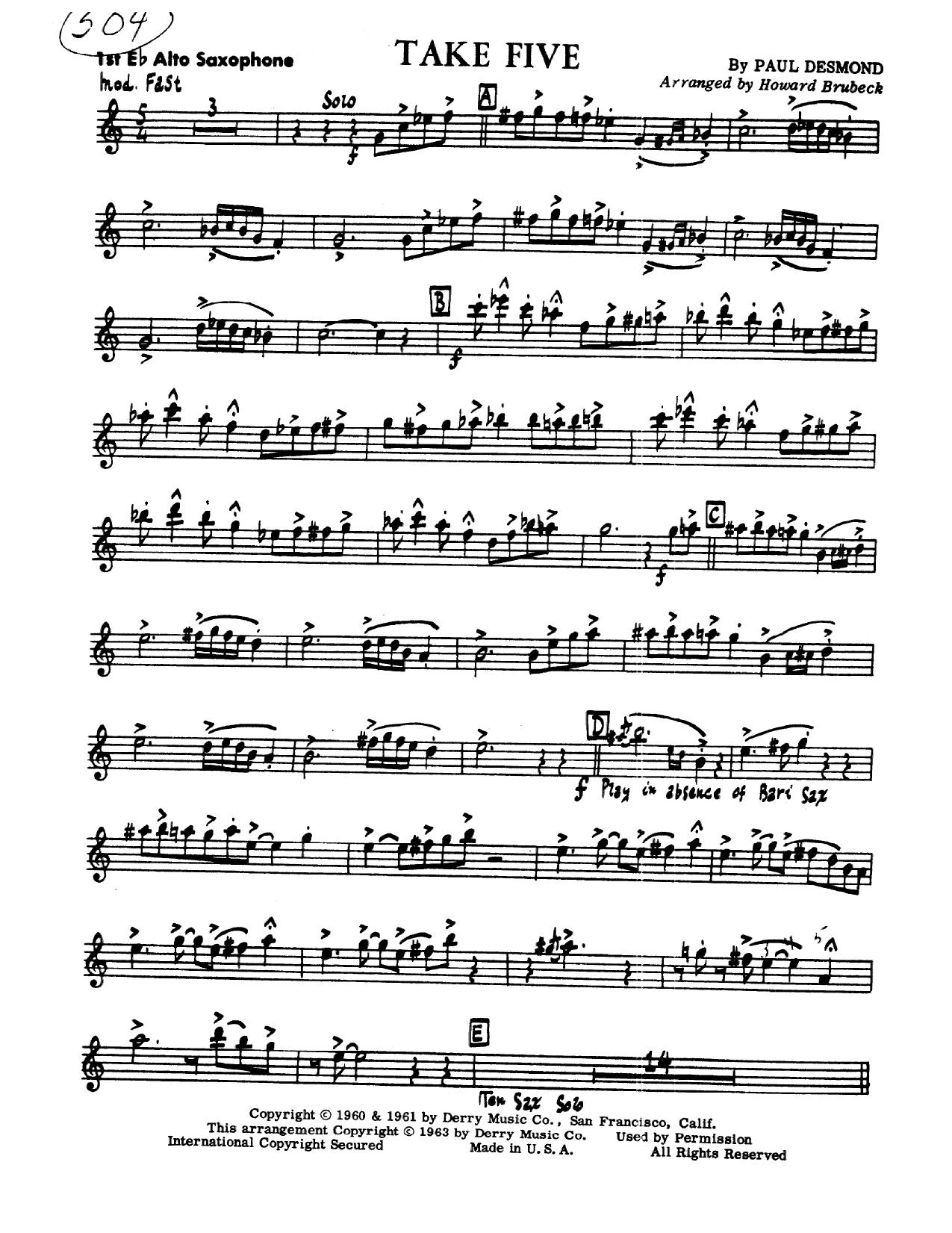
Take Five (H.Brubeck)
Composed by Paul Desmond
Arranged by H.Brubeck
- Ensemble: Big Band
- Style: Jazz Standard
- Pages: 25
- Instruments (17): 1st Eb Alto Saxophone, 2nd Bb Tenor Saxophone, 3rd Eb Alto Saxophone, 4th Bb Tenor Saxophone, 5th Eb Baritone Saxophone, 1st Bb Trumpet, 2nd Bb Trumpet, 3rd Bb Trumpet, 4th Bb Trumpet, 1st Trombone, 2nd Trombone, 3rd Trombone, 4th Trombone, Guitar, Drums, String Bass & Tuba, Piano
- Difficulty: medium
- Content: Individual Parts
- Format: PDF Download (Instant)
- Price: $24.99
Paul Desmond’s immortal "Take Five," originally recorded by the Dave Brubeck Quartet on their landmark 1959 album *Time Out*, stands as one of the most successful and recognizable jazz compositions in history. Rooted in the cool jazz movement of the West Coast, the piece broke conventional mold by utilizing an unconventional 5/4 meter, courtesy of Joe Morello’s hypnotic drum groove and Brubeck’s ostinato piano vamp. It bridges the gap between sophisticated modal jazz exploration and popular crossover appeal, remaining a foundational cornerstone of twentieth-century American music. Driving this big band adaptation is a sophisticated rhythmic pulse set entirely in a crisp, undulating 5/4 swing feel (subdivided as 3+2). The arrangement maintains the iconic, smoky minor-key vamp while translating Desmond’s languid, floating saxophone lines into rich, expansive brass and reed voicings. The overall mood balances cool, calculated tension with an underlying, kinetic energy. The interplay between the rhythmic sections creates an atmosphere that is simultaneously cerebral and effortlessly swinging, evoking the sophisticated atmosphere of a late-night modernist jazz club. H.Brubeck approaches the orchestration with a deep respect for the original counterpoint while expanding the palette for a full 16-instrument jazz orchestra. The arrangement features lush, tightly woven saxophone solis that mirror Desmond’s lyrical phrasing, contrasted by dynamic brass stabs and rolling modal shifts. Rather than relying on a simple transcription of the quartet version, this chart utilizes clever sectional counter-melodies and subtle harmonic extensions, particularly during the transition points between the iconic melodic phrases and the open solo sections. Melodic responsibilities are shared fluidly across the ensemble, with the alto saxophone section taking primary ownership of the famous head before passing thematic material to the brass. Open solo changes are provided for featured improvisers, allowing advanced soloists to stretch out over the modal 5/4 vamp. Technical challenges primarily center on maintaining an authentic, relaxed swing feel within the asymmetric 5/4 meter without rushing the subdivision. Rhythm section players—particularly the drummer and bassist—must possess a rock-solid internal clock to anchor the ensemble while maintaining the signature groove. Advanced high school, collegiate, and professional big bands will find this arrangement an exceptionally rewarding addition to their repertoire. It offers an ideal vehicle for teaching odd-meter proficiency to developing players while giving seasoned ensembles enough harmonic and stylistic depth to captivate a sophisticated audience. Mastering this 5/4 arrangement requires the rhythm section to establish an unshakeable foundation before the horns enter. The drummer must anchor the 3+2 subdivision cleanly on the ride cymbal, avoiding over-syncopation that could destabilize the ensemble's macro-pulse. Conductor focus should center on the transition areas between the structured ensemble solis and the open solo sections, ensuring the tempo remains steady without rushing through the bar-line shifts. Horn players should prioritize a smooth, connected legato phrasing during the main theme to capture the cool-jazz aesthetic pioneered by Desmond, keeping articulation light and unforced. Brass players must exercise restraint during background figures to avoid covering the soloist. Rehearsal should begin by clapping and speaking the 5/4 rhythm away from instruments until the asymmetric pulse feels entirely natural to every section. Q: What instruments and parts are included in this arrangement? A: This chart is scored for a 16-instrument big band ensemble, including Alto Saxophone 1, Alto Saxophone 3, Tenor Saxophone 2, Baritone Saxophone 5, and Trumpet 1, alongside a full complement of rhythm and supporting wind parts, totaling 25 pages with a conductor score included. Q: What is the difficulty level of this big band chart? A: This arrangement is tailored for advanced high school, collegiate, and professional jazz orchestras due to the demands of maintaining a relaxed swing feel within an asymmetric 5/4 meter and navigating open modal improvisation. Q: What is the musical style and historical context of the piece? A: Originating from Paul Desmond's composition for the Dave Brubeck Quartet's 1959 album *Time Out*, this piece is a defining masterpiece of the West Coast cool jazz movement, celebrated for pioneering odd-meter structures in mainstream jazz. Q: What makes H.Brubeck’s arrangement unique? A: It brilliantly scales down the iconic 1959 quartet recording into a full 16-instrument big band format by utilizing lush saxophone solis, intricate counter-melodies, and expanded harmonic voicings while preserving the haunting minor-key vamp. Q: What is the performance duration and tempo feel of this arrangement? A: The chart operates at a medium cool-jazz tempo, driven by a crisp, continuous 5/4 swing feel (subdivided 3+2), with a typical performance duration spanning approximately 5 to 6 minutes depending on the length of the open improvised solos.
Questions and answers
- What is included in the Take Five (H.Brubeck) PDF?
- The verified current file contains a conductor score and individual parts across 25 pages.
- How many instruments or parts are listed for Take Five (H.Brubeck)?
- The verified instrumentation list contains 17 entries for this Big Band arrangement.
- Who is credited for Take Five (H.Brubeck)?
- Composer: Paul Desmond. Arranger: H.Brubeck.
- What difficulty is listed for Take Five (H.Brubeck)?
- The verified difficulty level is medium.
- What style is listed for Take Five (H.Brubeck)?
- The catalog lists the style as Jazz Standard.
- Can I preview Take Five (H.Brubeck) before buying?
- Yes. The product page provides a preview generated from the current PDF file.
- How is Take Five (H.Brubeck) delivered?
- After successful payment, the digital PDF is made available for download. The displayed price is $24.99.
Musicians Also Search For
Take Five H.Brubeck PDF • Take Five H.Brubeck sheet music • Take Five arranged by H.Brubeck • H.Brubeck big band charts • H.Brubeck jazz arrangements PDF • Take Five Paul Desmond sheet music • Take Five Paul Desmond big band arrangements • Paul Desmond big band charts • Take Five big band arrangements • Take Five big band PDF download • Take Five jazz sheet music • big band sheet music download • Take Five conductor score PDF • Take Five individual parts download • Take Five sheet music PDF • Take Five Jazz Standard charts • Jazz Standard big band arrangements • buy Take Five sheet music • download Take Five PDF • Take Five jazz charts • best H.Brubeck big band arrangements • Paul Desmond arranged by H.Brubeck • Take Five printable sheet music • big band repertoire PDF