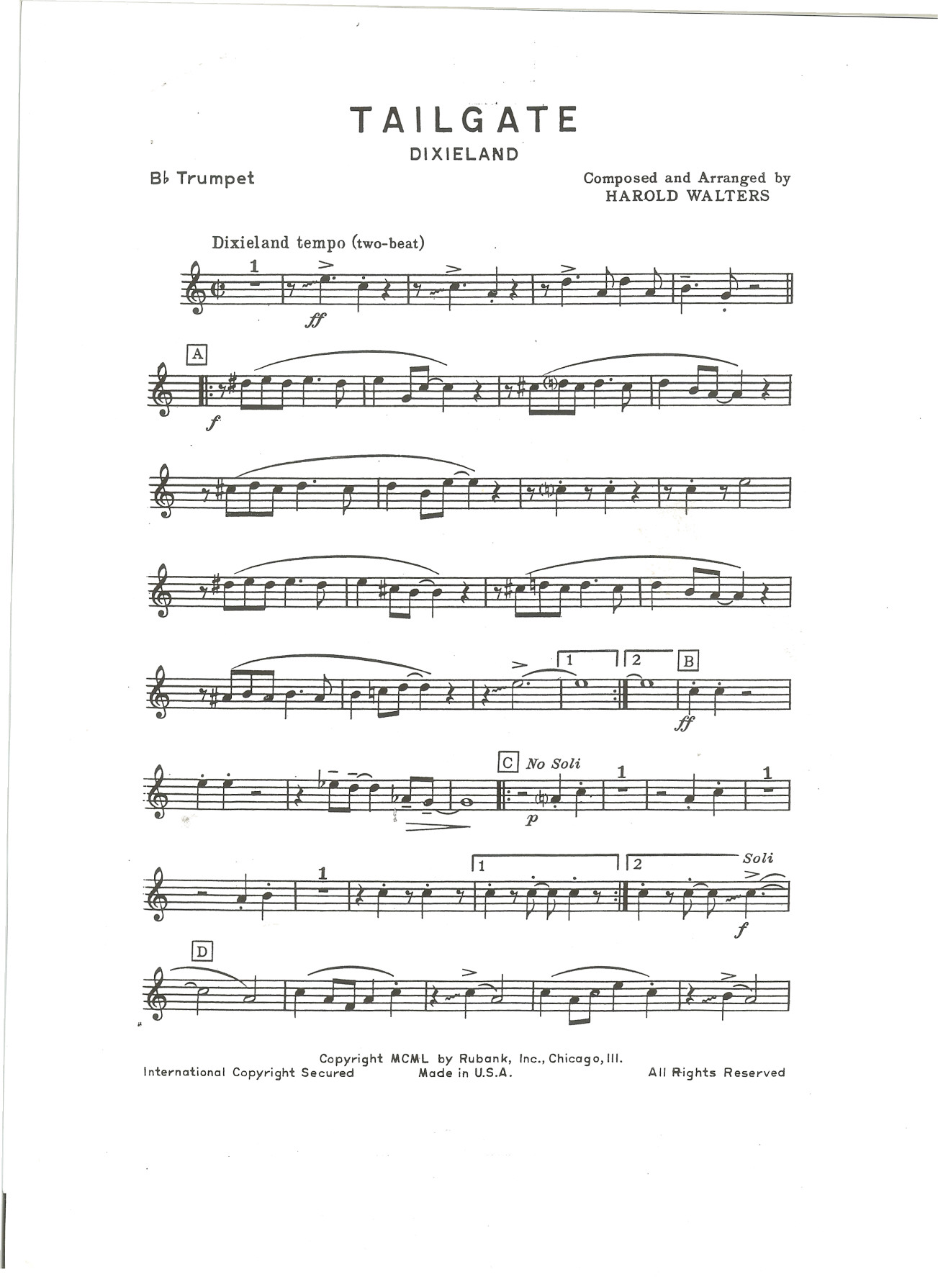
Tailgate (H.Walters)
Composed by Harold Walters
Arranged by Harold Walters
- Ensemble: Dixieland Band
- Style: Dixieland
- Pages: 18
- Difficulty: easy
- Content: Sheet Music
- Format: PDF Download (Instant)
- Price: $18.99
Harold Walters' "Tailgate" is a quintessential Dixieland original, capturing the exuberant spirit and infectious energy of early 20th-century American jazz. Composed by Walters himself, this piece harks back to the formative years of jazz, specifically the New Orleans and Chicago styles that flourished from the 1900s through the 1920s. The term "tailgate" itself evokes the image of trombonists playing from the open tailgate of a wagon, providing a robust rhythmic and melodic foundation in parades and outdoor performances. While not a traditional "standard" in the sense of being covered by countless artists, Walters' composition is a highly respected and frequently performed original within the Dixieland repertoire, celebrated for its authentic stylistic representation and engaging structure. It embodies the collective improvisation, driving two-beat feel, and call-and-response patterns that define the genre, making it a vibrant snapshot of jazz's foundational era. Musically, "Tailgate" is an up-tempo, spirited romp, typically performed in a bright 2/4 or 4/4 feel with a pronounced two-beat undercurrent. The primary key is often C or F major, allowing for the bright, open voicings characteristic of Dixieland. The mood is unequivocally joyous and celebratory, designed to get feet tapping and spirits soaring. It evokes the lively atmosphere of a New Orleans street parade or a bustling speakeasy, brimming with unbridled enthusiasm. The piece is structured to highlight the distinct roles of each instrument: the clarinet's soaring obbligatos, the cornet/trumpet's lead melody, the trombone's glissandi and counter-melodies, and the rhythm section's unwavering propulsion. The energy is consistently high, building through successive choruses and ensemble sections. Harold Walters' arrangement of his own composition is a masterclass in authentic Dixieland scoring. He meticulously crafts the interplay between the front-line instruments, ensuring that the collective improvisation feels organic yet structured. Walters' signature approach often involves clear melodic statements by the cornet, followed by intricate counter-melodies from the clarinet and robust, often humorous, "tailgate" trombone lines featuring prominent glissandi and smears. While there may not be extended, written-out solo sections in the modern jazz sense, the arrangement provides ample opportunities for each instrument to shine through its characteristic Dixieland role, often featuring short, improvised breaks or clearly defined melodic features. The arrangement is characterized by its bright, open voicings, avoiding overly complex harmonies in favor of clarity and rhythmic drive. Walters ensures that the piece remains true to the style's roots, delivering a vibrant and historically informed performance experience. Performing "Tailgate" is immensely rewarding for ensembles looking to capture the true essence of Dixieland. The cornet or trumpet typically carries the primary melodic line, often in unison or octaves with the clarinet during ensemble passages. The trombone provides crucial counterpoint and rhythmic punctuation, while the clarinet weaves intricate obbligato lines above the ensemble. The rhythm section (piano, bass, drums, banjo/guitar) provides a relentless, driving foundation. Technical challenges primarily involve maintaining the bright, consistent tempo and achieving the correct stylistic articulation—short, crisp notes on the cornet, fluid glissandi on the trombone, and agile runs on the clarinet. The ensemble must also master the art of collective improvisation, where each player contributes to the overall texture without clashing. The piece is ideal for high school, college, and community Dixieland bands, as it offers a fantastic vehicle for developing stylistic understanding, ensemble cohesion, and individual instrumental character within a historically significant genre. "Tailgate" demands a bright, unflagging tempo, typically around quarter note = 180-200 BPM, with a strong two-beat feel underpinning the entire performance. Conductors should emphasize a light, driving rhythm section feel, avoiding a heavy four-beat swing. Key technical challenges include the clarinet's agile scalar runs and arpeggios, the cornet/trumpet's crisp articulation and sustained melodic lines, and the trombone's characteristic glissandi and smears, which should be executed with flair and precision. Encourage the rhythm section to maintain a consistent, energetic pulse, with the banjo or guitar providing rhythmic strumming and the bass a walking two-beat. Rehearsal should focus on achieving tight ensemble interplay, particularly in the collective "improvisation" sections where each voice contributes to the overall texture. Ensure that the front-line instruments balance their individual parts to create a cohesive, vibrant sound without one instrument overpowering the others. Q: What instruments/parts are included in this arrangement? A: This arrangement typically includes parts for Cornet/Trumpet, Clarinet, Trombone, Piano, Bass, Drums, and optional Banjo or Guitar, reflecting a standard Dixieland band instrumentation. Q: What is the difficulty level of "Tailgate (H.Walters)"? A: "Tailgate" is generally considered a medium-difficulty piece, suitable for high school, college, and community Dixieland ensembles. It requires good technical proficiency on individual instruments and a solid understanding of Dixieland stylistic conventions. Q: What musical style and historical context does this arrangement represent? A: This arrangement is a prime example of the Dixieland jazz style, originating from early 20th-century New Orleans. It showcases the collective improvisation, driving two-beat feel, and instrumental roles characteristic of that foundational era of jazz. Q: What makes Harold Walters' arrangement of "Tailgate" unique? A: As the composer and arranger, Harold Walters' version is uniquely authentic, perfectly capturing the spirit and technical demands of the Dixieland genre. It features clear melodic lines, characteristic trombone glissandi, and well-balanced ensemble writing. Q: What is the typical performance duration or tempo for this piece? A: "Tailgate" is designed as an up-tempo, energetic piece. A typical performance tempo would be around quarter note = 180-200 BPM, resulting in a duration of approximately 2-3 minutes, depending on any improvised breaks or repeats.
Musicians Also Search For
Tailgate Harold Walters PDF • Tailgate Harold Walters sheet music • Tailgate arranged by Harold Walters • Harold Walters dixieland band charts • Harold Walters jazz arrangements PDF • Tailgate Harold Walters dixieland band arrangement • Tailgate dixieland band arrangement • Tailgate dixieland band PDF download • Tailgate jazz ensemble sheet music • dixieland band sheet music instant download • Tailgate sheet music with parts • Tailgate Dixieland chart • Dixieland dixieland band arrangements • buy Tailgate sheet music online • download Tailgate PDF • Tailgate jazz chart • best Harold Walters dixieland band arrangements • Tailgate printable sheet music • dixieland band repertoire PDF