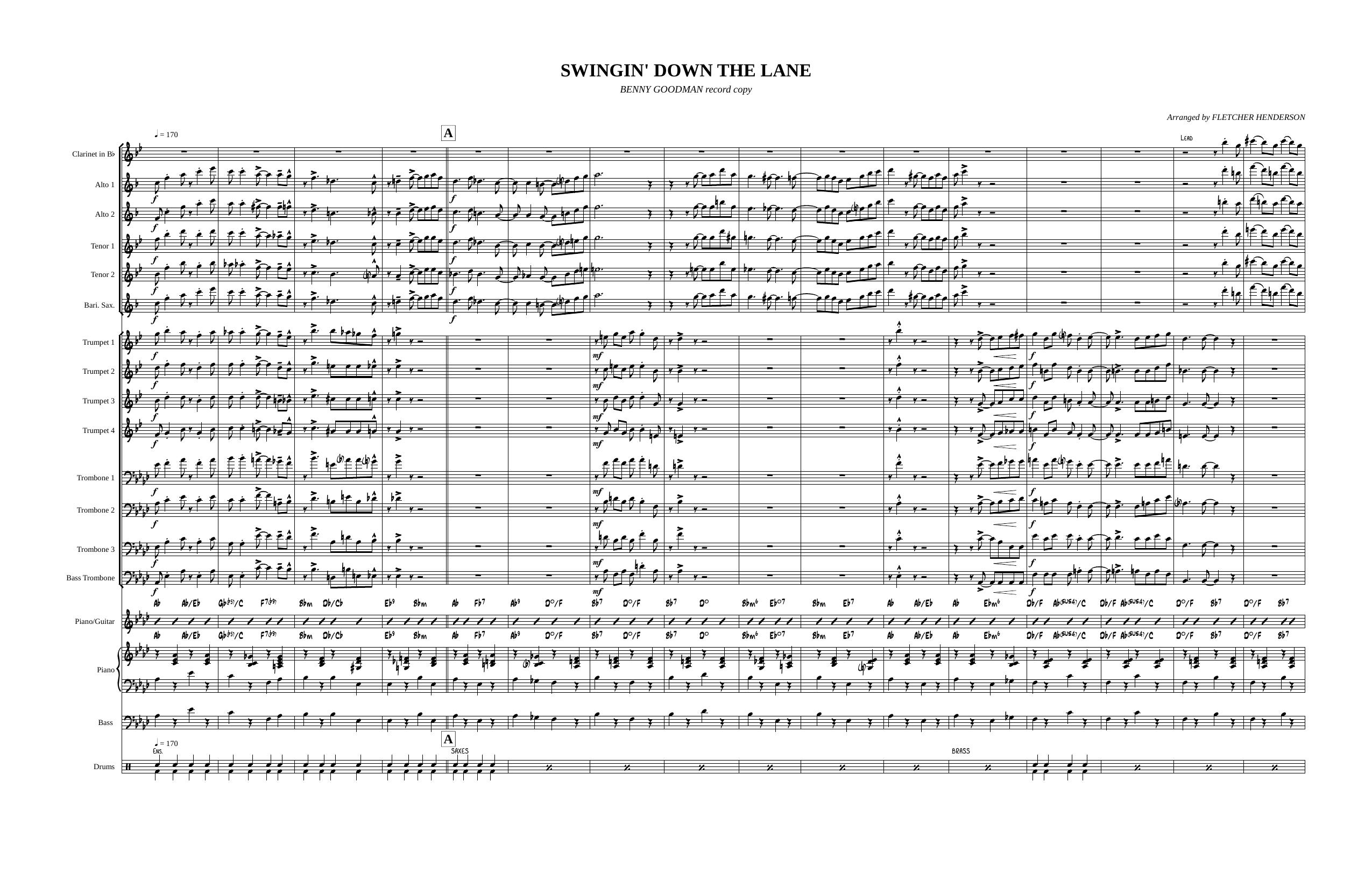
Swingin' Down The Lane (F.FHenderson)
Composed by Isham Jones
Arranged by Fletcher Henderson
- Ensemble: Big Band
- Pages: 47
- Instruments (18): Clarinet in Bb, Alto 1, Alto 2, Tenor 1, Tenor 2, Bari. Sax., Trumpet 1, Trumpet 2, Trumpet 3, Trumpet 4, Trombone 1, Trombone 2, Trombone 3, Bass Trombone, Guitar, Piano, Bass, Drums
- Difficulty: medium
- Content: Individual Parts
- Format: PDF Download (Instant)
- Price: $24.99
Isham Jones composed "Swingin' Down the Lane" in 1923 during the height of the early jazz and dance band era, with lyrics by Gus Kahn. It quickly became a popular standard recorded by major artists of the 1920s, including Isham Jones' own orchestra and later interpretations by vocalists and swing outfits. However, it was the visionary arranging genius of Fletcher Henderson—the foundational architect of the swing big band sound—who transformed this infectious Tin Pan Alley tune into a masterclass of jazz orchestration. Henderson's approach bridges the gap between early New Orleans polyphony and the fully realized, section-driven swing big band era that would dominate the following decade, showcasing the sophisticated sectional interplay that made his Harlem-based orchestra legendary at the Roseland Ballroom. Bouncing along with a buoyant, medium-tempo swing feel in 4/4 time, this arrangement exudes an irresistible, vintage optimism characteristic of the late-1920s jazz vernacular. The mood is effervescent and swinging, driven by a steady, propulsive rhythm section foundation that encourages an effortless, dancer-friendly groove. Henderson utilizes crisp harmonic voicings and call-and-response textures between the brass and reed sections, creating a dynamic, conversational flow. The melody is introduced with charm and clarity, gradually building in harmonic density and rhythmic complexity as the chart unfolds, ultimately culminating in a jubilant shout chorus that captures the unbridled high spirits of the Jazz Age. Fletcher Henderson’s distinctive arranging style shines through the clever deployment of sectional solis and interlocking countermelodies. Rather than relying on simple block-chord harmonization, Henderson treats the small-to-medium ensemble with remarkable textural variety, distributing thematic fragments across the instrumental voices to create a surprisingly full, rich sonic footprint despite the lean 7-instrument configuration (Alto Saxophone, Tenor Saxophone, Trumpet, Trombone, Piano, and rhythm section components spanning 47 comprehensive pages of manuscript). The horns execute tight, harmonized lines that demand clean articulation and a unified conception of early swing phrasing—favoring light, bouncy eighth notes over heavy, modern accents. Solo opportunities allow individual players to step into the spotlight with authentic period flair, backed by responsive ensemble punches. Advanced high school ensembles, collegiate jazz repertory groups, and professional vintage-style jazz bands will find this chart an exceptionally rewarding addition to their libraries. While the individual note reading is accessible, the true challenge and educational value lie in achieving authentic stylistic execution—mastering the subtle nuances of 1920s swing articulation, balance, and dynamic shading. Performing this Fletcher Henderson arrangement offers students and professionals alike a direct connection to the roots of big band history, making it a standout selection for showcase concerts, historical retrospectives, and dance-party sets alike. Achieving an authentic 1920s jazz feel is the primary objective when rehearsing this Fletcher Henderson arrangement. The tempo should remain steady and forward-moving, anchored by a light, driving ride cymbal and a crisp 2-and-4 Charleston-esque or four-to-the-bar acoustic bass feel. Horn players must focus on short, articulate phrasing ("doot-dat" articulation), avoiding heavy legato slurs that belong to later eras. The primary technical challenge lies in the precise synchronization of intricate ensemble figures between the saxophones, trumpet, and trombone. Balance is critical; because this is a 7-instrument configuration rather than a full 17-piece modern big band, every player acts as a principal voice. Ensure the piano player anchors the harmonic rhythm with stride-influenced or vintage root-chord comping without overpowering the horns. Utilize subtle lip trills, gentle falls, and plunger effects only where stylistically appropriate to enhance the vintage atmosphere without sliding into caricature. Relegate rehearsal time initially to sectional isolation of the countermelodies to ensure clean intonation before bringing the full ensemble together. Q: What instruments and parts are included in this arrangement? A: This 47-page arrangement is scored for a tight 7-instrument ensemble, specifically featuring Alto Saxophone, Tenor Saxophone, Trumpet, Trombone, Piano, and rhythm section support. Q: What is the difficulty level of this chart? A: It is moderately challenging, best suited for advanced high school, collegiate, and professional ensembles due to the high demand for stylistic authenticity and tight sectional blend. Q: What is the historical style and context of the piece? A: The music represents the classic 1923 Tin Pan Alley standard by Isham Jones, arranged in the pioneering, swinging big-band style of Fletcher Henderson from the late 1920s jazz era. Q: What makes this particular Fletcher Henderson arrangement unique? A: It features Henderson’s signature clever sectional interplay and counterpoint, adapted specifically to provide a rich, full big-band texture within a lean 7-instrument framework. Q: What is the recommended performance tempo and duration? A: The arrangement is performed at a bouncy, medium-swing tempo, with a typical duration of approximately 3 to 4 minutes depending on solo extensions.
Questions and answers
- What is included in the Swingin' Down The Lane (F.FHenderson) PDF?
- The verified current file contains a conductor score and individual parts across 47 pages.
- How many instruments or parts are listed for Swingin' Down The Lane (F.FHenderson)?
- The verified instrumentation list contains 18 entries for this Big Band arrangement.
- Who is credited for Swingin' Down The Lane (F.FHenderson)?
- Composer: Isham Jones. Arranger: Fletcher Henderson.
- What difficulty is listed for Swingin' Down The Lane (F.FHenderson)?
- The verified difficulty level is medium.
- Can I preview Swingin' Down The Lane (F.FHenderson) before buying?
- Yes. The product page provides a preview generated from the current PDF file.
- How is Swingin' Down The Lane (F.FHenderson) delivered?
- After successful payment, the digital PDF is made available for download. The displayed price is $24.99.
Musicians Also Search For
Swingin' Down The Lane Fletcher Henderson PDF • Swingin' Down The Lane Fletcher Henderson sheet music • Swingin' Down The Lane arranged by Fletcher Henderson • Fletcher Henderson big band charts • Fletcher Henderson jazz arrangements PDF • Swingin' Down The Lane Isham Jones sheet music • Swingin' Down The Lane Isham Jones big band arrangements • Isham Jones big band charts • Swingin' Down The Lane big band arrangements • Swingin' Down The Lane big band PDF download • Swingin' Down The Lane jazz sheet music • big band sheet music download • Swingin' Down The Lane conductor score PDF • Swingin' Down The Lane individual parts download • Swingin' Down The Lane sheet music PDF • buy Swingin' Down The Lane sheet music • download Swingin' Down The Lane PDF • Swingin' Down The Lane jazz charts • best Fletcher Henderson big band arrangements • Isham Jones arranged by Fletcher Henderson • Swingin' Down The Lane printable sheet music • big band repertoire PDF