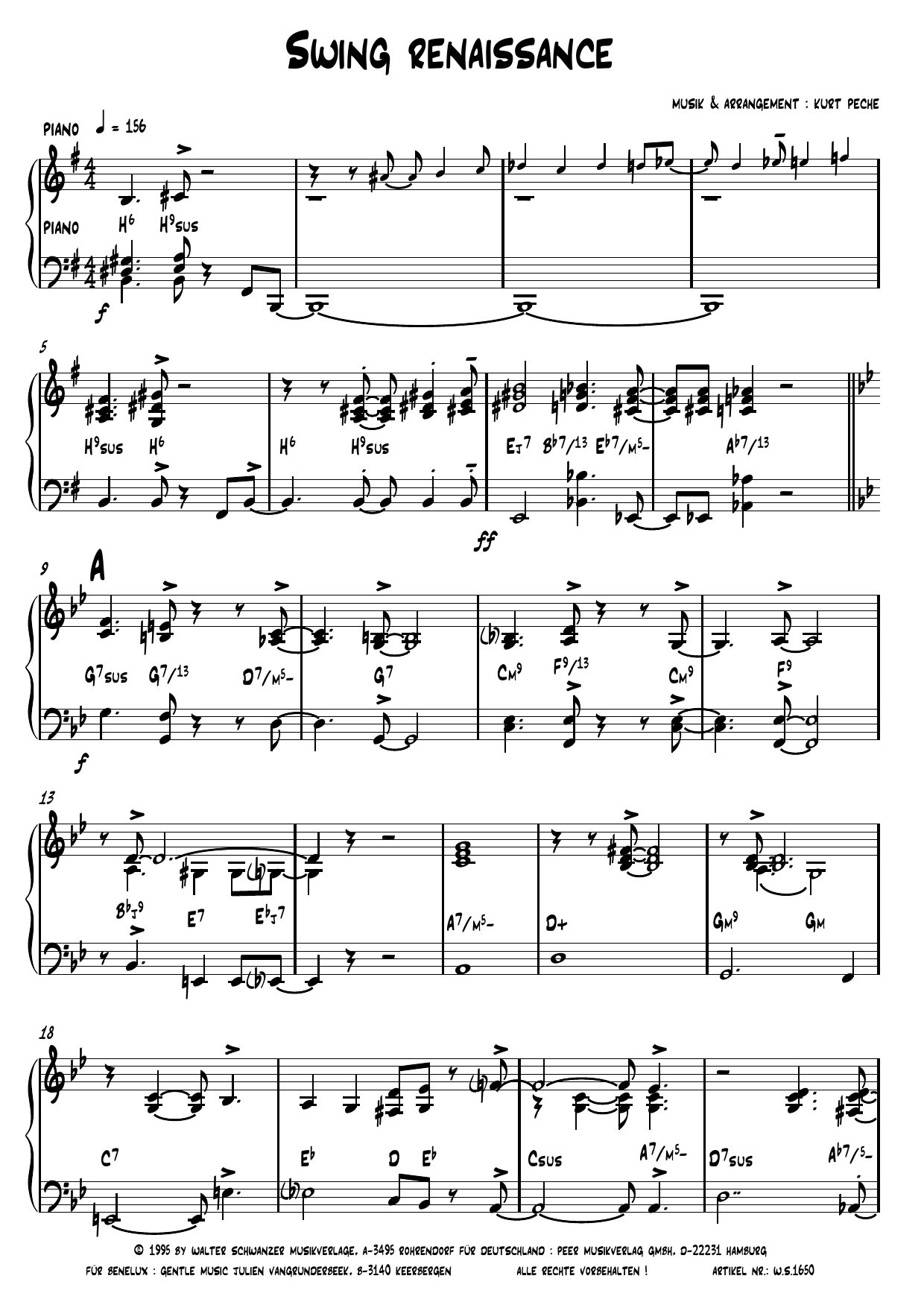
Swing Renaissanse (Kurt Peche)
Composed by George H. P. "Pops" Foster
- Ensemble: Big Band Dance
- Style: Big Band Dance
- Pages: 20
- Instruments (17): 1. Alt-Saxophon, 2. Alt-Saxophon, 1. Tenor-Saxophon, 2. Tenor-Saxophon, Baritonsaxophon, 1. Trompete, 2. Trompete, 3. Trompete, 4. Trompete, 1. Posaune, 2. Posaune, 3. Posaune, 4. Posaune, Gitarre, Piano, Bass, Drums
- Difficulty: easy
- Content: Individual Parts
- Format: PDF Download (Instant)
- Price: $24.99
"Swing Renaissanse (Kurt Peche)" breathes new life into the vibrant big band dance tradition, drawing inspiration from the foundational work of jazz pioneer George H. P. "Pops" Foster. Foster, a legendary bassist whose career spanned from the early New Orleans jazz scene through the swing era, was instrumental in shaping the rhythmic and harmonic landscape of early jazz. While the specific composition "Swing Renaissanse" might be a contemporary homage or reinterpretation, it firmly roots itself in the effervescent spirit of the 1930s and 40s, an era defined by its irresistible dance rhythms and soaring horn sections. This period saw the big band become the dominant popular music form, with ensembles like those led by Benny Goodman, Count Basie, and Duke Ellington filling dance halls across the nation. The piece captures the joyous, unpretentious energy of that golden age, designed to get feet tapping and spirits lifted. This arrangement is a quintessential medium-swing chart, anchored firmly in 4/4 time with a relaxed yet propulsive feel. The primary key of C Major provides a bright, accessible tonal center, allowing the melodic lines to shine with clarity and warmth. The overall mood is one of sophisticated exuberance, balancing intricate ensemble work with moments of spontaneous jazz improvisation. It evokes the feeling of a bustling dance floor, where elegance meets infectious rhythm. The arrangement maintains a consistent, uplifting energy throughout, characterized by its driving rhythm section and harmonically rich horn voicings that are both classic and fresh. The arranger, Kurt Peche, demonstrates a deep respect for the big band dance idiom while infusing it with his own distinctive voice. His approach is evident in the meticulously crafted voicings, which often feature tight, harmonized horn lines that create a full, resonant sound without being overly dense. Peche skillfully employs call-and-response patterns between the brass and saxophone sections, a hallmark of the swing era, building dynamic tension and release. While there isn't a traditional shout chorus in the bombastic sense, the arrangement culminates in a powerful ensemble section that serves a similar purpose, bringing all voices together in a unified, energetic statement. The use of extended harmonies is subtle, adding color and depth without straying from the accessible swing aesthetic. The melody is primarily carried by the alto saxophone and trumpet in unison or octaves during the A sections, giving it a bright and clear lead. The B section often features a soli passage for the saxophone section, showcasing their collective precision and blend. There are ample opportunities for featured solos, typically for tenor saxophone and trumpet, allowing individual musicians to express themselves within the established swing framework. Technical challenges include precise articulation in the fast-moving horn lines, maintaining a consistent swing feel at a medium tempo, and achieving balanced ensemble blend. The rewarding aspect lies in the collective experience of producing a vibrant, authentic big band sound that is both historically informed and immensely enjoyable to perform and hear. This arrangement is ideally suited for college and advanced high school jazz ensembles, as well as community big bands. Its accessible key and medium tempo make it manageable for groups with developing technical skills, while the nuanced voicings and opportunities for improvisation offer significant musical depth for more experienced players. Professional ensembles will appreciate its authentic swing feel and the solid framework it provides for creative interpretation. Conductors should emphasize a relaxed, yet driving medium-swing feel from the rhythm section, ensuring a consistent four-to-the-bar pulse. Articulation is key for the horn sections; encourage a light, detached approach on eighth notes in swing passages, with clear attacks and releases. Pay close attention to dynamics, particularly the crescendos leading into ensemble hits, to build excitement. The trumpet and tenor saxophone solo sections should encourage melodic and rhythmic improvisation within the swing style, focusing on storytelling rather than purely technical display. Rehearsal time should be dedicated to balancing the horn voicings, ensuring that inner voices are heard without overpowering the lead lines. For the ensemble sections, aim for a unified sound with precise cut-offs and attacks. No special techniques like plunger mutes or falls are explicitly notated, allowing for performer discretion in adding stylistic embellishments where appropriate. Q: What instruments/parts are included in this arrangement? A: This arrangement includes parts for 7 instruments: Alto Saxophone, Tenor Saxophone, Trumpet, Trombone, Piano, Bass, and Drums, totaling 20 pages of sheet music. Q: What is the difficulty level of "Swing Renaissanse (Kurt Peche)"? A: This arrangement is considered medium difficulty, suitable for college and advanced high school jazz ensembles, as well as community big bands, offering both accessible melodies and rewarding ensemble challenges. Q: What is the musical style and historical context of this piece? A: "Swing Renaissanse (Kurt Peche)" is a big band dance chart in a medium-swing style, drawing inspiration from the foundational jazz of George H. P. "Pops" Foster and the vibrant swing era of the 1930s and 40s. Q: What makes this arrangement unique? A: This arrangement by Kurt Peche uniquely blends classic big band dance aesthetics with fresh, accessible voicings, offering a sophisticated yet energetic medium-swing chart that honors historical traditions while feeling contemporary. Q: What is the typical performance duration or tempo for this piece? A: "Swing Renaissanse (Kurt Peche)" is intended to be performed at a medium-swing tempo, typically around 120-140 BPM, resulting in a performance duration of approximately 3-4 minutes depending on solo lengths.
Questions and answers
- What is included in the Swing Renaissanse (Kurt Peche) PDF?
- The verified current file contains individual parts across 20 pages.
- How many instruments or parts are listed for Swing Renaissanse (Kurt Peche)?
- The verified instrumentation list contains 17 entries for this Big Band Dance arrangement.
- Who is credited for Swing Renaissanse (Kurt Peche)?
- Composer: George H. P. "Pops" Foster.
- What difficulty is listed for Swing Renaissanse (Kurt Peche)?
- The verified difficulty level is easy.
- What style is listed for Swing Renaissanse (Kurt Peche)?
- The catalog lists the style as Big Band Dance.
- Can I preview Swing Renaissanse (Kurt Peche) before buying?
- Yes. The product page provides a preview generated from the current PDF file.
- How is Swing Renaissanse (Kurt Peche) delivered?
- After successful payment, the digital PDF is made available for download. The displayed price is $24.99.
Musicians Also Search For
Swing Renaissanse George H. P. "Pops" Foster sheet music • Swing Renaissanse George H. P. "Pops" Foster big band dance arrangements • George H. P. "Pops" Foster big band dance charts • Swing Renaissanse big band dance arrangements • Swing Renaissanse big band dance PDF download • Swing Renaissanse jazz sheet music • big band dance sheet music download • Swing Renaissanse individual parts download • Swing Renaissanse sheet music PDF • Swing Renaissanse Big Band Dance charts • Big Band Dance big band dance arrangements • buy Swing Renaissanse sheet music • download Swing Renaissanse PDF • Swing Renaissanse jazz charts • Swing Renaissanse printable sheet music • big band dance repertoire PDF