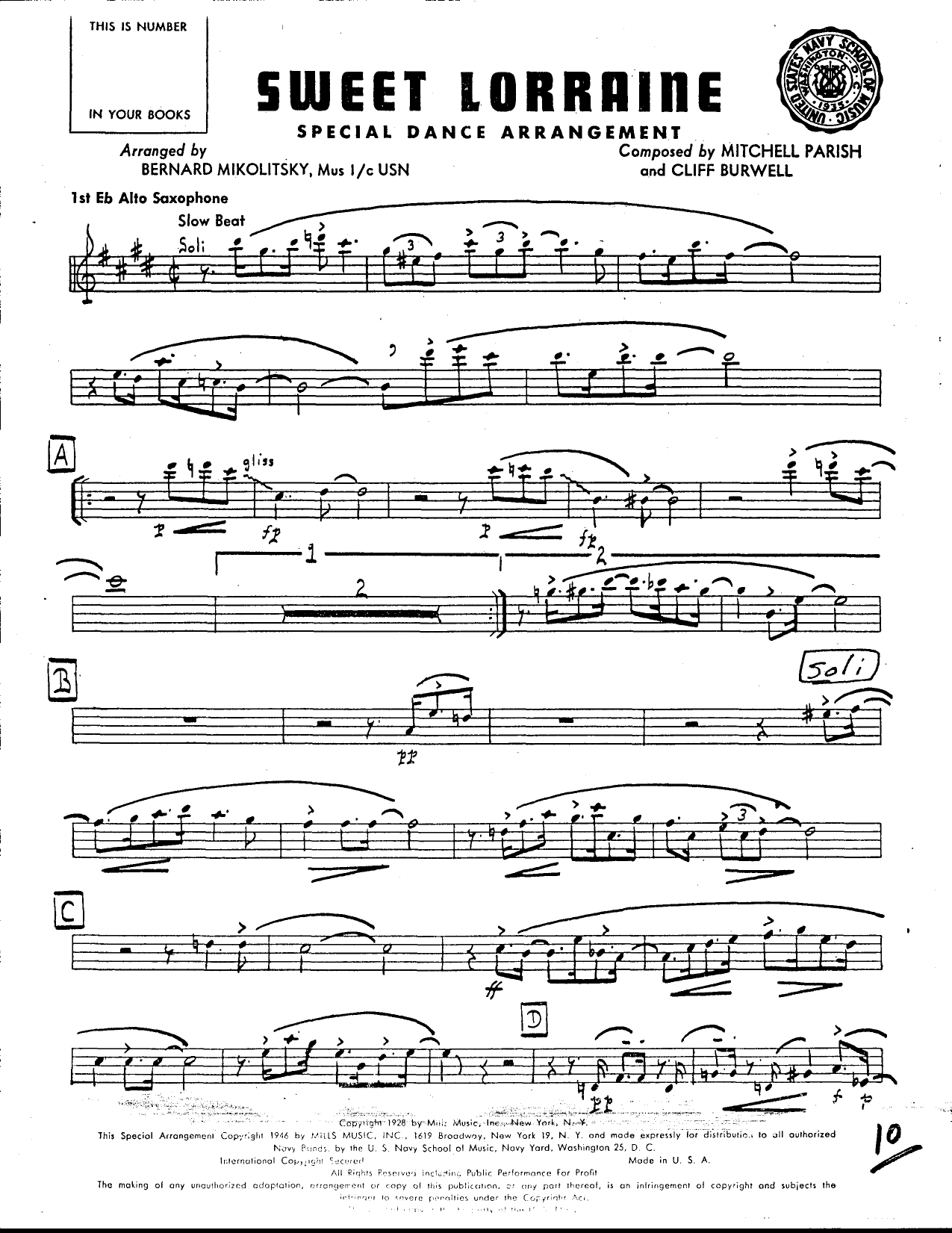
Sweet Lorraine (B.Mikolitsky) sheet music preview

Sweet Lorraine (B.Mikolitsky)

Composed by Cliff Burwell

Arranged by B.Mikolitsky

  • Ensemble: Big Band Dance
  • Style: Jazz Standard
  • Pages: 34
  • Instruments (17): 1st Eb Alto Saxophone, 2nd Eb Alto Saxophone, 1st Bb Tenor Saxophone, 2nd Bb Tenor Saxophone, 5th Eb Baritone Saxophone, 1st Bb Trumpet, 2nd Bb Trumpet, 3rd Bb Trumpet, 4th Bb Trumpet, 1st Trombone, 2nd Trombone, 3rd Trombone, 4th Trombone, Bass, Drums, Piano, Guitar
  • Difficulty: advanced
  • Content: Individual Parts
  • Format: PDF Download (Instant)
  • Price: $24.99

Written by Cliff Burwell with lyrics by Mitchell Parish, "Sweet Lorraine" remains one of the most enduring and beloved ballad-swing standards of the American Songbook, famously championed by Nat King Cole, Art Tatum, and countless jazz luminaries since its publication in 1928. Capturing the sophisticated, intimate warmth of the late 1920s and 1930s jazz era, the composition thrives on a rich, descending harmonic progression and a melody that balances gentle nostalgia with an optimistic, buoyant swing. It represents an era when jazz shifted from hot collective polyphony toward refined melodic lyricism and showcase arrangements for small groups and large ensembles alike. B.Mikolitsky’s masterful 17-instrument big band arrangement transforms this classic standard into a lush, mid-tempo swing feature that balances sophisticated harmonic depth with accessible ensemble interplay. Unfolding with a relaxed, infectious medium-swing groove, the chart evokes the sophisticated atmosphere of a 1940s supper club while introducing fresh, modern color choices. The mood oscillates between tender, introspective phrasing and warm, full-ensemble exuberance, making it an emotional anchor for any jazz concert program. The harmonic palette utilizes extended chords—such as major ninths, thirteenths, and altered dominants—giving the traditional changes a rich, contemporary sheen without ever losing the nostalgic charm of the original Burwell composition. The arrangement opens with a delicate, harmonized reed introduction that sets an intimate tone before introducing the primary melody, initially carried by the alto saxophone section with subtle brass cushioning. B.Mikolitsky builds momentum through clever counter-melodies in the trombones and a sweeping saxophone soli that demands clean articulation and blend. A featured improvised solo section provides a spotlight for a lead horn player over standard changes, backed by crisp comping figures from the rhythm section. The chart culminates in a tasteful, dynamic shout chorus that swells naturally before resolving into a quiet, breathtaking coda, showcasing the full expressive range of a traditional 17-piece big band. Advanced high school ensembles with strong section leaders, collegiate jazz orchestras, and professional community big bands will find this 68-page arrangement exceptionally rewarding. While the technical demands are moderate—relying heavily on stylistic consistency, intonation, and swing feel rather than breakneck tempos—the chart offers ample pedagogical value for developing precise section balance and dynamic control. Performers and audiences alike will appreciate how B.Mikolitsky honors the timeless elegance of "Sweet Lorraine" while injecting fresh vitality into every measure. Achieving the ideal performance of B.Mikolitsky's "Sweet Lorraine" requires a disciplined approach to a relaxed, laid-back medium-swing feel, anchored securely by the rhythm section. The tempo should sit comfortably around 112–120 BPM, avoiding any tendency to rush during the ensemble shout passages. Conductor focus should be directed toward maintaining an even balance between the muted brass accents and the lush, harmonized reed solis. Saxophone sections must prioritize a warm, blended tone, paying careful attention to intonation on the extended upper-structure chords. Brass players should utilize gentle, non-aggressive articulation, employing subtle cup or harmon mutes where indicated to preserve the intimate supper-club aesthetic. The drummer should maintain a steady, feather-light ride cymbal pattern with a two-and-four hi-hat chick, ensuring the swing feel breathes naturally without heavy-handedness. Rehearsals should initially isolate the dynamic swells in the shout chorus to ensure the ensemble achieves a seamless crescendo without sacrificing tone quality. Q: What instruments and parts are included in this arrangement? A: This 68-page publication includes a complete 17-instrument big band instrumentation, featuring 2 alto saxophones, 2 tenor saxophones, 1 baritone saxophone, 4 trumpets, 4 trombones, and a full rhythm section comprising piano, guitar, bass, and drum set. Q: What is the difficulty level of this arrangement? A: This chart is graded as medium difficulty, making it ideal for advanced high school bands, collegiate jazz ensembles, and professional community big bands looking for a sophisticated ballad-swing feature. Q: What is the historical style and context of "Sweet Lorraine"? A: Originally composed by Cliff Burwell in 1928 with lyrics by Mitchell Parish, the piece is a foundational jazz standard deeply rooted in the swing and pre-bop eras, famously popularized by artists like Nat King Cole and Art Tatum. Q: What makes B.Mikolitsky’s arrangement unique? A: This arrangement stands out through its sophisticated integration of modern extended harmonies and lush chord voicings, combined with a brilliantly crafted saxophone soli and a dynamically nuanced shout chorus that honors the original tune's intimate character. Q: What is the performance duration and recommended tempo for this piece? A: The arrangement is designed for a performance duration of approximately 4 to 5 minutes at a relaxed medium-swing tempo between 112 and 120 BPM.

Questions and answers

What is included in the Sweet Lorraine (B.Mikolitsky) PDF?
The verified current file contains individual parts across 34 pages.
How many instruments or parts are listed for Sweet Lorraine (B.Mikolitsky)?
The verified instrumentation list contains 17 entries for this Big Band Dance arrangement.
Who is credited for Sweet Lorraine (B.Mikolitsky)?
Composer: Cliff Burwell. Arranger: B.Mikolitsky.
What difficulty is listed for Sweet Lorraine (B.Mikolitsky)?
The verified difficulty level is advanced.
What style is listed for Sweet Lorraine (B.Mikolitsky)?
The catalog lists the style as Jazz Standard.
Can I preview Sweet Lorraine (B.Mikolitsky) before buying?
Yes. The product page provides a preview generated from the current PDF file.
How is Sweet Lorraine (B.Mikolitsky) delivered?
After successful payment, the digital PDF is made available for download. The displayed price is $24.99.

Musicians Also Search For

Sweet Lorraine B.Mikolitsky PDFSweet Lorraine B.Mikolitsky sheet musicSweet Lorraine arranged by B.MikolitskyB.Mikolitsky big band dance chartsB.Mikolitsky jazz arrangements PDFSweet Lorraine Cliff Burwell sheet musicSweet Lorraine Cliff Burwell big band dance arrangementsCliff Burwell big band dance chartsSweet Lorraine big band dance arrangementsSweet Lorraine big band dance PDF downloadSweet Lorraine jazz sheet musicbig band dance sheet music downloadSweet Lorraine individual parts downloadSweet Lorraine sheet music PDFSweet Lorraine Jazz Standard chartsJazz Standard big band dance arrangementsbuy Sweet Lorraine sheet musicdownload Sweet Lorraine PDFSweet Lorraine jazz chartsbest B.Mikolitsky big band dance arrangementsCliff Burwell arranged by B.MikolitskySweet Lorraine printable sheet musicbig band dance repertoire PDF

All arrangements by B.Mikolitsky All Cliff Burwell sheet music