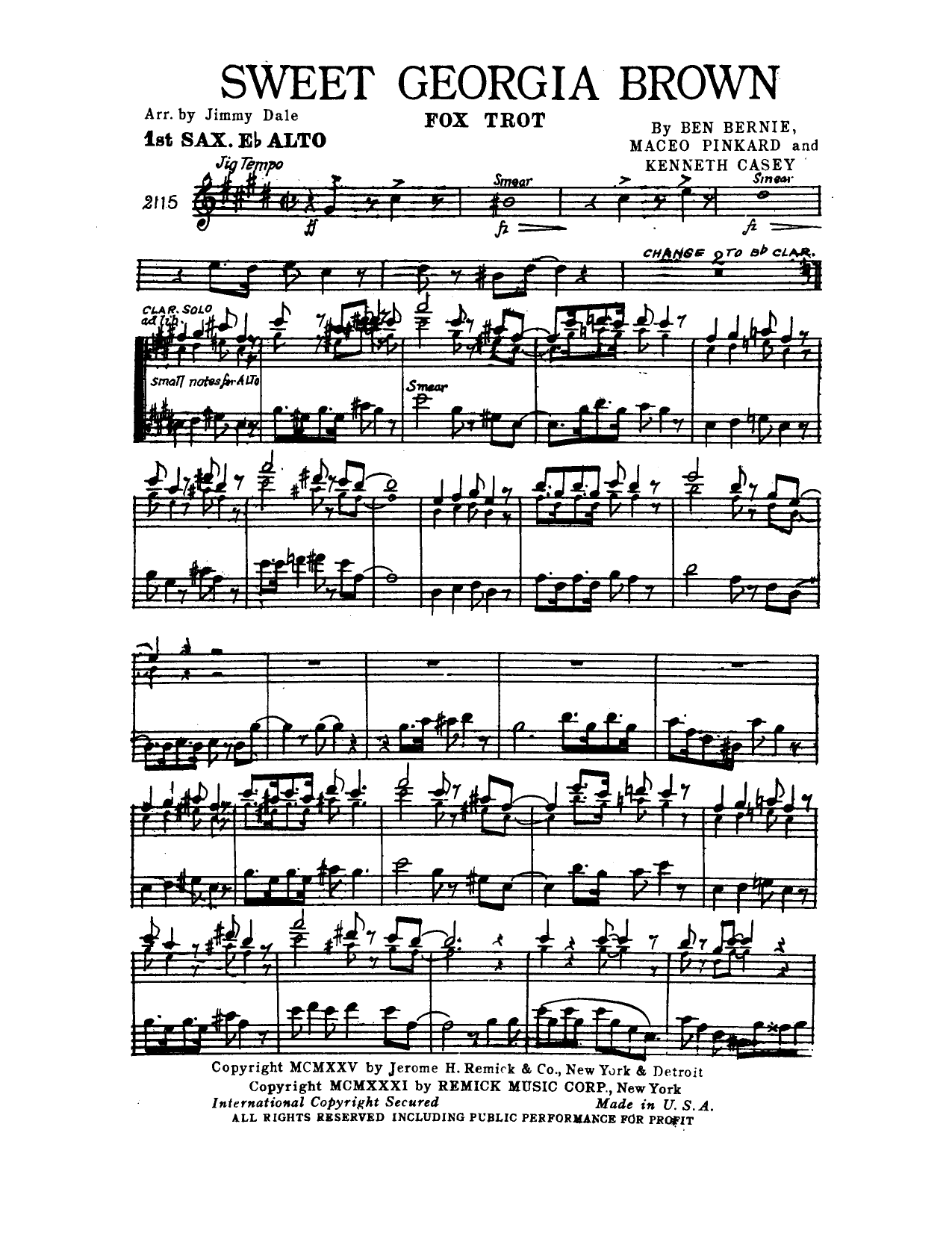
Sweet Georgie Brown (J.Dale)
Composed by Maceo Pinkard
Arranged by J. Dale
- Ensemble: Big Band Dance
- Style: Big Band Dance
- Pages: 28
- Instruments (11): 1st Saxophone Eb Alto, 3rd Saxophone Eb Alto, 2nd Saxophone Bb Tenor, 1st Trumpet in Bb, 2nd Trumpet in Bb, Trombone, Piano, Bass, Drums, Tenor Banjo, 1st Violin
- Difficulty: medium
- Content: Individual Parts
- Format: PDF Download (Instant)
- Price: $24.99
"Sweet Georgie Brown," originally composed by Maceo Pinkard, Ben Bernie, and Kenneth Casey in 1925, stands as an enduring pillar of the jazz repertoire, synonymous with the vibrant energy of the Roaring Twenties and the burgeoning Big Band Dance era. This iconic tune, a favorite of early jazz pioneers like Ben Bernie and His Orchestra, and later popularized by legends such as Count Basie, Ella Fitzgerald, and the Harlem Globetrotters, embodies the infectious optimism and sophisticated swing that defined an epoch. Its memorable, syncopated melody and bright harmonic progression have made it a perennial jam session staple and a test piece for countless ensembles, celebrated for its versatility and inherent danceability. The piece is typically performed in a bright, medium-up swing tempo, exuding a joyful, celebratory mood that invites movement and improvisation. J. Dale's arrangement of "Sweet Georgie Brown" for a compact 7-instrument big band dance ensemble masterfully captures the tune's classic spirit while offering a fresh, accessible interpretation. Dale, known for crafting arrangements that respect historical authenticity while being practical for smaller groups, employs clever voicings that create a full, rich sound despite the reduced instrumentation (Alto Sax, Tenor Sax, Trumpet, Trombone, Piano, Bass, Drums). The arrangement opens with the familiar melody carried by the saxophone section, often in unison or tight octaves, immediately setting the energetic tone. Dale's signature approach includes well-crafted soli sections that allow the horn lines to intertwine dynamically, showcasing the ensemble's precision. There are ample opportunities for featured solos, typically over the tune's standard AABA form, providing a platform for improvisation that is both challenging and rewarding. Performance of this arrangement demands a crisp articulation and a strong sense of swing from all players. The melody is passed between the saxophones and brass, ensuring each section has moments in the spotlight. While technically approachable for intermediate players, the arrangement's true reward lies in achieving a cohesive, driving swing feel and precise ensemble blend. The piano often provides rhythmic and harmonic support, occasionally stepping into a comping role or a brief melodic interjection. The arrangement culminates in a classic shout chorus, building excitement with layered brass and sax lines, leading to a vibrant, definitive close. This particular arrangement is ideally suited for high school and college jazz ensembles seeking to perform a classic standard with authentic big band flair, as well as community bands looking for a spirited, audience-pleasing number that is both challenging and achievable. Its concise instrumentation also makes it perfect for smaller venues or groups with limited personnel. This arrangement thrives on a consistent, driving medium-up swing feel, typically around 180-200 BPM. Emphasize light, articulated eighth notes and a strong quarter-note pulse in the rhythm section. Technical challenges include precise ensemble attacks and releases, particularly in the soli sections where horn lines interlock. Rehearsal should focus on intonation within the tight voicings and achieving a unified articulation across the saxes and brass. Encourage soloists to embrace the tune's traditional swing vocabulary. There are no specific extended techniques (like plungers or falls) explicitly notated, allowing for conductor discretion based on desired stylistic nuances. The rhythm section must provide a solid, unwavering foundation, with the bass walking consistently and the drums maintaining a crisp ride cymbal pattern. Q: What instruments are included in this arrangement? A: This arrangement includes parts for 7 instruments: Alto Saxophone, Tenor Saxophone, Trumpet, Trombone, Piano, Bass, and Drums. Q: What is the difficulty level of "Sweet Georgie Brown (J.Dale)"? A: This arrangement is suitable for intermediate-level ensembles, including high school, college, and community jazz bands, offering a rewarding challenge without being overly complex. Q: What musical style and historical context does this arrangement represent? A: It embodies the Big Band Dance style of the 1920s and 30s, capturing the vibrant, swinging energy of a classic jazz standard. Q: What makes J. Dale's arrangement of "Sweet Georgie Brown" unique? A: J. Dale's approach provides a full, authentic big band sound with a compact 7-instrumentation, featuring clever voicings, engaging soli sections, and ample solo opportunities. Q: What is the typical performance duration and tempo for this piece? A: The typical performance duration is around 3-4 minutes, designed for a bright, medium-up swing tempo, generally between 180-200 beats per minute.
Questions and answers
- What is included in the Sweet Georgie Brown (J.Dale) PDF?
- The verified current file contains individual parts across 28 pages.
- How many instruments or parts are listed for Sweet Georgie Brown (J.Dale)?
- The verified instrumentation list contains 11 entries for this Big Band Dance arrangement.
- Who is credited for Sweet Georgie Brown (J.Dale)?
- Composer: Maceo Pinkard. Arranger: J. Dale.
- What difficulty is listed for Sweet Georgie Brown (J.Dale)?
- The verified difficulty level is medium.
- What style is listed for Sweet Georgie Brown (J.Dale)?
- The catalog lists the style as Big Band Dance.
- Can I preview Sweet Georgie Brown (J.Dale) before buying?
- Yes. The product page provides a preview generated from the current PDF file.
- How is Sweet Georgie Brown (J.Dale) delivered?
- After successful payment, the digital PDF is made available for download. The displayed price is $24.99.
Musicians Also Search For
Sweet Georgie Brown J. Dale PDF • Sweet Georgie Brown J. Dale sheet music • Sweet Georgie Brown arranged by J. Dale • J. Dale big band dance charts • J. Dale jazz arrangements PDF • Sweet Georgie Brown Maceo Pinkard sheet music • Sweet Georgie Brown Maceo Pinkard big band dance arrangements • Maceo Pinkard big band dance charts • Sweet Georgie Brown big band dance arrangements • Sweet Georgie Brown big band dance PDF download • Sweet Georgie Brown jazz sheet music • big band dance sheet music download • Sweet Georgie Brown individual parts download • Sweet Georgie Brown sheet music PDF • Sweet Georgie Brown Big Band Dance charts • Big Band Dance big band dance arrangements • buy Sweet Georgie Brown sheet music • download Sweet Georgie Brown PDF • Sweet Georgie Brown jazz charts • best J. Dale big band dance arrangements • Maceo Pinkard arranged by J. Dale • Sweet Georgie Brown printable sheet music • big band dance repertoire PDF