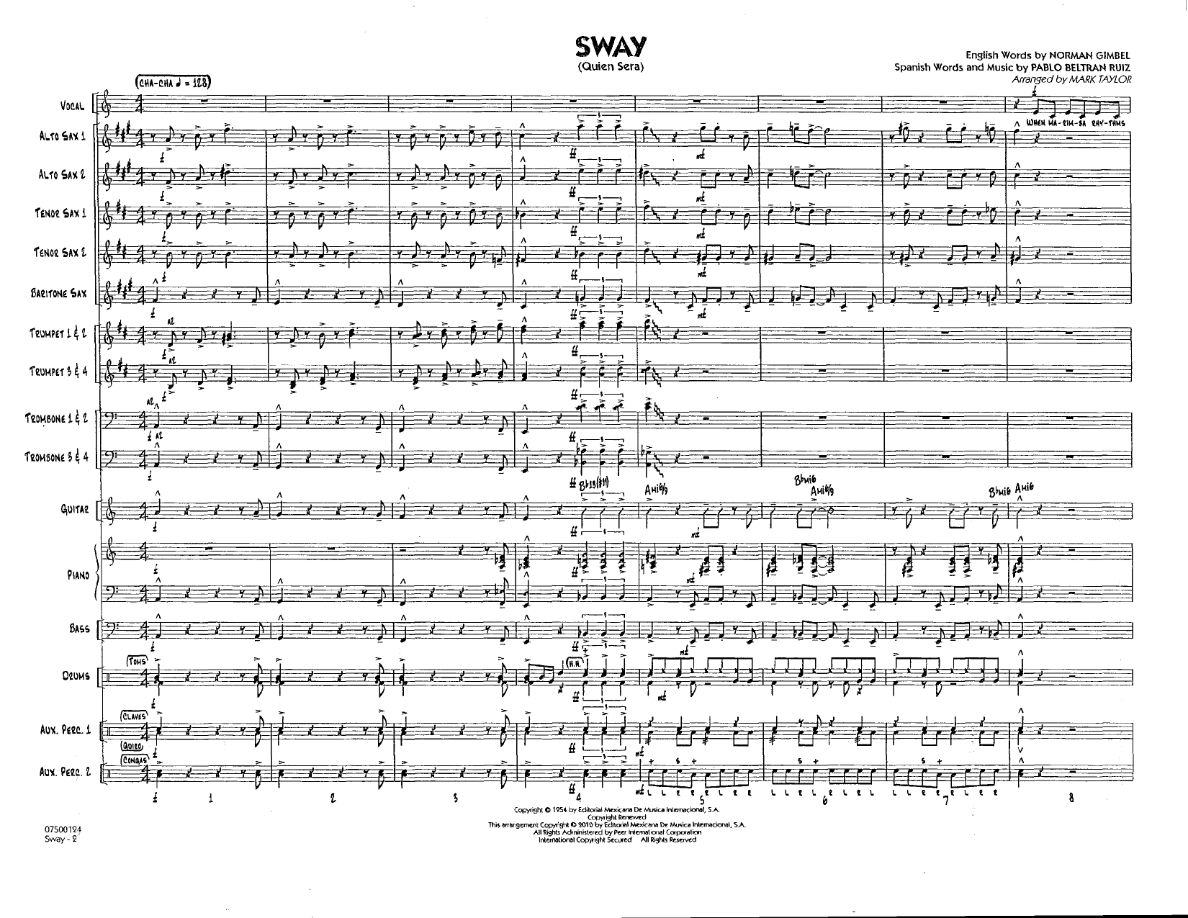
Sway (M.Taylor)
Composed by Pablo Beltrán Ruiz
Arranged by Mark Taylor
- Ensemble: Big Band
- Pages: 57
- Instruments (21): Vocal Solo, Tenor Sax Solo, Alto Sax 1, Alto Sax 2, Tenor Sax 1, Tenor Sax 2, Baritone Sax, Trumpet 1, Trumpet 2, Trumpet 3, Trumpet 4, Trombone 1, Trombone 2, Trombone 3, Trombone 4, Guitar, Piano/Vocal, Bass, Drums, Aux. Percussion 1 (Claves, Guiro), Aux. Percussion 2 (Congas)
- Difficulty: advanced
- Content: Individual Parts
- Format: PDF Download (Instant)
- Price: $24.99
Originally composed in 1953 by Mexican bandleader and composer Pablo Beltrán Ruiz under the title "¿Quién será?", the melody became an international sensation when English lyrics were penned by Norman Gimbel and recorded by Dean Martin in 1954. This quintessential Latin-pop crossover standard bridges the gap between traditional mambo rhythms and American mid-century vocal jazz. The composition's irresistible, sultry ostinato bassline and infectious vocal hook have cemented its status as a timeless staple of the Great American Songbook, interpreted by legends ranging from Ella Fitzgerald to Michael Bublé. Rooted in an authentic, driving Latin-swing groove rather than a strict straight-eighths Afro-Cuban feel, this chart pulses with a sophisticated medium-tempo Latin-jazz pulse (around 120–124 BPM). The harmonic landscape balances lush, modal colorations with crisp, punchy horn stabs that evoke the classic lounges of Las Vegas's Rat Pack era. The arrangement opens with a seductive, rhythm-section-driven vamp before the vocal enters, establishing an atmosphere of effortless cool, suave sophistication, and subtle romantic tension that instantly captivates an audience. Mark Taylor, renowned for his masterful grasp of commercial big band writing and idiomatic scoring, approaches "Sway" with a brilliant balance of transparency and brassy punch. Taylor utilizes rich, contemporary extended voicings in the saxes while keeping the brass writing clean and transparent to leave ample sonic space for the vocalist. The arrangement features a gorgeous, harmonically rich sax soli that reinterprets the core melody midway through, followed by a dynamic, high-energy shout chorus that trades traditional bebop intensity for a sweeping, cinematic Latin-jazz climax. Carried primarily by the featured vocalist, the melody is intelligently reinforced by subtle woodwind counterlines. An open solo section—ideally suited for piano, tenor saxophone, or trumpet—allows a featured improviser to stretch out over accessible, jazz-oriented changes before returning to a dramatic vocal climax. Technically, the chart demands precise rhythmic articulation, particularly in the section unisons and syncopated montuno figures, making it deeply rewarding for ensembles that excel at stylistic crispness and dynamic control. Advanced high school, collegiate, and professional community big bands will find this arrangement an ideal centerpiece for standard concert repertoire, vocal features, or celebratory gala sets. Because the ensemble writing supports the vocalist without overpowering them, groups can focus heavily on micro-dynamics, stylistic unity, and groove pocket without wrestling with excessive technical hurdles. It offers an exceptional vehicle for showcasing a charismatic guest vocalist while giving the instrumentalists plenty of sophisticated ensemble writing to sink their teeth into. The primary technical challenge in executing Mark Taylor's chart lies in maintaining a locked-in, unhurried Latin groove without dragging or rushing the tempo. The rhythm section is the engine: the bass must anchor the dotted-quarter/eighth-note ostinato with absolute consistency, while the drummer avoids overly aggressive rock backbeats in favor of crisp cross-stick rimshots and authentic ride-cymbal patterns. Horn players must approach the syncopated figures with a sharp, articulated tongue, ensuring that all off-beat accents pop cleanly out of the texture without heavy vibrato. Pay close attention to the dynamic markings during the sax soli; the saxes must blend tightly to project the intricate chordal movement over the rhythm section's vamp. Brass players should use controlled, warm tones rather than forced volume during the background figures behind the vocalist, saving their brightness for the climactic shout chorus. Rehearsal should begin with the rhythm section alone to lock in the groove before layering in the horns section by section, ensuring stylistic uniformity across all 17 voices. Q: What instruments and parts are included in this big band arrangement? A: The 17-instrument instrumentation features a vocal part, 5 saxophones (Alto 1/2, Tenor 1/2, Baritone), 4 trumpets, 4 trombones, and a full rhythm section comprising piano, guitar, bass, and drums. Q: What is the difficulty level of Mark Taylor's "Sway"? A: This arrangement is rated as medium (Grade 3.5 to 4), making it comfortably accessible for advanced high school ensembles while offering enough harmonic sophistication and stylistic nuance for collegiate and professional bands. Q: What style and historical era does this arrangement inhabit? A: It inhabits the mid-century vocal jazz and Latin-swing tradition, capturing the suave, sophisticated atmosphere popularized by 1950s icons like Dean Martin while utilizing modern big band arranging techniques. Q: What makes this specific arrangement by Mark Taylor unique? A: Taylor expertly balances lush, contemporary chord voicings with traditional mambo-infused backgrounds, featuring a standout saxophone soli and a cinematic shout chorus tailored specifically to support a lead vocalist. Q: What is the performance duration and recommended tempo for this chart? A: The arrangement runs approximately 3 to 4 minutes and is best performed at a medium-tempo Latin-swing groove around 120 to 124 beats per minute.
Questions and answers
- What is included in the Sway (M.Taylor) PDF?
- The verified current file contains a conductor score and individual parts across 57 pages.
- How many instruments or parts are listed for Sway (M.Taylor)?
- The verified instrumentation list contains 21 entries for this Big Band arrangement.
- Who is credited for Sway (M.Taylor)?
- Composer: Pablo Beltrán Ruiz. Arranger: Mark Taylor.
- What difficulty is listed for Sway (M.Taylor)?
- The verified difficulty level is advanced.
- Can I preview Sway (M.Taylor) before buying?
- Yes. The product page provides a preview generated from the current PDF file.
- How is Sway (M.Taylor) delivered?
- After successful payment, the digital PDF is made available for download. The displayed price is $24.99.
Musicians Also Search For
Sway Mark Taylor PDF • Sway Mark Taylor sheet music • Sway arranged by Mark Taylor • Mark Taylor big band charts • Mark Taylor jazz arrangements PDF • Sway Pablo Beltrán Ruiz sheet music • Sway Pablo Beltrán Ruiz big band arrangements • Pablo Beltrán Ruiz big band charts • Sway big band arrangements • Sway big band PDF download • Sway jazz sheet music • big band sheet music download • Sway conductor score PDF • Sway individual parts download • Sway sheet music PDF • buy Sway sheet music • download Sway PDF • Sway jazz charts • best Mark Taylor big band arrangements • Pablo Beltrán Ruiz arranged by Mark Taylor • Sway printable sheet music • big band repertoire PDF