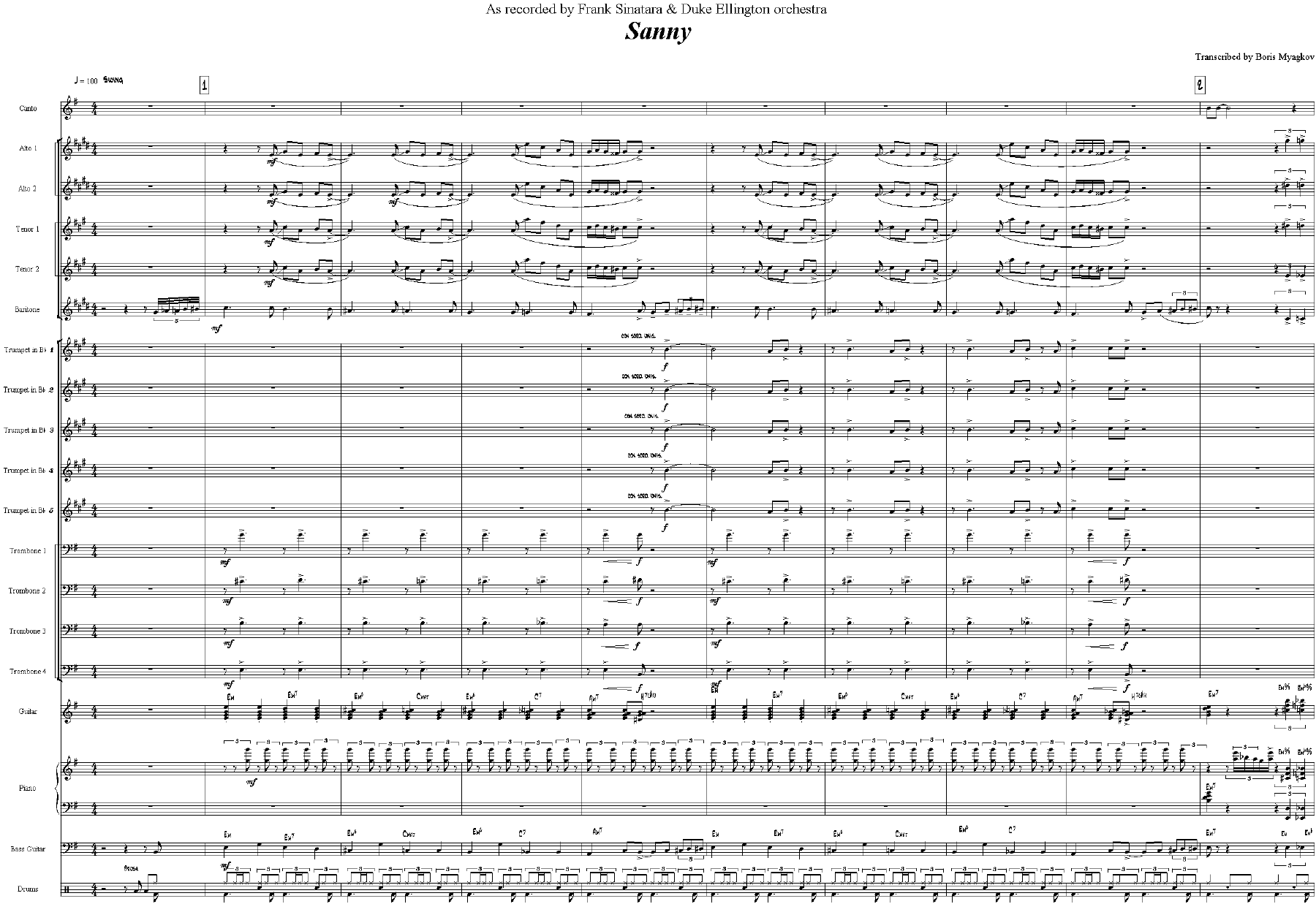
Sunny (B.May)
Composed by Bobby Hebb
Arranged by Billy May
- Ensemble: Big Band
- Style: Jazz Standard
- Pages: 28
- Instruments (19): Solo vocal, Alto Sax 1, Alto Sax 2, Tenor Sax 1, Tenor Sax 2, Baritone Sax, Trumpet 1, Trumpet 2, Trumpet 3, Trumpet 4, Trumpet 5, Trombone 1, Trombone 2, Trombone 3, Trombone 4, Guitar, Piano, Bass, Drums
- Difficulty: medium
- Content: Individual Parts
- Format: PDF Download (Instant)
- Price: $24.99
Bobby Hebb's "Sunny," penned in 1963 and released in 1966, stands as an enduring testament to the soul-jazz era, transcending its R&B origins to become one of the most frequently covered songs in popular music history. Its optimistic lyrical theme and infectious, yet sophisticated, harmonic progression quickly cemented its status as a jazz standard, embraced by a diverse array of artists from Frank Sinatra and Ella Fitzgerald to Marvin Gaye and Stevie Wonder. The original recording, characterized by its distinctive blend of pop, soul, and jazz sensibilities, captured the zeitgeist of a hopeful decade, establishing "Sunny" as a timeless anthem of joy and resilience. Its pervasive melodic and harmonic structure, often featuring a minor key verse transitioning to a major key chorus, offers a compelling narrative arc that has captivated audiences and musicians for generations, making it a staple in both vocal and instrumental jazz repertoires. Billy May's arrangement of "Sunny" for big band is a masterclass in sophisticated orchestral jazz, transforming Hebb's soulful original into a vibrant, swinging showpiece. May, renowned for his distinctive "slurpy" brass voicings and meticulous attention to ensemble color, approaches this jazz standard with his characteristic blend of precision and panache. The arrangement is set at a bright, medium swing tempo, typically around 144-152 BPM, maintaining the original's optimistic mood while infusing it with a dynamic big band energy. The primary key is C minor for the verse sections, transitioning seamlessly to C major for the chorus, a harmonic journey that May highlights with rich, often close-voiced brass and saxophone soli passages. The overall mood is exhilarating and polished, evoking the golden age of big band jazz with a contemporary flair that remains eternally fresh. May's distinctive arranging style is immediately evident in the intricate interplay between sections. The melody is initially carried by the solo vocalist, allowing for expressive interpretation before the full ensemble takes over. Signature May techniques abound, including tightly voiced saxophone soli lines that weave through the brass figures, and powerful, often plunger-muted, brass sections that punctuate the arrangement with thrilling precision. A particularly notable feature is the development of the shout chorus, where May builds tension and excitement through layered ensemble figures, culminating in a powerful, full-band statement that is both harmonically inventive and rhythmically driving. Featured solos are strategically placed, offering opportunities for improvisation over the familiar changes, typically for tenor saxophone or trumpet, providing a contrast to the tightly arranged ensemble passages. Performing this arrangement is a rewarding experience for a big band that thrives on precision and dynamic contrast. While technically demanding in its ensemble articulation and dynamic control, the challenges are well within the grasp of advanced high school, college, community, and professional jazz ensembles. The intricate voicings require careful balance and blend, particularly in the brass and saxophone sections, and the rhythmic precision needed for May's signature figures demands a cohesive rhythm section. The payoff, however, is immense: a polished, exhilarating performance that showcases the band's musicality and technical prowess, delivering a truly iconic jazz standard with the unmistakable stamp of Billy May's genius. Conductors should emphasize a consistent, driving medium swing feel throughout, ensuring the rhythm section lays down a solid, yet flexible, foundation. Aim for a tempo between 144-152 BPM. Key technical challenges include the precise articulation required for Billy May's signature brass figures, often involving quick, clean tonguing and controlled plunger mute work. Saxophone soli sections demand excellent intonation and blend, particularly in the close voicings. Rehearsal time should be dedicated to balancing the dynamic contrasts between the vocal sections and the full ensemble, ensuring the vocalist is always supported without being overpowered. Pay close attention to the transitions between the C minor verse and C major chorus, ensuring harmonic clarity. Encourage brass players to execute falls and doits with stylistic flair, but within the ensemble's overall dynamic. Q: What instruments and parts are included in this arrangement? A: This arrangement is scored for 19 instruments: Solo Vocal, Alto Saxophone 1, Alto Saxophone 2, Tenor Saxophone 1, Tenor Saxophone 2, Baritone Saxophone, Trumpet 1, Trumpet 2, Trumpet 3, Trumpet 4, Trombone 1, Trombone 2, Trombone 3, Bass Trombone, Guitar, Piano, Bass, Drums, and includes a conductor score. Q: What is the difficulty level of this "Sunny" arrangement by Billy May? A: This arrangement is considered advanced, suitable for experienced high school, college, community, and professional big bands. It requires strong ensemble precision, dynamic control, and technical proficiency from all sections. Q: What is the musical style and historical context of this arrangement? A: This is a big band jazz arrangement of the classic soul-jazz standard "Sunny," originally composed by Bobby Hebb in 1963. Billy May's treatment infuses the piece with a sophisticated, swinging big band sound characteristic of the mid-20th century jazz orchestra. Q: What makes Billy May's arrangement of "Sunny" unique? A: Billy May's signature style is evident through his "slurpy" brass voicings, intricate saxophone soli sections, and dynamic shout choruses. The arrangement features a compelling harmonic journey from C minor to C major, showcasing May's masterful use of orchestral color and rhythmic drive. Q: What is the typical performance duration and tempo for this arrangement? A: The typical performance duration for this arrangement is approximately 3-4 minutes, depending on the length of improvised solos. It is designed to be performed at a bright, medium swing tempo, generally ranging from 144 to 152 beats per minute.
Questions and answers
- What is included in the Sunny (B.May) PDF?
- The verified current file contains a conductor score and individual parts across 28 pages.
- How many instruments or parts are listed for Sunny (B.May)?
- The verified instrumentation list contains 19 entries for this Big Band arrangement.
- Who is credited for Sunny (B.May)?
- Composer: Bobby Hebb. Arranger: Billy May.
- What difficulty is listed for Sunny (B.May)?
- The verified difficulty level is medium.
- What style is listed for Sunny (B.May)?
- The catalog lists the style as Jazz Standard.
- Can I preview Sunny (B.May) before buying?
- Yes. The product page provides a preview generated from the current PDF file.
- How is Sunny (B.May) delivered?
- After successful payment, the digital PDF is made available for download. The displayed price is $24.99.
Musicians Also Search For
Sunny Billy May PDF • Sunny Billy May sheet music • Sunny arranged by Billy May • Billy May big band charts • Billy May jazz arrangements PDF • Sunny Bobby Hebb sheet music • Sunny Bobby Hebb big band arrangements • Bobby Hebb big band charts • Sunny big band arrangements • Sunny big band PDF download • Sunny jazz sheet music • big band sheet music download • Sunny conductor score PDF • Sunny individual parts download • Sunny sheet music PDF • Sunny Jazz Standard charts • Jazz Standard big band arrangements • buy Sunny sheet music • download Sunny PDF • Sunny jazz charts • best Billy May big band arrangements • Bobby Hebb arranged by Billy May • Sunny printable sheet music • big band repertoire PDF