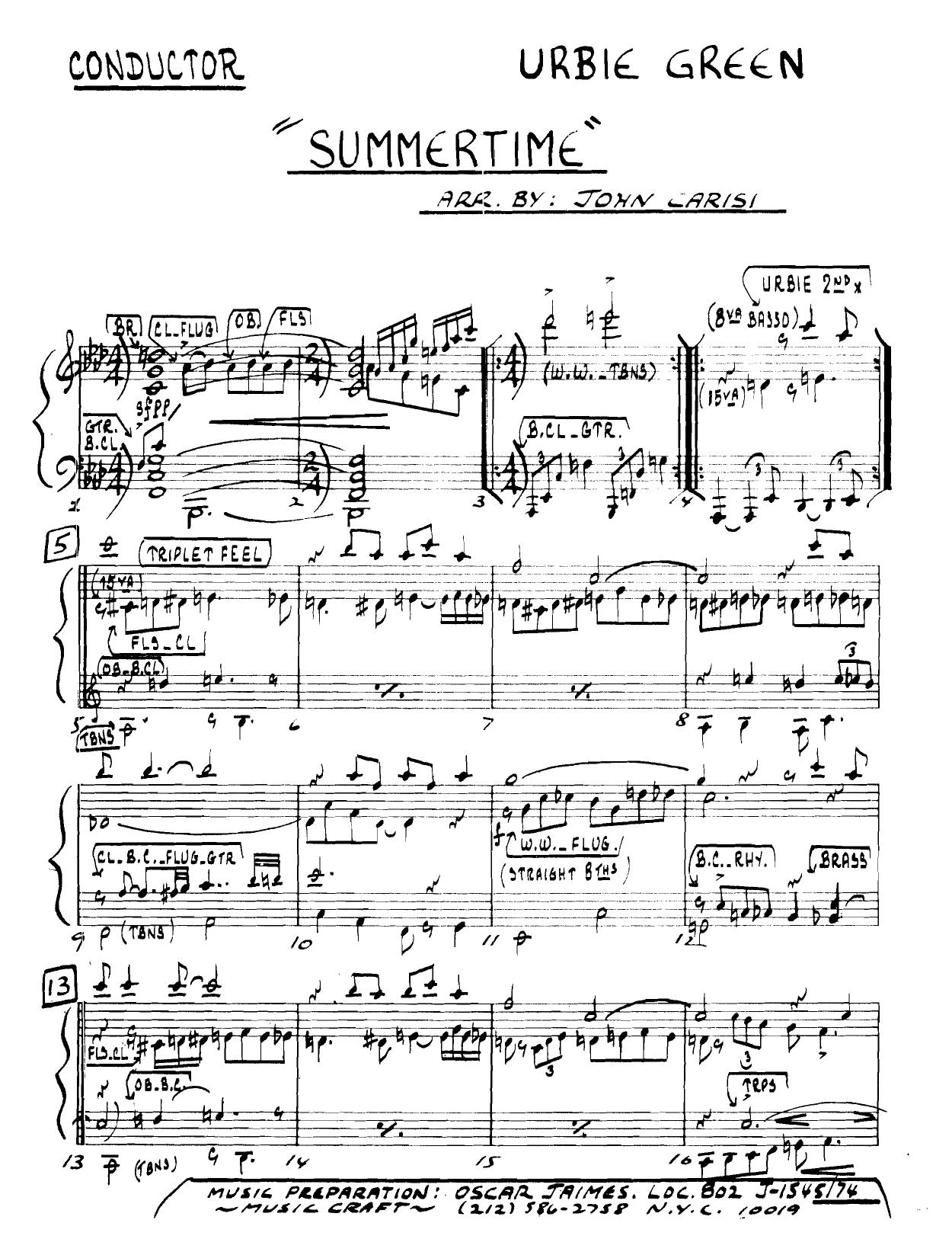
Summertime (J.Carisi)
Composed by George Gershwin
Arranged by J.Carisi
- Ensemble: Big Band
- Style: Jazz Standard
- Pages: 51
- Instruments (19): Conductor, Urbie (Solo Trombone), Reed I (Flute/Alto Sax), Reed II (Flute/Alto Sax), Reed III (Clarinet/Tenor Sax), Reed IV (Oboe/Tenor Sax), Reed V (Bass Clarinet/Baritone Sax), Trumpet I, Trumpet II, Trumpet III, Flugelhorn 4 (Trumpet IV), Trombone I, Trombone II, Trombone III, Trombone IV (Bass), Piano, Guitar, Bass, Drums
- Difficulty: advanced
- Content: Individual Parts
- Format: PDF Download (Instant)
- Price: $24.99
George Gershwin’s immortal 1935 aria "Summertime," originally penned for the folk opera *Porgy and Bess*, stands as one of the most recorded and reinterpreted compositions in the history of American music. While countless vocalists and small jazz combos have immortalized its haunting minor-key motifs—most notably through landmark recordings by Miles Davis and Gil Evans, or Janis Joplin—adapting its languid, Mississippi Delta atmosphere for a full 21-instrument big band presents a fascinating structural challenge. Gershwin’s hypnotic, cradling melody inherently demands a delicate balance between lush, impressionistic orchestration and the driving momentum intrinsic to modern jazz arranging. J.Carisi’s sophisticated big band interpretation reimagines the classic tune through a rich, modern-harmonic lens, shifting between a sultry, atmospheric ballad feel and simmering, modal-tinged swing grooves. The mood evokes a dense, humid southern evening, opening with a shimmering woodwind texture before descending into dark, brooding brass voicings. Carisi utilizes extended chord extensions—sharp elevenths, altered thirteenths, and suspended quartal harmonies—to inject a contemporary harmonic tension that honors the bittersweet melancholy of the original text while pushing the ensemble into fresh sonic territory. The arrangement opens with a delicate, rubato introduction carried by the woodwinds and muted brass, gradually establishing a pulsing, understated medium-swing groove anchored by the rhythm section. The lead alto saxophone and flutes share the primary melodic duties in the opening statements, weaving intricate counterlines above a warm, sustained brass bed. A standout feature of Carisi's chart is a sweeping, harmonized saxophone soli that reinterprets the verse with intricate chromatic passing tones, leading seamlessly into an open solo section designated for trumpet or tenor saxophone over a modal vamp. The climax arrives via a meticulously constructed shout chorus that builds from a whisper to a commanding, full-ensemble roar, driven by syncopated cross-rhythms and soaring lead trumpet lines, before dissolving back into the tranquil, haunting stillness of the original theme. Advanced high school ensembles with strong section players, as well as collegiate and professional jazz orchestras, will find this chart an exceptional vehicle for developing dynamic control, blend, and mature phrasing. While the technical demands are moderately high—primarily due to subtle intonation requirements within the complex chord voicings and the need for absolute stylistic unity during the rubato sections—the payoff is an intensely rewarding, deeply atmospheric centerpiece for any sophisticated jazz concert program. Executing Carisi’s arrangement successfully requires rigorous attention to dynamic shading and section balance, particularly during the transition from the rubato introduction into the strict-tempo swing feel. Conductor focus should center on the blend within the sax section during the soli; intonation on altered dominant chords must be tuned collectively rather than vertically by individual players. Brass players should utilize cup mutes or harmon mutes where indicated in the score to achieve the desired twilight timbre, reserving open bell work for the powerful shout chorus peaks. Ensure the rhythm section maintains a laid-back, behind-the-beat feel to preserve the sultry, relaxed mood without dragging the tempo. Directors should spend early rehearsals isolating the subtle rhythmic unisons between the piano comping and the bass line to lock in the underlying groove before layering the horn harmonies on top. Q: What instruments and parts are included in this big band package? A: The 21-instrument instrumentation includes a comprehensive Conductor Score, a full reed section featuring Flute, Alto Saxophone 1, Alto Saxophone 2, Clarinet, and standard big band doubling parts, alongside complete brass and rhythm section parts across 51 detailed pages. Q: What is the designated difficulty level of this J.Carisi arrangement? A: This chart is pitched at an advanced level, making it best suited for accomplished high school jazz bands, university ensembles, and professional big bands capable of navigating complex extended harmonies and delicate rubato transitions. Q: How does this arrangement fit into the historical jazz standard tradition? A: It builds directly upon the rich legacy of Gershwin’s 1935 *Porgy and Bess* masterpiece, channeling the sophisticated, impressionistic orchestration style pioneered by arrangers like Gil Evans while incorporating modern harmonic language. Q: What distinguishes J.Carisi's treatment of "Summertime" from other big band versions? A: Carisi’s chart stands out through its innovative use of modal vamps, a deeply textured harmonized saxophone soli, and a dynamic arc that transforms a traditionally slow vocal melody into a sophisticated, tension-and-release orchestral journey. Q: What is the performance duration and recommended tempo feel for this piece? A: The arrangement runs approximately 5 to 6 minutes in length and features a flexible introductory rubato section that settles into a relaxed, sultry medium-swing groove.
Questions and answers
- What is included in the Summertime (J.Carisi) PDF?
- The verified current file contains a conductor score and individual parts across 51 pages.
- How many instruments or parts are listed for Summertime (J.Carisi)?
- The verified instrumentation list contains 19 entries for this Big Band arrangement.
- Who is credited for Summertime (J.Carisi)?
- Composer: George Gershwin. Arranger: J.Carisi.
- What difficulty is listed for Summertime (J.Carisi)?
- The verified difficulty level is advanced.
- What style is listed for Summertime (J.Carisi)?
- The catalog lists the style as Jazz Standard.
- Can I preview Summertime (J.Carisi) before buying?
- Yes. The product page provides a preview generated from the current PDF file.
- How is Summertime (J.Carisi) delivered?
- After successful payment, the digital PDF is made available for download. The displayed price is $24.99.
Musicians Also Search For
Summertime J.Carisi PDF • Summertime J.Carisi sheet music • Summertime arranged by J.Carisi • J.Carisi big band charts • J.Carisi jazz arrangements PDF • Summertime George Gershwin sheet music • Summertime George Gershwin big band arrangements • George Gershwin big band charts • Summertime big band arrangements • Summertime big band PDF download • Summertime jazz sheet music • big band sheet music download • Summertime conductor score PDF • Summertime individual parts download • Summertime sheet music PDF • Summertime Jazz Standard charts • Jazz Standard big band arrangements • buy Summertime sheet music • download Summertime PDF • Summertime jazz charts • best J.Carisi big band arrangements • George Gershwin arranged by J.Carisi • Summertime printable sheet music • big band repertoire PDF