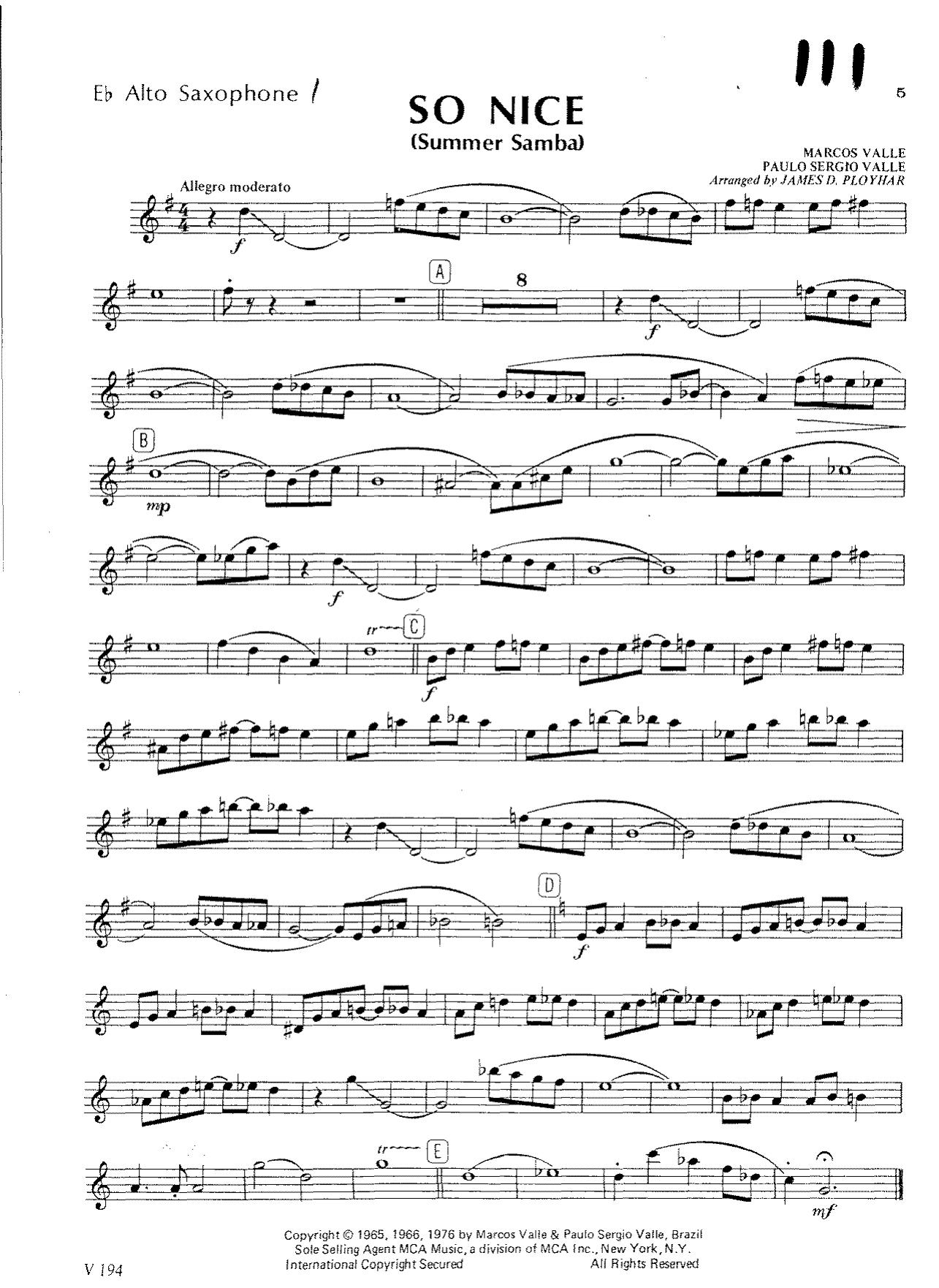
Summer Samba (So Nice)
Composed by Marcos Valle
Arranged by J.Ployhar
- Ensemble: Big Band
- Style: Jazz Standard
- Pages: 24
- Instruments (18): Eb Alto Saxophone, 1st Bb Clarinet, 2nd Bb Clarinet, Bb Tenor Saxophone, Eb Baritone Saxophone, 1st Flute, 1st Bb Trumpet, 2nd Bb Trumpet, 3rd Trumpet, 1st Trombone, 2nd Trombone, 3rd Trombone, Guitar (Rhythm), Piano, Bass Guitar, String Bass, Percussion, 1st Horn in F
- Difficulty: medium
- Content: Individual Parts
- Format: PDF Download (Instant)
- Price: $24.99
Marcos Valle’s timeless bossa nova masterpiece, "Summer Samba (So Nice)" ("Samba de Verão"), represents the golden era of 1960s Brazilian jazz and pop crossover. Originally composed in 1964 with Portuguese lyrics by his brother Paulo Sérgio Valle, and later popularized globally with English lyrics by Norman Gimbel, the tune became an instant jazz and lounge standard. Recorded by legendary artists such as Walter Wanderley, Astrud Gilberto, and Johnny Mathis, the composition epitomizes the relaxed, sun-drenched sophistication of the bossa nova movement. Its seamless blend of gentle syncopation, sophisticated major-seventh harmonies, and an irresistibly infectious melody has secured its place in the permanent canon of jazz standards, bridging traditional Brazilian rhythms with American cool jazz sensibilities. The musical character of this chart centers on an authentic, breezy Latin-bossa groove set in a moderate, swaying tempo. The mood is effortlessly optimistic and warm, evoking the carefree atmosphere of coastal breezes and mid-century modern elegance. Rather than relying on aggressive, high-energy brass blasts, the arrangement maintains a translucent acoustic texture that allows the inherent lyrical grace of Valle’s melody to breathe. The harmonic landscape is rich with extended chord structures—major ninths, thirteenths, and chromatic passing chords—that give the chart a sophisticated, lush flavor while remaining remarkably accessible to listeners and players alike. Arranger J.Ployhar captures the essence of the bossa nova style by utilizing transparent, clean voicings across the ensemble. The woodwinds play a prominent role in establishing the characteristic texture, featuring a combined palette of alto saxophone, dual Bb clarinets, tenor saxophone, and baritone saxophone that mimics the light, reedy timbre often found in classic West Coast and Brazilian studio orchestrations. Ployhar distributes the melodic weight thoughtfully, allowing the primary themes to flow smoothly between the saxophone and brass sections without heavy orchestration getting in the way of the rhythmic subtlety. Rhythmic precision in the percussion and rhythm section is paramount, anchoring the syncopated bass figures and guitar-like chordal ticks that define the genre's underlying pulse. Intermediate-level ensembles, particularly advanced high school big bands and active community jazz orchestras, will find this arrangement remarkably rewarding. The technical challenges lie less in extreme velocity or altissimo range demands, and much more in stylistic control, dynamic balance, and maintaining a relaxed, uniform swing-latin eighth-note feel. Solo opportunities are integrated naturally within the form, offering featured instrumentalists a comfortable canvas to improvise over accessible bossa changes. Conductors will appreciate how effectively the 24-page score balances full-ensemble color with sparse, punchy accompaniment figures, ensuring that the rhythm section and horns lock into a hypnotic, danceable pocket from the very first measure. Achieving an authentic performance of this arrangement requires strict adherence to a relaxed, forward-moving bossa nova groove. Avoid rushing the tempo; the underlying pulse should feel completely natural and unforced. The rhythm section is the engine of this chart: the bass player must maintain a steady, hypnotic two-beat or walking bossa pattern without heavy downbeat accents, while the drummer utilizes a crisp cross-stick rimshot pattern on the snare and a steady ride cymbal pulse that defines the Latin feel. Horn players should pay close attention to articulation, keeping eighth notes relatively even rather than heavily swung, reserving any stylistic stretching for designated jazz solo sections. Dynamic restraint is crucial—ensure the accompanying horns never overpower the lead melodic voices, particularly when clarinets and saxophones share thematic material. Rehearsals should initially focus on locking the rhythm section's groove independently before layering the horn lines, ensuring that every syncopated stab lands precisely with the percussion. Q: What instruments and parts are included in this big band arrangement? A: The 18-instrument instrumentation features Alto Saxophone, 1st Bb Clarinet, 2nd Bb Clarinet, Bb Tenor Saxophone, Eb Baritone Saxophone, along with standard big band brass and rhythm section parts spanning a 24-page score and parts format. Q: What is the difficulty level of this J.Ployhar arrangement? A: This arrangement is graded as intermediate, making it an ideal choice for advanced high school jazz bands, college ensembles, and community groups looking to incorporate authentic bossa nova literature into their repertoire. Q: What is the style and historical context of "Summer Samba (So Nice)"? A: Composed by Marcos Valle in 1964, the piece is a foundational bossa nova standard that defined the international Brazilian jazz craze of the 1960s, popularized by recordings from artists like Walter Wanderley and Astrud Gilberto. Q: What makes this specific arrangement by J.Ployhar unique? A: Ployhar incorporates a distinctive woodwind-heavy texture utilizing dual Bb clarinets alongside standard saxophones, creating a lighter, more transparent 1960s studio-orchestra sound distinct from heavier, brass-heavy contemporary big band charts. Q: What is the recommended performance duration and tempo feel? A: The arrangement is designed for a moderate, relaxed bossa nova tempo (around 120-132 BPM), resulting in a performance duration of approximately 3 to 4 minutes depending on the length of improvised solos.
Questions and answers
- What is included in the Summer Samba (So Nice) PDF?
- The verified current file contains individual parts across 24 pages.
- How many instruments or parts are listed for Summer Samba (So Nice)?
- The verified instrumentation list contains 18 entries for this Big Band arrangement.
- Who is credited for Summer Samba (So Nice)?
- Composer: Marcos Valle. Arranger: J.Ployhar.
- What difficulty is listed for Summer Samba (So Nice)?
- The verified difficulty level is medium.
- What style is listed for Summer Samba (So Nice)?
- The catalog lists the style as Jazz Standard.
- Can I preview Summer Samba (So Nice) before buying?
- Yes. The product page provides a preview generated from the current PDF file.
- How is Summer Samba (So Nice) delivered?
- After successful payment, the digital PDF is made available for download. The displayed price is $24.99.
Musicians Also Search For
Summer Samba J.Ployhar PDF • Summer Samba J.Ployhar sheet music • Summer Samba arranged by J.Ployhar • J.Ployhar big band charts • J.Ployhar jazz arrangements PDF • Summer Samba Marcos Valle sheet music • Summer Samba Marcos Valle big band arrangements • Marcos Valle big band charts • Summer Samba big band arrangements • Summer Samba big band PDF download • Summer Samba jazz sheet music • big band sheet music download • Summer Samba individual parts download • Summer Samba sheet music PDF • Summer Samba Jazz Standard charts • Jazz Standard big band arrangements • buy Summer Samba sheet music • download Summer Samba PDF • Summer Samba jazz charts • best J.Ployhar big band arrangements • Marcos Valle arranged by J.Ployhar • Summer Samba printable sheet music • big band repertoire PDF