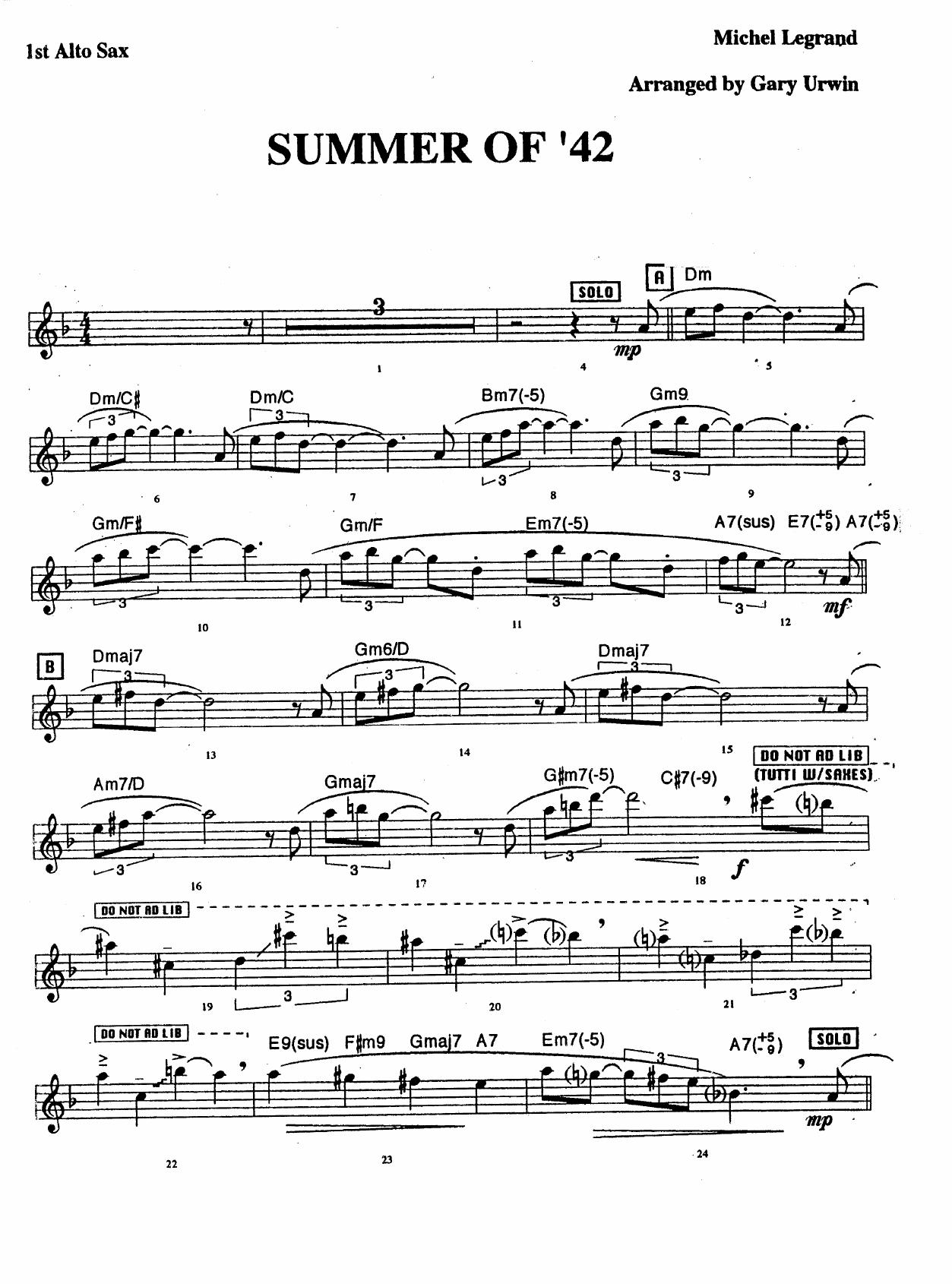
Summer Of '42 (G.Urwin)
Composed by Michel Legrand
Arranged by Gary Urwin
- Ensemble: Big Band
- Pages: 37
- Instruments (18): 1st Alto Sax, 2nd Alto Sax, 1st Tenor Sax, 2nd Tenor Sax, Bari Sax, Trumpet 1, Trumpet 2, Trumpet 3, Trumpet 4, Trumpet 5 (Optional), 1st Trombone, 2nd Trombone, 3rd Trombone, 4th Trombone, Guitar, Piano, Bass, Drums
- Difficulty: medium
- Content: Individual Parts
- Format: PDF Download (Instant)
- Price: $24.99
Michel Legrand’s haunting, Academy Award-winning theme from the 1971 nostalgic coming-of-age film *Summer of '42* has long transcended its cinematic origins to become a cherished touchstone in modern jazz repertoire. Originally conceived as a delicate, melancholic film score capturing the bittersweet innocence of wartime adolescence on the New England coast, the composition's inherent harmonic richness and lyrical, sweeping melody immediately attracted the attention of jazz artists. It bridges the gap between cinematic impressionism and sophisticated post-bop harmony, offering a malleable framework that invites sophisticated reinterpretation while retaining its deeply evocative, nostalgic core. Gary Urwin’s masterful big band treatment elevates Legrand’s timeless melody into a lush, dynamic jazz ballad that balances intimate lyrical transparency with towering, cinematic ensemble climaxes. Unfolding at a relaxed, contemplative tempo, the arrangement establishes an atmospheric mood characterized by warm, rubato-leaning intros that gently settle into an undulating, expressive underlying pulse. The emotional arc moves fluidly from poignant introspection to soaring, widescreen passion, evoking a profound sense of wistful longing and emotional depth through rich, extended chord voicings and meticulous dynamic contrast. Urwin approaches the material with a profound respect for Legrand’s original melodic contours while infusing the score with signature West Coast modern jazz sophistication. The chart relies heavily on dense, impressionistic saxophone soli sections and intricate brass counterpoint that evoke the breezy, sophisticated textures associated with top-tier studio arrangers. Rather than relying on a conventional, predictable swing groove, Urwin utilizes a rubato-to-tempo framework, building tension through subtle harmonic shifts, gorgeous flugelhorn and tenor saxophone colorations, and a breathtakingly orchestrated transitional buildup that showcases his trademark attention to tonal color. The melody is carried primarily by the alto saxophone and lead trumpet, with extended solo opportunities thoughtfully integrated to allow a sensitive soloist to interpret the changes with expressive freedom. Technical challenges center less on breakneck velocity and much more on blend, intonation, balance, and sustained breath support during extended, lushly voiced sustained passages. The saxophones double on multiple woodwinds where appropriate, and the brass require immaculate control in the upper-middle registers to execute the translucent chord clusters without forcing the tone. Advanced high school groups with strong section players, as well as collegiate, community, and professional big bands, will find this arrangement an invaluable program centerpiece. It provides an ideal vehicle for showcasing a band's maturity, tonal beauty, and expressive capabilities, making it a powerful contrast piece in any concert program that demands emotional resonance alongside technical precision. Executing Gary Urwin’s arrangement of *Summer of '42* successfully requires an absolute commitment to a warm, blended ensemble sound and meticulous dynamic control. Conductors should emphasize a relaxed, flowing time-feel, avoiding any rigid or mechanical rhythmic interpretation; the rubato sections demand careful listening and flexible breathing between the rhythm section and horns. The primary technical challenge lies in maintaining pristine intonation across dense, impressionistic chord voicings, particularly in the muted brass and close-harmony saxophone passages. Rhythm section players must approach their parts with extreme subtlety; the pianist should voice chords with a light, impressionistic touch reminiscent of Bill Evans or Claude Debussy, avoiding heavy comping that could muddy the rich lower-register horn voicings. The bassline should be warm and sustained, anchoring the harmony without overtaking the texture. Ensure that the lead trumpet and lead alto saxophonist balance seamlessly during the primary thematic statements, and coach soloists to treat the changes with a lyrical, melodic-development approach rather than playing technical patterns. Rehearsals should initially focus on section intonation and balance at piano and pianissimo dynamics before opening up the volume for the major emotional peaks. Q: What instruments and parts are included in this arrangement? A: This chart is scored for a standard 18-piece big band instrumentation, featuring Alto Saxophone 1 & 2, Tenor Saxophone 1 & 2, Baritone Saxophone, 4 Trumpets (with flugelhorn doubles recommended), 4 Trombones, Guitar, Piano, Acoustic Bass, and Drum Set across 37 total pages of music. Q: What is the difficulty level of this arrangement? A: This arrangement is graded as advanced, tailored for collegiate, professional, and advanced high school big bands that possess mature section blend, strong intonation control, and refined expressive capabilities. Q: What is the musical style and historical context of this piece? A: It is a sophisticated jazz ballad style arrangement based on Michel Legrand’s iconic 1971 film theme, representing the lush, cinematic approach to modern arranging popularized by West Coast jazz masters. Q: What makes Gary Urwin's arrangement unique compared to other versions? A: Urwin’s chart stands out for its impressionistic harmonic reharmonizations, dense and gorgeous saxophone soli writing, and its seamless transition from intimate rubato ballad textures to sweeping, widescreen orchestral jazz climaxes. Q: What is the performance duration and tempo guideline for this piece? A: While performance duration typically ranges between 5 to 6 minutes depending on the length of improvised solos, the piece is anchored by a slow, relaxed, and expressive ballad tempo that prioritizes lyrical phrasing over strict metronomic rigidity.
Questions and answers
- What is included in the Summer Of '42 (G.Urwin) PDF?
- The verified current file contains individual parts across 37 pages.
- How many instruments or parts are listed for Summer Of '42 (G.Urwin)?
- The verified instrumentation list contains 18 entries for this Big Band arrangement.
- Who is credited for Summer Of '42 (G.Urwin)?
- Composer: Michel Legrand. Arranger: Gary Urwin.
- What difficulty is listed for Summer Of '42 (G.Urwin)?
- The verified difficulty level is medium.
- Can I preview Summer Of '42 (G.Urwin) before buying?
- Yes. The product page provides a preview generated from the current PDF file.
- How is Summer Of '42 (G.Urwin) delivered?
- After successful payment, the digital PDF is made available for download. The displayed price is $24.99.
Musicians Also Search For
Summer Of '42 Gary Urwin PDF • Summer Of '42 Gary Urwin sheet music • Summer Of '42 arranged by Gary Urwin • Gary Urwin big band charts • Gary Urwin jazz arrangements PDF • Summer Of '42 Michel Legrand sheet music • Summer Of '42 Michel Legrand big band arrangements • Michel Legrand big band charts • Summer Of '42 big band arrangements • Summer Of '42 big band PDF download • Summer Of '42 jazz sheet music • big band sheet music download • Summer Of '42 individual parts download • Summer Of '42 sheet music PDF • buy Summer Of '42 sheet music • download Summer Of '42 PDF • Summer Of '42 jazz charts • best Gary Urwin big band arrangements • Michel Legrand arranged by Gary Urwin • Summer Of '42 printable sheet music • big band repertoire PDF