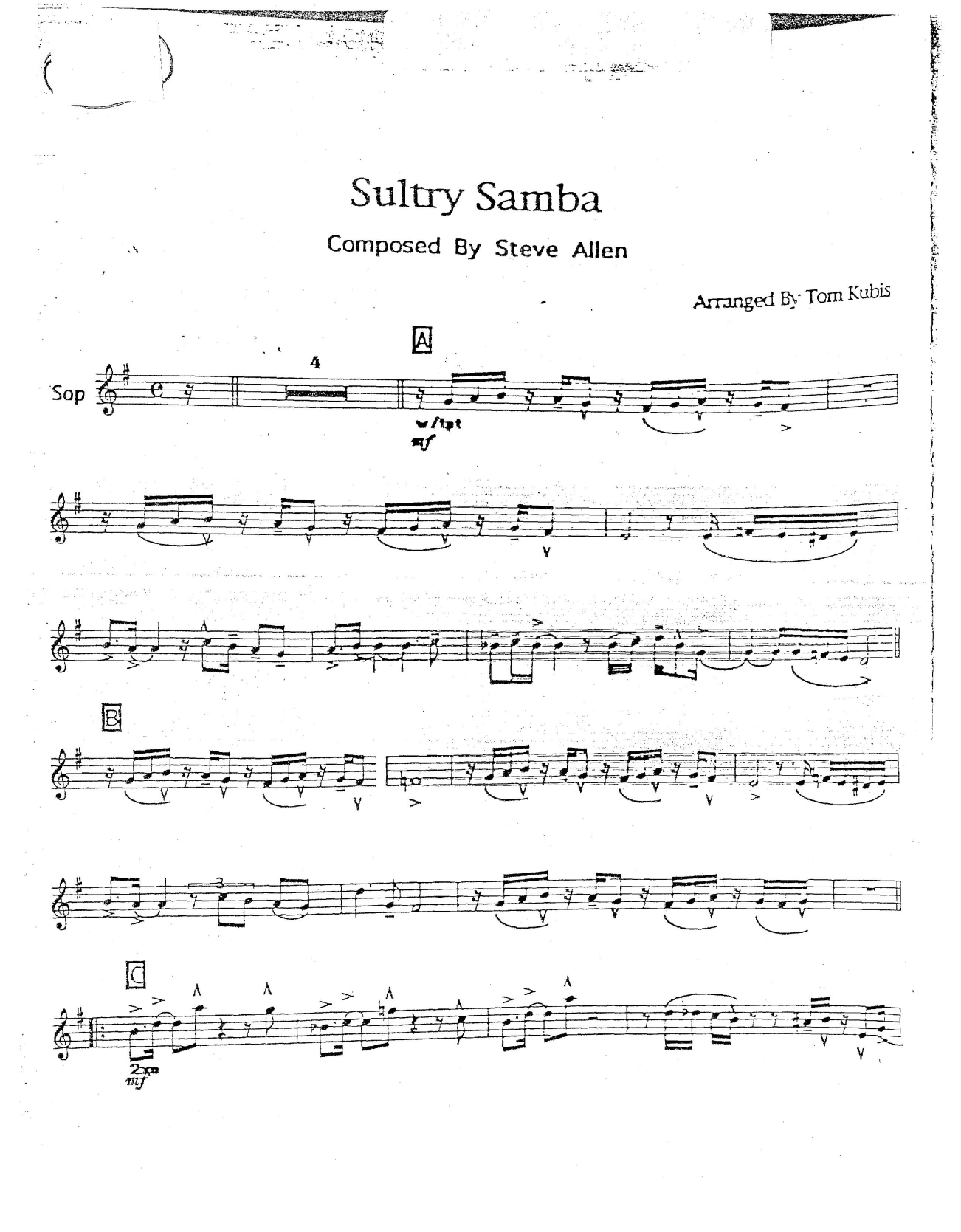
Sultry Samba (T.Kubis)
Composed by Tom Kubis
Arranged by Tom Kubis
- Ensemble: Big Band
- Pages: 38
- Instruments (17): Soprano Saxophone, Alto Saxophone 2, Tenor Saxophone 1, Tenor Saxophone 2, Baritone Saxophone, Trumpet 1, Trumpet 2, Trumpet 3, Trumpet 4, Trombone 1, Trombone 2, Trombone 3, Trombone 4, Guitar, Piano, Bass, Drums
- Difficulty: medium
- Content: Individual Parts
- Format: PDF Download (Instant)
- Price: $24.99
Tom Kubis has long established himself as one of the most inventive and swinging voices in contemporary big band writing, and "Sultry Samba" stands as a prime example of his mastery over Latin-jazz idioms. Written and recorded within the vibrant lineage of West Coast studio jazz, this chart captures the sunny, sophisticated energy that defined Kubis’s numerous collaborations with elite Los Angeles session players. Rather than relying on generic bossa nova clichés, Kubis infuses the traditional samba framework with modern harmonic sophistication, crisp counterpoint, and an undeniable groove that bridges the gap between classic Count Basie swing and contemporary Latin fusion. Propelled by an infectious, driving percussion groove in 4/4 time, "Sultry Samba" alternates between sultry, relaxed lyricism and high-voltage ensemble pyrotechnics. The composition opens with a seductive, undulating melodic line introduced by the saxophones—featuring prominent voicing for soprano and alto saxophones—before expanding into lush, chromatic brass harmonies that evoke a breezy coastal atmosphere. The mood shifts effortlessly from sultry and mysterious to jubilant and explosive, driven by Kubis’s trademark clever horn interjections and rhythmic displacement. The harmonic language utilizes extended tertian structures, chromatic mediants, and subtle modal shifts that give the chart its sophisticated edge while maintaining an instantly engaging melodic appeal. Kubis’s structural brilliance shines through in the arrangement's architecture, featuring tightly wound sax solis that demand absolute precision and rhythmic unison. The woodwind doubling—highlighted by soprano saxophone on the lead chair and double-reed or low-reed interplay down to the baritone—creates a rich, contemporary textural palette distinct from traditional big band scoring. Solo opportunities are provided for key improvisers, allowing featured soloists to stretch out over accessible yet stimulating chord changes. The culmination of the chart builds toward a vibrant shout chorus that reinterpreting the primary thematic material with full ensemble force, utilizing dynamic contrast and sharp articulations to maximize impact before a crisp, memorable coda. Advanced high school ensembles with strong section players, collegiate jazz orchestras, and professional big bands will find "Sultry Samba" an exceptional vehicle for showcasing technical agility and stylistic versatility. While the rhythmic syncopation demands familiarity with Latin phrasing, the payoff is immense, rewarding the ensemble with a crowd-pleasing showpiece that balances intellectual arranging craftsmanship with pure entertainment value. Conductor and players alike will appreciate how efficiently Kubis’s scoring sits on the instruments, allowing the band to focus heavily on stylistic nuance, dynamic balance, and stylistic swing-Latin integration. Mastering "Sultry Samba" requires a disciplined approach to the delicate balance between relaxed Latin feel and high-energy big band drive. The rhythm section is the anchor; the drummer must maintain an authentic samba groove without overplaying, ensuring the ride cymbal and hi-hat articulate the eighth-note subdivisions cleanly while the bass player locks in a hypnotic tumbao-inspired line. For the wind sections, precision in articulation is paramount. Short notes must be clipped and punchy, while sustained lines require a warm, continuous air stream to prevent the complex extended harmonies from sounding pinched. Watch out for rapid dynamic shifts; the chart relies heavily on sudden subitopianissimo drops immediately following brass blasts to create its signature dramatic tension. Rehearsal should begin by separating the rhythm section and saxophones to lock in the intricate soli lines at a reduced tempo before integrating the brass. Ensure the lead trumpet is comfortable with the upper-register demands, though endurance is managed well through thoughtful scoring. Emphasize clean section blend over sheer volume during the quieter thematic statements to preserve the "sultry" atmosphere. Q: What instruments and parts are included in this 17-instrument big band arrangement? A: The instrumentation comprises a standard 17-piece big band setup spanning 5 saxophones (featuring Soprano Saxophone, Alto Saxophone 2, Tenor Saxophone 1, Tenor Saxophone 2, and Baritone Saxophone), 4 trumpets, 4 trombones, and a full 4-piece rhythm section (piano, guitar, bass, and drums) across a comprehensive 38-page score and part set. Q: What is the difficulty level of Tom Kubis's "Sultry Samba"? A: This arrangement is graded as advanced (suitable for top-tier high school, collegiate, and professional big bands), primarily due to its intricate saxophone soli writing, sophisticated extended harmonies, and the requirement for tight rhythmic synchronization within a Latin-jazz style. Q: What musical style and historical era does this piece represent? A: Written by renowned West Coast arranger Tom Kubis, the piece represents contemporary West Coast big band jazz, fusing traditional Brazilian samba grooves with modern mainstream jazz harmonies and energetic ensemble writing. Q: What makes this specific arrangement unique compared to standard big band Latin charts? A: Its uniqueness lies in Kubis's brilliant integration of soprano saxophone on the lead chair, intricate woodwind voicings, and sophisticated harmonic twists that elevate a standard Latin groove into a masterclass of modern big band composition and counterpoint. Q: What is the approximate performance duration and tempo feel of the piece? A: "Sultry Samba" is performed at a bright, driving Latin tempo (around medium-up quarter note = 160-168 BPM), with an average performance duration of approximately 4 to 5 minutes depending on the length of the improvised solos.
Questions and answers
- What is included in the Sultry Samba (T.Kubis) PDF?
- The verified current file contains individual parts across 38 pages.
- How many instruments or parts are listed for Sultry Samba (T.Kubis)?
- The verified instrumentation list contains 17 entries for this Big Band arrangement.
- Who is credited for Sultry Samba (T.Kubis)?
- Composer: Tom Kubis. Arranger: Tom Kubis.
- What difficulty is listed for Sultry Samba (T.Kubis)?
- The verified difficulty level is medium.
- Can I preview Sultry Samba (T.Kubis) before buying?
- Yes. The product page provides a preview generated from the current PDF file.
- How is Sultry Samba (T.Kubis) delivered?
- After successful payment, the digital PDF is made available for download. The displayed price is $24.99.
Musicians Also Search For
Sultry Samba Tom Kubis PDF • Sultry Samba Tom Kubis sheet music • Sultry Samba arranged by Tom Kubis • Tom Kubis big band charts • Tom Kubis jazz arrangements PDF • Sultry Samba Tom Kubis big band arrangements • Sultry Samba big band arrangements • Sultry Samba big band PDF download • Sultry Samba jazz sheet music • big band sheet music download • Sultry Samba individual parts download • Sultry Samba sheet music PDF • buy Sultry Samba sheet music • download Sultry Samba PDF • Sultry Samba jazz charts • best Tom Kubis big band arrangements • Sultry Samba printable sheet music • big band repertoire PDF