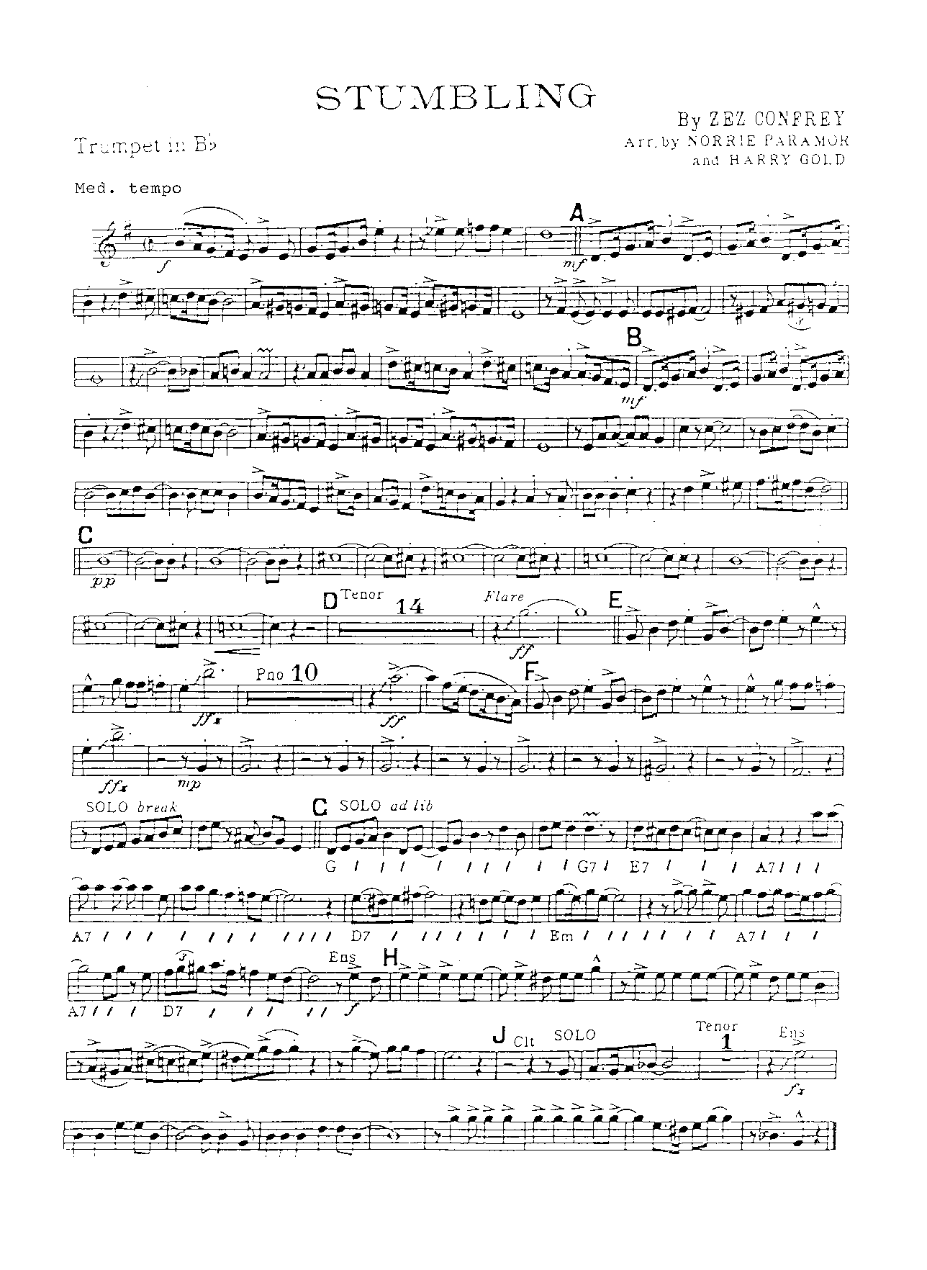
Stumbling (N.Paramor - H.Gold)
Composed by Zez Confrey
Arranged by N.Paramor - H.Gold
- Ensemble: Dixieland Band
- Style: Ragtime
- Pages: 13
- Instruments (8): Trumpet in Bb, Bb Clarinet, Tenor Saxophone, Trombone, Guitar/Banjo, Piano, Tuba/Bass, Drums
- Difficulty: easy
- Content: Individual Parts
- Format: PDF Download (Instant)
- Price: $18.99
"Stumbling," originally composed by Zez Confrey in 1922, emerged during the vibrant "Jazz Age" and is a quintessential example of novelty piano and early jazz, often categorized within the broader ragtime style. Confrey, a classically trained pianist, became renowned for his intricate, playful compositions that blended ragtime's syncopated rhythms with a technical brilliance influenced by French Impressionists like Debussy and Ravel. While Confrey was primarily known for his piano works like "Kitten on the Keys" and "Dizzy Fingers," "Stumbling" quickly became a popular song, capturing the lighthearted, sometimes awkward, spirit of the era. Its lyrical narrative humorously depicts a clumsy dancer, making it an enduring and relatable piece that became a standard in instrumental jazz and pop literature. This Dixieland Band arrangement of "Stumbling" by N. Paramor and H. Gold breathes new life into Confrey's classic, reimagining its sprightly character for a full ensemble. The arrangement maintains the original's bright, up-tempo feel, typically performed at a brisk allegro, and is likely set in a bright major key to preserve its cheerful, almost comedic mood. The musical character is defined by its infectious syncopation and a driving, four-to-the-bar rhythm section that propels the piece forward. It evokes a sense of joyful abandon and nostalgic charm, perfectly suited for a Dixieland setting. The energy is consistently high, encouraging a lively and engaging performance from all musicians. Norrie Paramor, a celebrated British record producer, composer, and arranger, and Harry Gold, a prominent British Dixieland jazz saxophonist and bandleader, bring their combined expertise to this arrangement. Their approach to "Stumbling" likely features the characteristic polyphonic interplay of a Dixieland band, with the clarinet weaving intricate counter-melodies above the trumpet's lead, and the trombone providing rhythmic fills and glissandi. Expect a clear melodic presentation, often shared between the front-line instruments (trumpet, clarinet, trombone), with opportunities for improvised or written-out solos that capture the improvisational spirit of the style. The arrangement may include a classic "shout chorus" where the full ensemble plays tutti, driving to a powerful climax, and potentially some call-and-response sections. Paramor and Gold are known for their meticulous yet spirited arrangements, ensuring both authenticity to the Dixieland style and engaging parts for each musician. Performing this arrangement is rewarding for its historical connection and its inherent musical joy. Technical challenges include maintaining crisp articulation at a fast tempo, precise ensemble playing during intricate contrapuntal sections, and navigating the syncopated rhythms with accuracy and swing feel. The piece offers a fantastic opportunity for developing rhythmic precision and stylistic authenticity in early jazz. This arrangement is highly suitable for college and community jazz bands, as well as semi-professional Dixieland ensembles looking to expand their repertoire with a historically significant and musically engaging piece. Its clear structure and idiomatic writing make it an excellent vehicle for teaching Dixieland style and improvisation within an ensemble context. To capture the authentic spirit of "Stumbling," conductors should aim for a bright, consistent allegro tempo, around 180-200 BPM, with a driving two-beat feel in the rhythm section that leans into a four-to-the-bar swing. Key technical challenges include maintaining rhythmic precision, particularly in the syncopated melodic lines and ensemble hits, and ensuring clean articulation, especially from the brass and woodwinds. Encourage brass players to use plunger mutes for specific sections to achieve a classic "wah-wah" effect, adding character and humor. Rehearsal should focus on balancing the contrapuntal lines of the front-line instruments, ensuring the trumpet's lead voice is clear while the clarinet and trombone weave their independent parts without overpowering. Emphasize dynamic contrasts to highlight the playful nature of the piece, particularly between melodic statements and accompanying figures. Q: What instruments/parts are included in this arrangement? A: This Dixieland Band arrangement typically includes parts for trumpet, clarinet, trombone, piano, banjo/guitar, bass (tuba/string bass), and drums. The 13 pages suggest comprehensive scoring for each instrument. Q: What is the difficulty level of this arrangement? A: This arrangement is suitable for intermediate to advanced ensembles, including college, community, and semi-professional Dixieland bands. It requires good rhythmic precision, clean articulation, and an understanding of early jazz stylistic nuances. Q: What is the musical style and historical context of "Stumbling"? A: "Stumbling" is a classic novelty piano piece composed by Zez Confrey in 1922, firmly rooted in the Ragtime era and early jazz. It embodies the lively, syncopated, and often humorous character of the "Jazz Age." Q: What makes this N. Paramor - H. Gold arrangement unique? A: This arrangement uniquely adapts Zez Confrey's original piano novelty piece for a Dixieland Band, showcasing the distinctive arranging styles of Norrie Paramor and Harry Gold. It features idiomatic voicings, potential soli sections, and a faithful yet fresh interpretation of the original's playful character. Q: What is the typical performance duration or tempo for this piece? A: "Stumbling" is an up-tempo piece, typically performed at a brisk allegro (around 180-200 BPM). A full performance of this arrangement would likely last approximately 2.5 to 3.5 minutes, depending on the inclusion and length of improvised solos.
Questions and answers
- What is included in the Stumbling (N.Paramor - H.Gold) PDF?
- The verified current file contains individual parts across 13 pages.
- How many instruments or parts are listed for Stumbling (N.Paramor - H.Gold)?
- The verified instrumentation list contains 8 entries for this Dixieland Band arrangement.
- Who is credited for Stumbling (N.Paramor - H.Gold)?
- Composer: Zez Confrey. Arranger: N.Paramor - H.Gold.
- What difficulty is listed for Stumbling (N.Paramor - H.Gold)?
- The verified difficulty level is easy.
- What style is listed for Stumbling (N.Paramor - H.Gold)?
- The catalog lists the style as Ragtime.
- Can I preview Stumbling (N.Paramor - H.Gold) before buying?
- Yes. The product page provides a preview generated from the current PDF file.
- How is Stumbling (N.Paramor - H.Gold) delivered?
- After successful payment, the digital PDF is made available for download. The displayed price is $18.99.
Musicians Also Search For
Stumbling N.Paramor - H.Gold PDF • Stumbling N.Paramor - H.Gold sheet music • Stumbling arranged by N.Paramor - H.Gold • N.Paramor - H.Gold dixieland band charts • N.Paramor - H.Gold jazz arrangements PDF • Stumbling Zez Confrey sheet music • Stumbling Zez Confrey dixieland band arrangements • Zez Confrey dixieland band charts • Stumbling dixieland band arrangements • Stumbling dixieland band PDF download • Stumbling jazz sheet music • dixieland band sheet music download • Stumbling individual parts download • Stumbling sheet music PDF • Stumbling Ragtime charts • Ragtime dixieland band arrangements • buy Stumbling sheet music • download Stumbling PDF • Stumbling jazz charts • best N.Paramor - H.Gold dixieland band arrangements • Zez Confrey arranged by N.Paramor - H.Gold • Stumbling printable sheet music • dixieland band repertoire PDF