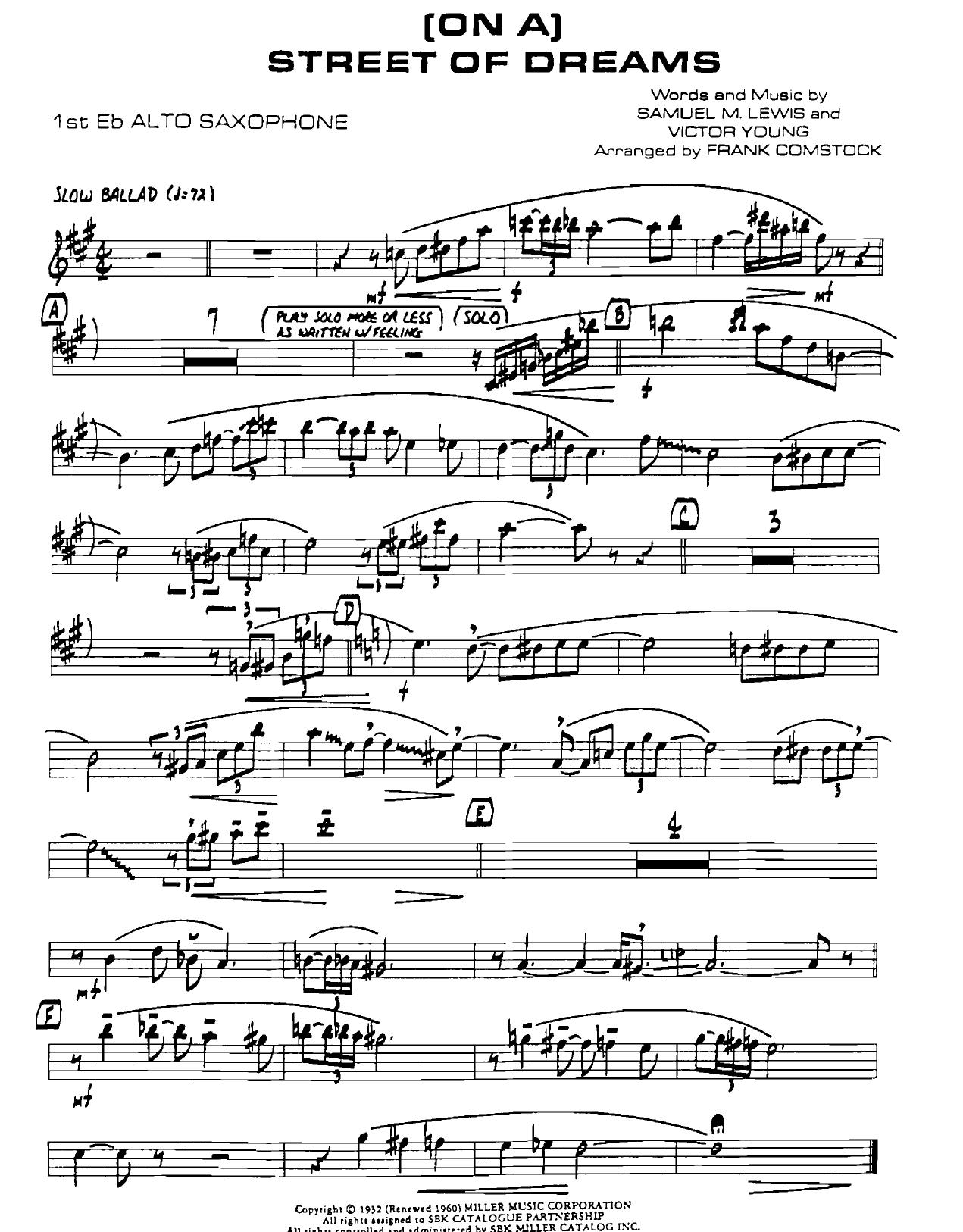
Street Of Dreams (F.Comstock) sheet music preview

Street Of Dreams (F.Comstock)

Composed by Victor Young

Arranged by Frank Comstock

  • Ensemble: Big Band
  • Pages: 20
  • Instruments (17): 1st Eb Alto Saxophone, 2nd Eb Alto Saxophone, 1st Bb Tenor Saxophone, 2nd Bb Tenor Saxophone, Eb Baritone Saxophone, 1st Bb Trumpet, 2nd Bb Trumpet, 3rd Bb Trumpet, 4th Bb Trumpet, 1st Trombone, 2nd Trombone, 3rd Trombone, 4th Trombone, Piano, Guitar, Bass, Drums
  • Difficulty: easy
  • Content: Individual Parts
  • Format: PDF Download (Instant)
  • Price: $24.99

Victor Young and Sam M. Lewis crafted "Street of Dreams" in 1932, a hauntingly sophisticated ballad that quickly ascended to the status of the Great American Songbook standard. Immortalized by legendary vocalists and instrumentalists alike—including Frank Sinatra, Ella Fitzgerald, and various West Coast jazz luminaries—the composition embodies the nocturnal melancholy and romantic yearning of the pre-war era. Its sophisticated harmonic progression, characterized by descending chromatic lines and rich minor-key coloring, offers an ideal canvas for jazz arrangers seeking to evoke a moody, cinematic atmosphere. Frank Comstock’s masterful big band interpretation transforms this timeless melody into a masterclass of West Coast cool and lush harmonic texture. Written in a relaxed, evocative medium-slow tempo, the chart opens with a shimmering, atmospheric introduction that immediately establishes a contemplative mood. Comstock utilizes nuanced woodwind doubling and tightly-knit brass voicings to create a warm, cinematic blanket of sound, leaning into extended chords (major 7ths, diminished passing tones, and suspended dominants) that expand upon Young's original changes. The dynamic contour moves seamlessly from intimate, whispered ensemble passages to rich, swelling climaxes that never lose their underlying restraint. The melodic presentation is shared gracefully across the ensemble, featuring lush saxophone solis that highlight Comstock's trademark linear writing and balanced section interplay. Trumpets and trombones act as a warm cushion, occasionally stepping forward with delicate counter-melodies that weave through the primary theme. An expressive improvised solo section allows a featured soloist—ideally an alto saxophonist or trumpeter with a warm, lyrical tone—to stretch out over the traditional form. While the arrangement avoids heavy, aggressive shout choruses in favor of subtle dynamic shading and sophisticated re-harmonizations, it builds to a poignant, emotionally resonant climax before dissolving back into a quiet, reflective coda. Advanced high school, collegiate, and professional jazz ensembles will find this arrangement an exceptional vehicle for developing sectional blend, intonation, and sophisticated ballad playing. Because the primary technical challenges lie not in raw velocity, but in breath control, subtle time-feel, and pristine balance across the 9-instrument configuration, it demands mature musicality and attentive listening from every player. It serves as an ideal programming choice to provide contrast in a concert set, showcasing an ensemble's capacity for nuance, beauty, and restrained emotional power. Recreating Frank Comstock’s signature West Coast sound requires meticulous attention to dynamic control and intonation, particularly in the quiet, exposed ensemble passages. The tempo should remain a relaxed, breathing medium-slow ballad feel; avoid rushing the eighth-note subdivisions to maintain the laid-back, late-night character. The primary technical challenge rests on the saxophone section during the soli passages, where seamless blend and precise articulation of scalar runs are paramount. Brass players must exercise extreme caution with vibrato—keep it narrow and controlled to preserve the modern, cool-jazz aesthetic. Mutes are generally not required, allowing the natural, warm timbre of the instruments to dominate. During rehearsals, the conductor should first isolate the rhythm section to establish a rock-solid, unhurried pulse, ensuring the bass provides a deep, foundational anchor without heavy articulation. Pay close attention to the inner-voice movement within the harmonic structure; balance must favor the moving lines in the tenor and trombone parts to bring out Comstock's clever voice-leading. Q: What instruments and parts are included in this 9-instrument big band arrangement? A: This arrangement is scored for a 9-instrument ensemble featuring Alto Saxophone, Tenor Saxophone, Baritone Saxophone, Trumpet, Trombone, and a complete rhythm section. The 20-page set provides comprehensive individual parts tailored for this intimate yet full-sounding configuration. Q: What is the difficulty level of this arrangement? A: This chart is graded as medium-advanced, making it well-suited for proficient high school groups, collegiate ensembles, and professional pick-up bands. The technical demands focus heavily on blend, intonation, and mature ballad interpretation rather than extreme velocity. Q: What is the historical style and musical context of this piece? A: Composed by Victor Young in 1932, "Street of Dreams" is a cornerstone jazz standard of the Great American Songbook. Frank Comstock’s arrangement filters this timeless tune through a sophisticated West Coast jazz lens, emphasizing lush harmonies and a cinematic, nocturnal mood. Q: What makes Frank Comstock’s arrangement unique compared to other versions? A: Comstock avoids heavy, high-energy shout choruses in favor of intricate linear writing, rich extended chord voicings, and delicate woodwind-and-brass interplays. His distinct approach elevates the ballad into a masterclass of cool-jazz texture and dynamic restraint. Q: What is the recommended performance duration and tempo for this arrangement? A: The arrangement is performed at a relaxed, medium-slow ballad tempo with a smooth 4/4 swing or sustained feel. A typical performance runs approximately 3 to 4 minutes, depending on the length allotted for the featured improvised solo.

Questions and answers

What is included in the Street Of Dreams (F.Comstock) PDF?
The verified current file contains individual parts across 20 pages.
How many instruments or parts are listed for Street Of Dreams (F.Comstock)?
The verified instrumentation list contains 17 entries for this Big Band arrangement.
Who is credited for Street Of Dreams (F.Comstock)?
Composer: Victor Young. Arranger: Frank Comstock.
What difficulty is listed for Street Of Dreams (F.Comstock)?
The verified difficulty level is easy.
Can I preview Street Of Dreams (F.Comstock) before buying?
Yes. The product page provides a preview generated from the current PDF file.
How is Street Of Dreams (F.Comstock) delivered?
After successful payment, the digital PDF is made available for download. The displayed price is $24.99.

Musicians Also Search For

Street Of Dreams Frank Comstock PDFStreet Of Dreams Frank Comstock sheet musicStreet Of Dreams arranged by Frank ComstockFrank Comstock big band chartsFrank Comstock jazz arrangements PDFStreet Of Dreams Victor Young sheet musicStreet Of Dreams Victor Young big band arrangementsVictor Young big band chartsStreet Of Dreams big band arrangementsStreet Of Dreams big band PDF downloadStreet Of Dreams jazz sheet musicbig band sheet music downloadStreet Of Dreams individual parts downloadStreet Of Dreams sheet music PDFbuy Street Of Dreams sheet musicdownload Street Of Dreams PDFStreet Of Dreams jazz chartsbest Frank Comstock big band arrangementsVictor Young arranged by Frank ComstockStreet Of Dreams printable sheet musicbig band repertoire PDF

All arrangements by Frank Comstock All Victor Young sheet music