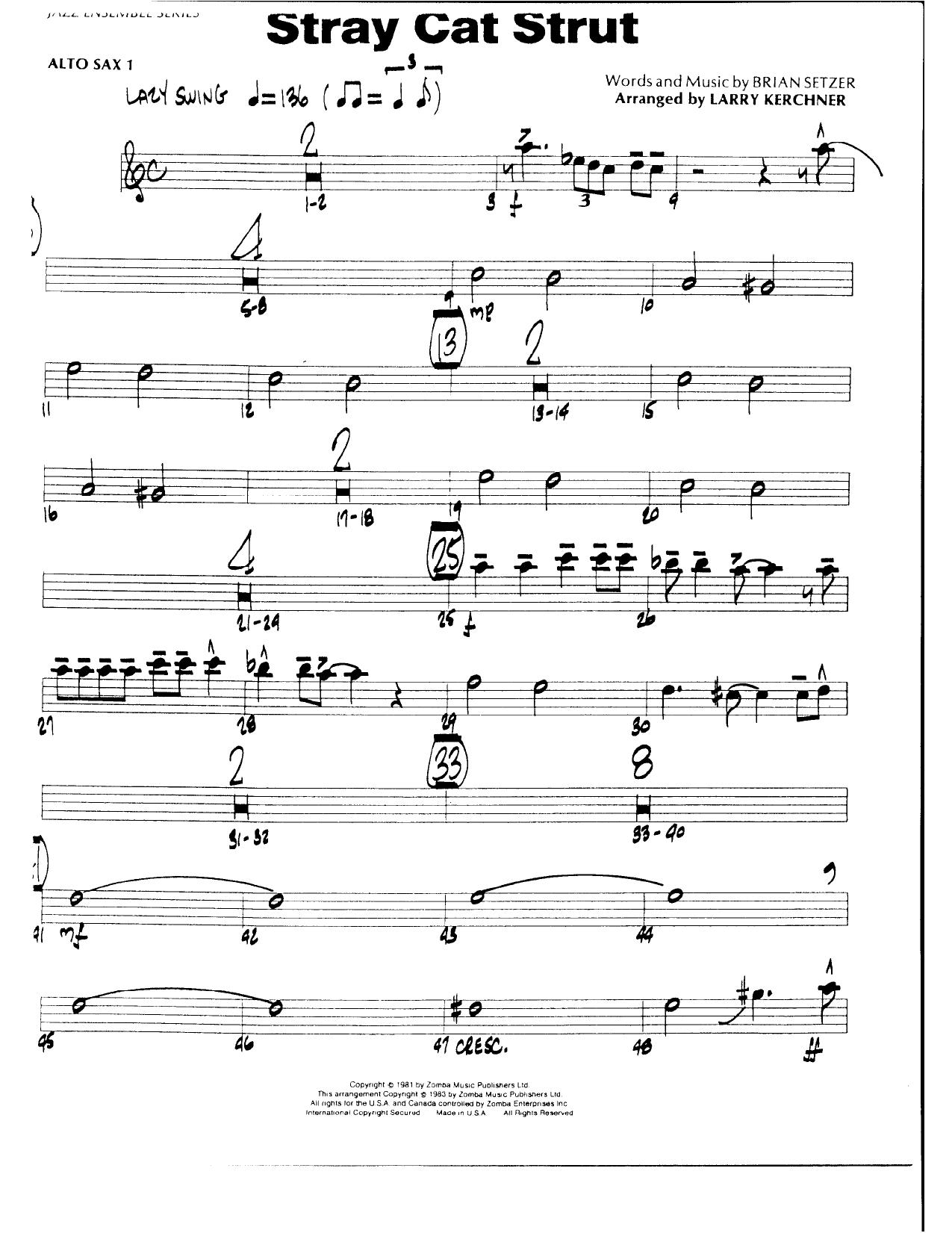
Stray Cat Strut (L.Kerchner)
Composed by Brian Setzer
Arranged by L.Kerchner
- Ensemble: Big Band
- Style: Jazz Standard
- Pages: 36
- Instruments (17): Alto Sax 1, Alto Sax 2, Tenor Sax 1, Tenor Sax 2, Baritone Sax, Trumpet 1, Trumpet 2, Trumpet 3, Trumpet 4, Trombone 1, Trombone 2, Trombone 3, Trombone 4, Piano, Guitar, Bass, Drums
- Difficulty: medium
- Content: Individual Parts
- Format: PDF Download (Instant)
- Price: $24.99
Originally catapulted to international fame by Brian Setzer and the Stray Cats on their 1981 self-titled debut album, and later cemented as a neo-swing revival anthem through their 1990s big band recordings, "Stray Cat Strut" bridges the gap between classic rockabilly attitude and the slick, horn-driven sophistication of mid-century big band jazz. Brian Setzer’s iconic minor-key vamp, heavily indebted to the cool-jazz modal explorations of pioneers like Miles Davis and the sultry cinematic tension of a 1950s detective noir soundtrack, translates with astonishing naturalness into a full-scale jazz ensemble format. This timeless crossover appeal has earned the tune a permanent fixture in modern jazz repertoire, beloved by audiences for its instantly recognizable, slinky melodic hook and driving, finger-snapping groove. Larry Kerchner’s masterful big band adaptation captures every ounce of the original's smoky, swaggering persona while expanding the sonic palette with rich, contemporary jazz orchestration. Driven by an infectious medium-tempo swing-rock groove in a minor key, the chart exudes an atmosphere of confident cool, balancing sultry, laid-back unison lines with explosive, brass-heavy dynamic outbursts. Kerchner expertly exploits the dynamic range of the 17-piece instrumentation, juxtaposing sparse, rhythm-section-led tension against thick, harmonically sophisticated sax soli sections and roaring ensemble shout choruses. The mood shifts effortlessly from slinky and mysterious to high-octane excitement, offering a theatrical flair that commands the listener's attention from the first downbeat to the final chord. In this arrangement, the iconic melody is primarily carried by the saxophone section and muted brass, creating an authentic, smoky alleyway aesthetic before opening up for featured improvised solos. Kerchner constructs a brilliant conversational interplay between the rhythm section and the horn tiers, utilizing sharp dynamic contrasts, staggered entrances, and chromatic line-cliches to heighten the dramatic tension. The technical demands of the chart lie not in breakneck speeds, but in rhythmic precision, stylistic uniformity, and articulation control—particularly in executing the crisp swing-eighths, precise staccato punches, and sultry pitch bends that define the genre. Advanced high school, collegiate, and professional community big bands will find this chart to be an absolute showstopper that bridges mainstream crowd-pleasing appeal with genuine educational and artistic merit. Because the technical hurdles are balanced by intuitive melodic writing and clear sectional phrasing, ensembles can focus heavily on stylistic nuance, groove cohesion, and stage presence. It serves as an ideal festival showcase or concert closer, guaranteed to leave audiences humming the instantly catchy refrain long after the final note fades. Success with Kerchner’s chart hinges entirely on establishing and maintaining a locked-in, unhurried medium-tempo groove that balances a relaxed swagger with razor-sharp rhythmic precision. The rhythm section—particularly the drum set and bass—must anchor the chart with a steady, driving pulse that avoids rushing during dynamic swells. Brass players should make extensive use of plunger mutes, cup mutes, and controlled falls to replicate the vocal, storytelling quality of the original melody. Directors should spend early rehearsals isolating the intricate saxophone soli, ensuring that the articulation—especially the treatment of accented notes and ghosted tones—is uniform across all five players. Pay close attention to the balance during the transition points between sparse accompaniment and full-ensemble hits; the lower voices (baritone saxophone and bass trombone) must project clearly to support the rich, minor-key extended harmonies without muddying the texture. Q: What instrumentation and parts are included in this big band arrangement? A: This arrangement is scored for a standard 17-piece big band, comprising 2 alto saxophones, 2 tenor saxophones, 1 baritone saxophone, 4 trumpets, 4 trombones, guitar, piano, bass, and drums, spanning a comprehensive 36-page score and parts set. Q: What is the difficulty level of this arrangement? A: It is rated at an intermediate-to-advanced level (Grade 4), making it exceptionally well-suited for advanced high school, collegiate, and professional community jazz orchestras seeking a substantial crowd-pleaser. Q: What is the musical style and historical background of this piece? A: Originally composed by Brian Setzer and famously recorded by the Stray Cats, this piece is styled as a minor-key jazz-swing hybrid that blends 1950s cool-jazz noir aesthetics with the explosive energy of the 1990s neo-swing revival. Q: What makes Larry Kerchner’s arrangement unique? A: Kerchner elevates a classic rockabilly tune into a sophisticated big band chart by incorporating clever dynamic contrasts, rich extended minor harmonies, sultry muted brass writing, and a dynamic shout chorus. Q: What is the recommended performance tempo and duration? A: The chart is set at a confident medium-tempo swing groove, typically clocking in at around 3 to 4 minutes in duration, allowing for improvised solo sections and dynamic development.
Questions and answers
- What is included in the Stray Cat Strut (L.Kerchner) PDF?
- The verified current file contains individual parts across 36 pages.
- How many instruments or parts are listed for Stray Cat Strut (L.Kerchner)?
- The verified instrumentation list contains 17 entries for this Big Band arrangement.
- Who is credited for Stray Cat Strut (L.Kerchner)?
- Composer: Brian Setzer. Arranger: L.Kerchner.
- What difficulty is listed for Stray Cat Strut (L.Kerchner)?
- The verified difficulty level is medium.
- What style is listed for Stray Cat Strut (L.Kerchner)?
- The catalog lists the style as Jazz Standard.
- Can I preview Stray Cat Strut (L.Kerchner) before buying?
- Yes. The product page provides a preview generated from the current PDF file.
- How is Stray Cat Strut (L.Kerchner) delivered?
- After successful payment, the digital PDF is made available for download. The displayed price is $24.99.
Musicians Also Search For
Stray Cat Strut L.Kerchner PDF • Stray Cat Strut L.Kerchner sheet music • Stray Cat Strut arranged by L.Kerchner • L.Kerchner big band charts • L.Kerchner jazz arrangements PDF • Stray Cat Strut Brian Setzer sheet music • Stray Cat Strut Brian Setzer big band arrangements • Brian Setzer big band charts • Stray Cat Strut big band arrangements • Stray Cat Strut big band PDF download • Stray Cat Strut jazz sheet music • big band sheet music download • Stray Cat Strut individual parts download • Stray Cat Strut sheet music PDF • Stray Cat Strut Jazz Standard charts • Jazz Standard big band arrangements • buy Stray Cat Strut sheet music • download Stray Cat Strut PDF • Stray Cat Strut jazz charts • best L.Kerchner big band arrangements • Brian Setzer arranged by L.Kerchner • Stray Cat Strut printable sheet music • big band repertoire PDF