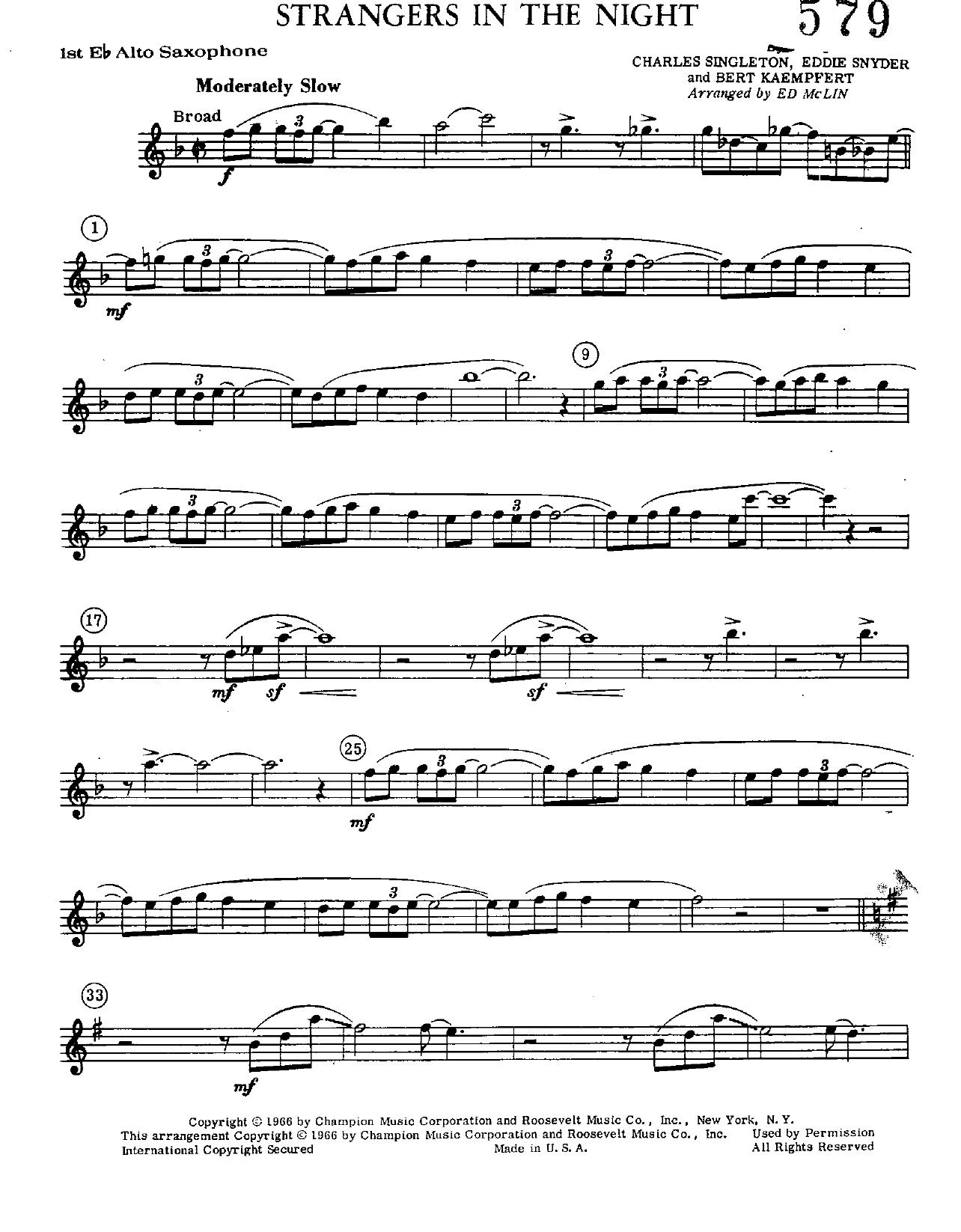
Strangers In The Night (E.McLin)
Composed by Sammy Fain
Arranged by Ed McLin
- Ensemble: Big Band
- Style: Jazz Standard
- Pages: 36
- Instruments (17): 1st Eb Alto Saxophone, 3rd Eb Alto Saxophone, 2nd Bb Tenor Saxophone, 4th Bb Tenor Saxophone, 5th Eb Baritone Saxophone, 1st Bb Trumpet, 2nd Bb Trumpet, 3rd Bb Trumpet, 4th Bb Trumpet, 1st Trombone, 2nd Trombone, 3rd Trombone, 4th Trombone, Piano, Guitar, Bass, Drums
- Difficulty: medium
- Content: Individual Parts
- Format: PDF Download (Instant)
- Price: $24.99
Originally composed by Sammy Fain with lyrics by Charles Singleton and Eddie Snyder, "Strangers in the Night" achieved immortal status when Frank Sinatra recorded it in 1966 for his album of the same name. Winning multiple Grammy Awards, including Record of the Year and Best Vocal Performance, Sinatra's definitive rendition captured the sophisticated, late-night cool of the mid-1960s pop-standards landscape, quickly cementing the tune as a staple of the Great American Songbook and a favorite vehicle for jazz instrumentalists seeking a rich harmonic framework. Ed McLin’s big band treatment translates this iconic vocal masterpiece into a suave, medium-tempo swing chart that balances lush, cinematic voicings with an inviting, driving pulse. Operating primarily in a comfortable yet expressive key center, the arrangement evokes an atmosphere of dimly lit cocktail lounges and sophisticated urban nightlife. The mood shifts effortlessly from sultry, reflective introductory passages to fuller, harmonically rich ensemble statements, maintaining a warm, engaging energy throughout that captivates both performers and audiences alike. McLin’s signature arranging style shines through his meticulous voice-leading and transparent section writing. Rather than relying on heavy-handed modern reharmonizations, McLin respects the integrity of Fain’s original melody while enriching the underlying chord structures with sophisticated upper-extension voicings for the saxes and subtle, pastel background figures in the brass. The chart features well-crafted soli sections that highlight the interplay between the reed and brass families, utilizing classic block-chord writing reminiscent of the golden age of studio big bands, while avoiding overly dense counterpoint that might obscure the melody's core lyrical beauty. The melodic weight is shared gracefully across the ensemble, opening with intimate statements in the reed section before the brass steps in to broaden the textural palette. Solo opportunities are thoughtfully integrated, providing a featured player the space to improvise over a comfortable, flowing changes-based background. Technically, the arrangement is accessible yet musically demanding in terms of blend, intonation, and stylistic cohesion; players must master a relaxed, laid-back swing eighth-note feel rather than an aggressive bebop articulation. The emotional payoff peaks during a tasteful developmental section that builds naturally into a satisfying, dynamic ensemble swell before resolving to a gentle, memorable coda. Advanced high school ensembles, collegiate jazz orchestras, and professional community big bands will find this chart an ideal centerpiece for standard concert programs or dance sets. Because it does not rely on blistering tempos or extreme altissimo registers, bands can dedicate their rehearsal focus entirely to what matters most in this style: tone quality, ensemble balance, dynamic shading, and subtle rhythmic nuance. Conductors approaching Ed McLin’s arrangement of "Strangers in the Night" should prioritize a relaxed, buoyant medium-swing tempo (around 116–120 BPM). The primary technical challenge lies in avoiding a stiff or rushed eighth-note feel; the rhythm section must lock into a deep, driving pocket while the horns maintain a smooth, legato phrasing style. Pay close attention to dynamic markings in the saxophones and trombones during background figures, ensuring they never overpower the designated lead voice. Trumpets should utilize warm, rounded tones rather than blazing commercial brightness, fitting the nocturnal mood of the chart. Rehearsal should begin with the rhythm section alone to establish the foundational groove and harmonic flow before layering in the horns. Work section-by-section to balance the chordal voicings, specifically ensuring that the inner voices of the sax section project clearly. Emphasize a unified approach to articulation: back-phrasing slightly on the downbeats will yield that authentic, smoky late-night jazz club aesthetic. Q: What instruments and parts are included in this big band arrangement? A: The instrumentation features a standard 17-piece big band setup, comprising Alto Saxophone 1, Alto Saxophone 3, Tenor Saxophone 2, Tenor Saxophone 4, Baritone Saxophone 5, along with standard brass and rhythm sections across a comprehensive 36-page score and parts set. Q: What is the difficulty level of this chart? A: This arrangement is well-suited for advanced high school, collegiate, and community jazz bands, offering manageable technical demands while requiring a high level of ensemble maturity, blend, and stylistic awareness. Q: What is the musical style and historical context of this piece? A: The chart is a medium-swing jazz standard adaptation of Sammy Fain’s classic tune, famously popularized by Frank Sinatra in 1966, capturing the sophisticated, late-night aesthetic of the mid-century vocal and instrumental tradition. Q: What makes Ed McLin’s arrangement unique? A: McLin’s treatment stands out for its lush, cinematic voicings, transparent section writing, and respectful adherence to the iconic melody, enhanced by tasteful upper-extension harmonies and classic block-chord solis. Q: What is the recommended tempo and approximate performance duration? A: The piece is designed to be performed at a relaxed medium-swing tempo of approximately 116–120 BPM, resulting in a performance duration of roughly 3 to 4 minutes depending on solo extensions.
Questions and answers
- What is included in the Strangers In The Night (E.McLin) PDF?
- The verified current file contains individual parts across 36 pages.
- How many instruments or parts are listed for Strangers In The Night (E.McLin)?
- The verified instrumentation list contains 17 entries for this Big Band arrangement.
- Who is credited for Strangers In The Night (E.McLin)?
- Composer: Sammy Fain. Arranger: Ed McLin.
- What difficulty is listed for Strangers In The Night (E.McLin)?
- The verified difficulty level is medium.
- What style is listed for Strangers In The Night (E.McLin)?
- The catalog lists the style as Jazz Standard.
- Can I preview Strangers In The Night (E.McLin) before buying?
- Yes. The product page provides a preview generated from the current PDF file.
- How is Strangers In The Night (E.McLin) delivered?
- After successful payment, the digital PDF is made available for download. The displayed price is $24.99.
Musicians Also Search For
Strangers In The Night Ed McLin PDF • Strangers In The Night Ed McLin sheet music • Strangers In The Night arranged by Ed McLin • Ed McLin big band charts • Ed McLin jazz arrangements PDF • Strangers In The Night Sammy Fain sheet music • Strangers In The Night Sammy Fain big band arrangements • Sammy Fain big band charts • Strangers In The Night big band arrangements • Strangers In The Night big band PDF download • Strangers In The Night jazz sheet music • big band sheet music download • Strangers In The Night individual parts download • Strangers In The Night sheet music PDF • Strangers In The Night Jazz Standard charts • Jazz Standard big band arrangements • buy Strangers In The Night sheet music • download Strangers In The Night PDF • Strangers In The Night jazz charts • best Ed McLin big band arrangements • Sammy Fain arranged by Ed McLin • Strangers In The Night printable sheet music • big band repertoire PDF