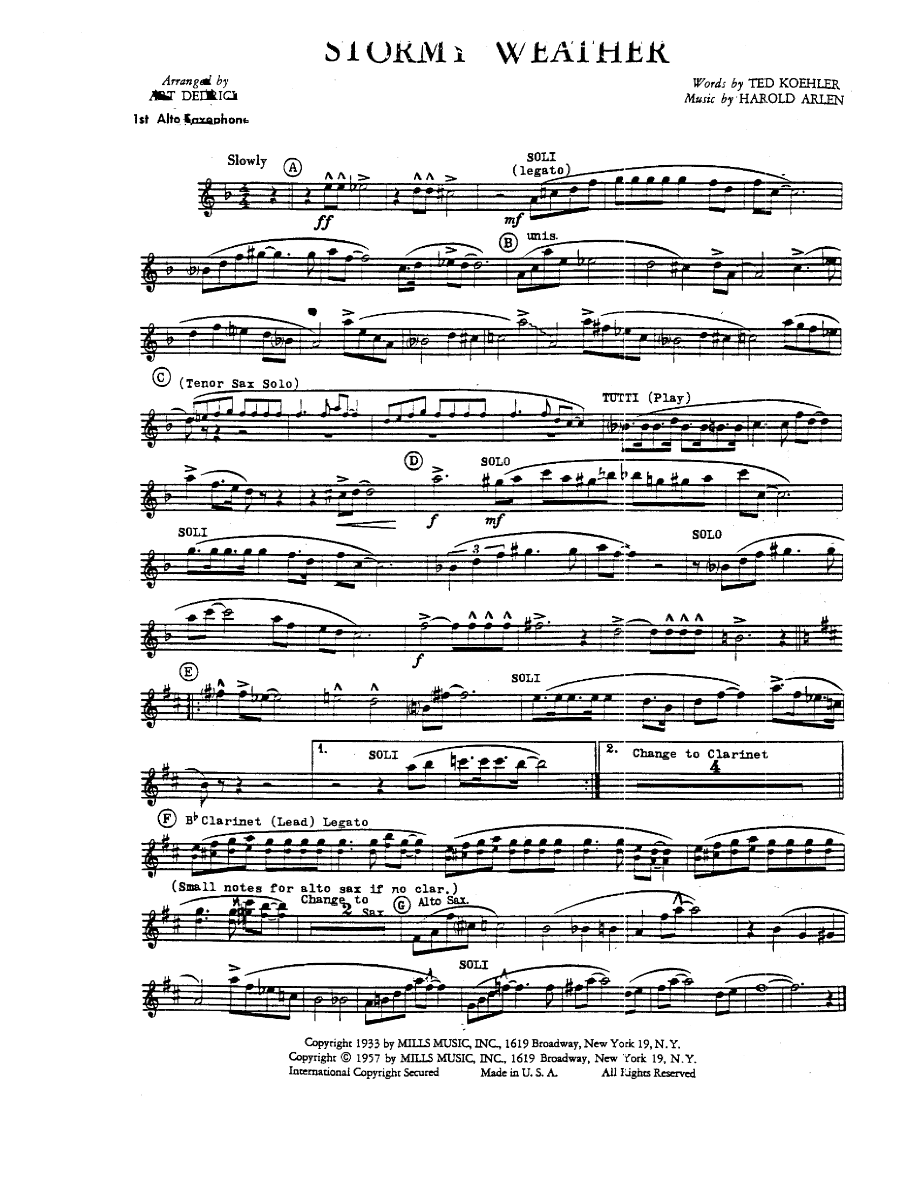
Stormy Weather (A.Dedrick)
Composed by Harold Arlen
Arranged by Art Dedrick
- Ensemble: Big Band
- Style: Jazz Standard
- Pages: 16
- Instruments (15): 1st Alto Saxophone, 3rd Alto Saxophone, 2nd Tenor Saxophone, 4th Tenor Saxophone, 5th Baritone Saxophone, 1st Trumpet, 2nd Trumpet, 3rd Trumpet, 1st Trombone, 2nd Trombone, 3rd Trombone, Drums, String Bass, Guitar, Piano
- Difficulty: easy
- Content: Individual Parts
- Format: PDF Download (Instant)
- Price: $24.99
Harold Arlen's timeless classic, "Stormy Weather," first captivated audiences in 1933, quickly becoming an indelible part of the Great American Songbook and a cornerstone of the jazz standard repertoire. Made iconic by vocalists like Ethel Waters and, most famously, Lena Horne, the song emerged from the heart of the Depression era, embodying a profound sense of melancholy and longing through its poignant lyrics and sophisticated harmonic structure. Its enduring appeal lies in its ability to convey deep emotion, a characteristic that has allowed it to transcend generations and musical styles, cementing its status as a ballad of unparalleled depth and beauty. Art Dedrick's masterful big band arrangement of "Stormy Weather" embraces the song's inherent emotional weight, presenting it as a lush, medium-slow swing ballad (approximately 80-90 BPM) in the key of C minor. The mood is one of sophisticated melancholy, infused with the rich harmonic language typical of the mid-20th century big band sound. Dedrick's signature lies in his ability to craft arrangements that are both accessible and musically rewarding, often characterized by warm, full voicings, clear melodic statements, and a natural, unforced swing feel. This particular chart showcases his talent for creating a cohesive orchestral texture that supports the melody while allowing individual sections to shine. The arrangement opens with a beautifully voiced saxophone choir, establishing the iconic melody with a tender, expressive quality. Dedrick's voicings are notably rich, utilizing close harmony and subtle counter-melodies to add depth without cluttering the texture. The melody is passed between sections, with the brass joining for a powerful yet controlled statement in the second A section. A featured solo, typically for tenor saxophone, provides an opportunity for expressive improvisation over the song's familiar changes, supported by carefully crafted ensemble figures that build intensity. Dedrick masterfully employs dynamic contrasts, moving from hushed, intimate passages to full, soaring ensemble moments, particularly in the climactic shout chorus, which is built on the melody's most memorable phrases. The arrangement concludes with a reflective, fading coda, leaving a lasting impression of the song's inherent sorrow and beauty. This arrangement is ideally suited for college, community, and advanced high school jazz ensembles. While not overtly technically demanding in terms of blistering tempos or complex rhythmic figures, its challenges lie in achieving a unified, expressive ballad performance. Bands will develop their ability to blend, balance, and articulate with nuance, focusing on sustained tones, dynamic control, and a cohesive ensemble sound. The rewarding experience comes from performing a classic standard with a sophisticated, heartfelt interpretation, allowing musicians to connect deeply with the music's emotional core and develop their ballad playing skills. To achieve the full emotional impact of Dedrick's "Stormy Weather," conductors should emphasize a consistent, relaxed medium-slow swing feel, avoiding any tendency to rush. Focus on long, sustained tones, particularly in the saxophone section, ensuring excellent blend and intonation, especially during the opening melodic statements. Dynamic control is paramount; encourage musicians to play with a wide dynamic range, from soft, breathy pianissimos to full, resonant fortissimos, always maintaining a rich tone. The brass section should articulate with warmth and precision, using a controlled vibrato where appropriate, and paying close attention to Dedrick's specific dynamic markings to build tension and release effectively. The solo section requires a sensitive accompaniment, providing a supportive harmonic cushion without overpowering the soloist. Rehearsal time should be dedicated to shaping phrases, listening across sections, and ensuring the ensemble breathes as one, allowing the inherent melancholy and beauty of the piece to shine through. Q: What instruments are included in this arrangement? A: This arrangement is scored for a standard 17-piece big band: Alto Saxophone 1 & 2, Tenor Saxophone 1 & 2, Baritone Saxophone, Trumpet 1-4, Trombone 1-4, Piano, Bass, Drums, and Guitar. Q: What is the difficulty level of Art Dedrick's "Stormy Weather"? A: This arrangement is rated as medium difficulty, appropriate for advanced high school, college, and community jazz ensembles. Its challenges lie more in musicality, blend, and dynamic control than in extreme technical demands. Q: What is the musical style and historical context of this arrangement? A: This is a big band jazz standard arrangement of Harold Arlen's "Stormy Weather," a classic ballad from 1933. Art Dedrick's treatment reflects a mid-20th-century big band sound, emphasizing lush harmonies and a medium-slow swing feel. Q: What makes this specific Art Dedrick arrangement unique? A: Dedrick's arrangement is known for its warm, full voicings, clear melodic presentation, and thoughtful dynamic contrasts. It features a beautifully voiced saxophone choir, a featured tenor saxophone solo, and a powerful yet controlled ensemble shout chorus. Q: What is the approximate performance duration and tempo of this piece? A: The approximate performance duration is 3:30 to 4:00 minutes, depending on the soloist. The tempo is a medium-slow swing, typically around 80-90 beats per minute.
Questions and answers
- What is included in the Stormy Weather (A.Dedrick) PDF?
- The verified current file contains individual parts across 16 pages.
- How many instruments or parts are listed for Stormy Weather (A.Dedrick)?
- The verified instrumentation list contains 15 entries for this Big Band arrangement.
- Who is credited for Stormy Weather (A.Dedrick)?
- Composer: Harold Arlen. Arranger: Art Dedrick.
- What difficulty is listed for Stormy Weather (A.Dedrick)?
- The verified difficulty level is easy.
- What style is listed for Stormy Weather (A.Dedrick)?
- The catalog lists the style as Jazz Standard.
- Can I preview Stormy Weather (A.Dedrick) before buying?
- Yes. The product page provides a preview generated from the current PDF file.
- How is Stormy Weather (A.Dedrick) delivered?
- After successful payment, the digital PDF is made available for download. The displayed price is $24.99.
Musicians Also Search For
Stormy Weather Art Dedrick PDF • Stormy Weather Art Dedrick sheet music • Stormy Weather arranged by Art Dedrick • Art Dedrick big band charts • Art Dedrick jazz arrangements PDF • Stormy Weather Harold Arlen sheet music • Stormy Weather Harold Arlen big band arrangements • Harold Arlen big band charts • Stormy Weather big band arrangements • Stormy Weather big band PDF download • Stormy Weather jazz sheet music • big band sheet music download • Stormy Weather individual parts download • Stormy Weather sheet music PDF • Stormy Weather Jazz Standard charts • Jazz Standard big band arrangements • buy Stormy Weather sheet music • download Stormy Weather PDF • Stormy Weather jazz charts • best Art Dedrick big band arrangements • Harold Arlen arranged by Art Dedrick • Stormy Weather printable sheet music • big band repertoire PDF