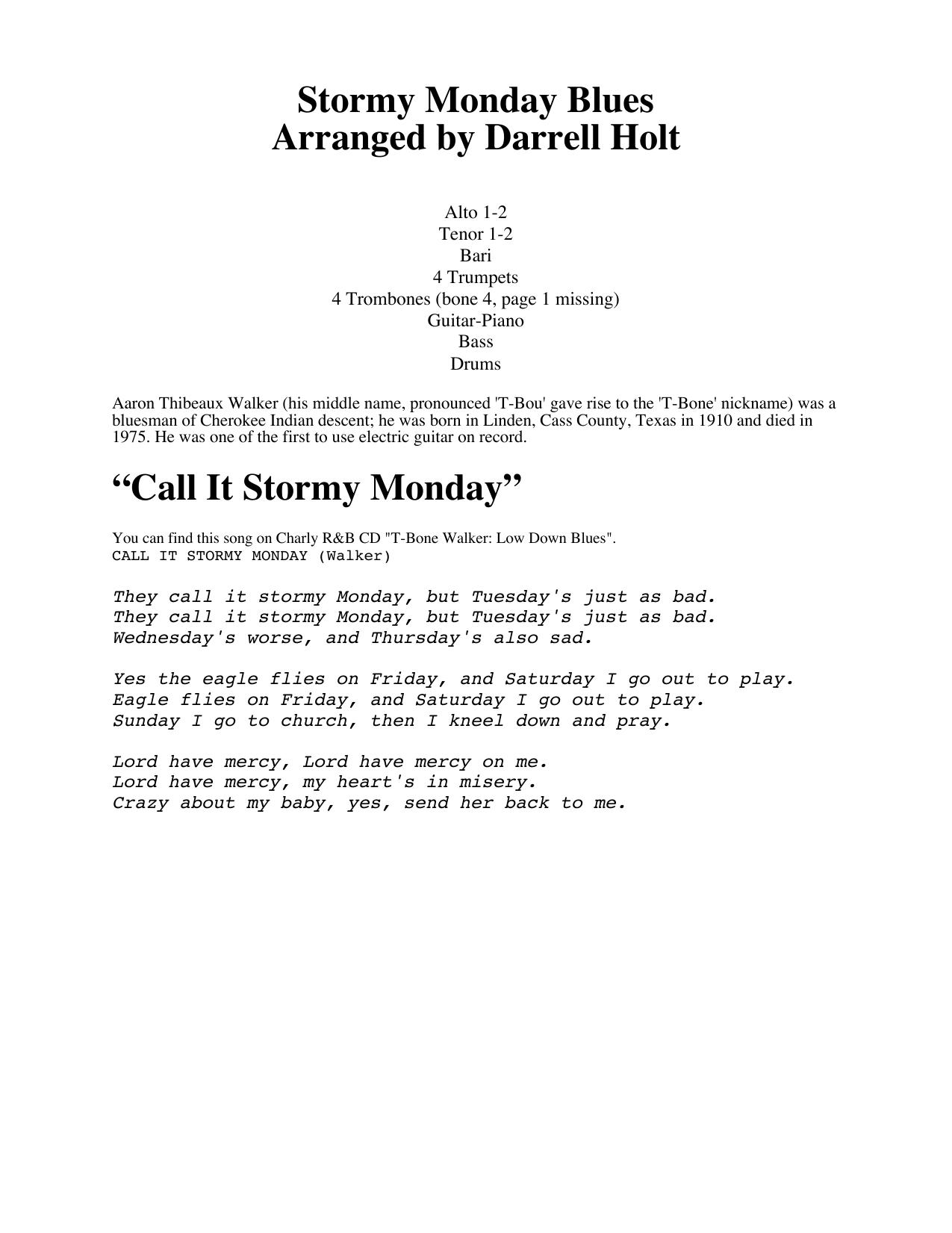
Stormy Monday Blues (D.Holt) sheet music preview

Stormy Monday Blues (D.Holt)

Composed by T-Bone Walker

Arranged by D.Holt

  • Ensemble: Big Band
  • Style: Jazz Standard
  • Pages: 48
  • Instruments (16): 1st Alto Sax, 2nd Alto Sax, 1st Tenor Sax, 2nd Tenor Sax, Bari Sax, 1st Trumpet, 2nd Trumpet, 3rd Trumpet, 4th Trumpet, 1st Trombone, 2nd Trombone, 3rd Trombone, 4th Trombone, Piano-Guitar, Bass, Drums
  • Difficulty: medium
  • Content: Individual Parts
  • Format: PDF Download (Instant)
  • Price: $24.99

T-Bone Walker’s timeless 1947 classic "Stormy Monday Blues"—formally registered as "Call It Stormy Monday (But Tuesday Is Just as Bad)"—stands as one of the foundational pillars of electric blues and a quintessential vehicle for jazz-blues expression. Recorded initially for Black & White Records, Walker’s masterwork bridged the gap between Kansas City jump blues and sophisticated urban jazz, later codified as an essential standard through landmark covers by artists like B.B. King, Lou Rawls, and Bobby "Blue" Bland. Its iconic slow-burn minor-pentatonic changes and descending bassline structure provide an endless canvas for expressive improvisation and rich ensemble textures, making it a staple of mid-century American music history. Conceived as a smoldering, late-night slow blues in 12/4 or slow 4/4 swing feel, this D.Holt arrangement oozes atmospheric tension and smoky, post-war jazz club elegance. The chart opens with a moody, muted brass introduction that establishes a heavy, contemplative atmosphere before settling into a lazy, triplet-driven groove. The harmonic language expands upon Walker's original three-chord framework by incorporating lush, extended tertian harmonies, secondary dominants, and subtle chromatic inner-voice movements reminiscent of the Count Basie and Duke Ellington libraries. The emotional arc moves effortlessly from introspective melancholy to soaring, cathartic peaks, driven by dynamic shifts and rich, dense chord voicings across the full ensemble. Arranger D.Holt brings a masterclass in dynamic contrast and section interplay to this treatment, avoiding static background figures in favor of conversational call-and-response writing between the reeds and brass. The arrangement features a lush sax soli that reinterprets the iconic melody through sophisticated modern-jazz colorations, utilizing tight, interlocking harmonies that highlight the warm timbre of the woodwind section. Brass writing relies heavily on expressive plunger work, subtle falls, and warm, open-horn pads that evoke the classic Kansas City sound. A powerful, restrained shout chorus builds organically without losing the inherent intimacy of the blues, utilizing a slow crescendo that maximizes the emotional impact of the ensemble's collective voice before dropping back down to a whisper. Designed primarily for advanced high school, collegiate, and professional community big bands, this 49-page chart requires a mature rhythm section capable of maintaining a deep, unhurried pocket and a horn section comfortable with nuanced phrasing and dynamic control. Alto saxophone 1 and trumpet 1 carry prominent solo responsibilities, offering ample space for personalized blues storytelling over well-crafted background shout figures. The primary technical challenge lies not in high-register endurance or breakneck tempos, but in the subtle art of micro-timing, swing subdivision accuracy, and maintaining a unified, smoky tone quality across all 17 voices. Achieving the authentic, laid-back feel of this arrangement requires strict adherence to the conductor’s tempo and a relaxed, triplet-based swing subdivision. The rhythm section is the anchor; the drummer should utilize a loose, lazy triplet ride cymbal pattern with a heavy emphasis on beats two and four, while the bassist walks a steady, quarter-note line that leans slightly forward into the beat to create tension against the relaxed horn figures. Brass players should master the use of cup and harmon mutes during the opening statements to achieve the necessary vocal, crying timbre. Avoid overblowing the dynamic peaks; the power of this chart stems from its controlled burn and enormous dynamic range, transitioning seamlessly from a whisper-soft pp to a commanding, resonant ff during the climax. Rehearsals should focus heavily on section blend, intonation on extended 9th and 13th chords, and matching the vibrato width across the saxophones during the soli passage. Q: What specific instruments and parts are included in this arrangement? A: The 49-page package is scored for a standard 17-instrument big band, consisting of 2 alto saxophones, 2 tenor saxophones, 1 baritone saxophone, 4 trumpets, 4 trombones, piano, guitar, bass, and drums. Q: What is the designated difficulty level for this chart? A: This arrangement is calibrated for advanced high school, collegiate, and professional big bands, requiring strong section discipline, precise intonation on extended harmonies, and mature blues interpretation. Q: What is the historical style and musical background of the piece? A: Based on T-Bone Walker's 1947 electric blues masterpiece, this chart bridges traditional jump blues and sophisticated urban jazz standard traditions, channeling the late-night, slow-swing aesthetic of mid-century big bands. Q: What makes this specific arrangement by D.Holt unique? A: It elevates the traditional three-chord blues structure through lush, extended chord voicings, a sophisticated saxophone soli, expressive muted brass writing, and a dynamically controlled shout chorus that avoids clichéd bombast. Q: What is the performance tempo and expected duration of the piece? A: The arrangement is set to a slow, smoldering swing feel (approximately 60–68 BPM) and runs for roughly 5 to 6 minutes, allowing ample room for featured improvised solos.

Questions and answers

What is included in the Stormy Monday Blues (D.Holt) PDF?
The verified current file contains individual parts across 48 pages.
How many instruments or parts are listed for Stormy Monday Blues (D.Holt)?
The verified instrumentation list contains 16 entries for this Big Band arrangement.
Who is credited for Stormy Monday Blues (D.Holt)?
Composer: T-Bone Walker. Arranger: D.Holt.
What difficulty is listed for Stormy Monday Blues (D.Holt)?
The verified difficulty level is medium.
What style is listed for Stormy Monday Blues (D.Holt)?
The catalog lists the style as Jazz Standard.
Can I preview Stormy Monday Blues (D.Holt) before buying?
Yes. The product page provides a preview generated from the current PDF file.
How is Stormy Monday Blues (D.Holt) delivered?
After successful payment, the digital PDF is made available for download. The displayed price is $24.99.

Musicians Also Search For

Stormy Monday Blues D.Holt PDFStormy Monday Blues D.Holt sheet musicStormy Monday Blues arranged by D.HoltD.Holt big band chartsD.Holt jazz arrangements PDFStormy Monday Blues T-Bone Walker sheet musicStormy Monday Blues T-Bone Walker big band arrangementsT-Bone Walker big band chartsStormy Monday Blues big band arrangementsStormy Monday Blues big band PDF downloadStormy Monday Blues jazz sheet musicbig band sheet music downloadStormy Monday Blues individual parts downloadStormy Monday Blues sheet music PDFStormy Monday Blues Jazz Standard chartsJazz Standard big band arrangementsbuy Stormy Monday Blues sheet musicdownload Stormy Monday Blues PDFStormy Monday Blues jazz chartsbest D.Holt big band arrangementsT-Bone Walker arranged by D.HoltStormy Monday Blues printable sheet musicbig band repertoire PDF

All arrangements by D.Holt All T-Bone Walker sheet music