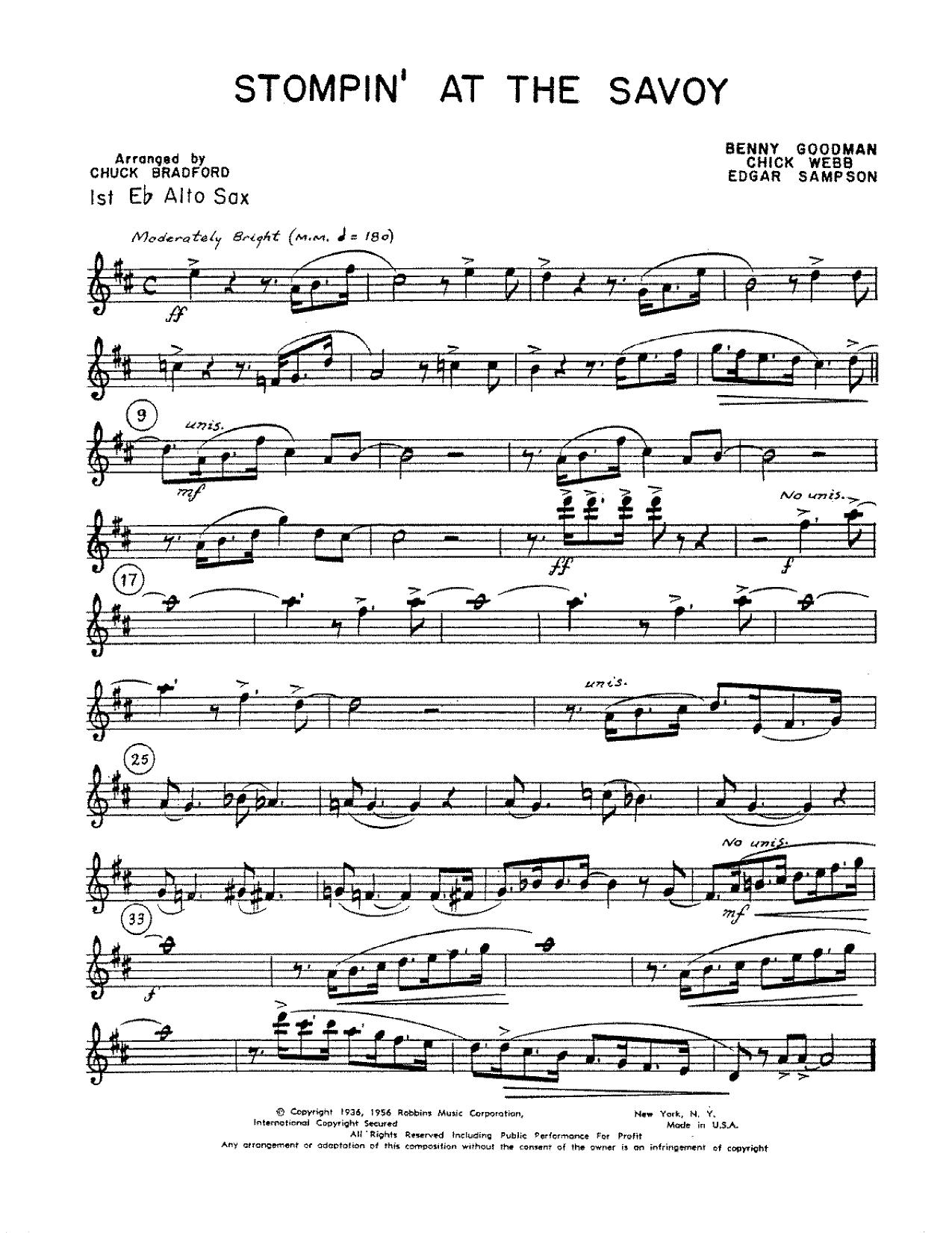
Stompin At The Savoy (C.Bradford)
Composed by Edgar Sampson
Arranged by C.Bradford
- Ensemble: Big Band
- Style: Jazz Standard
- Pages: 35
- Instruments (17): 1st Eb Alto Sax, 2nd Eb Alto Sax, 1st Bb Tenor Sax, 2nd Bb Tenor Sax, Eb Baritone Sax, 1st Trumpet, 2nd Trumpet, 3rd Trumpet, 4th Trumpet, 1st Trombone, 2nd Trombone, 3rd Trombone, 4th Trombone, Piano, Guitar, String Bass, Drums
- Difficulty: medium
- Content: Individual Parts
- Format: PDF Download (Instant)
- Price: $24.99
Written by Edgar Sampson in 1934 and immortalized by the Chick Webb Orchestra with breathtaking vocals by Ella Fitzgerald, "Stompin' at the Savoy" stands as one of the definitive anthems of the Swing Era. Named after Harlem’s legendary Savoy Ballroom—the iconic, integrated dance palace where the Lindy Hop was born—the composition captures the pulsating, joyful energy of 1930s Harlem nightlife. As a staple of the Great American Songbook and a quintessential jazz standard, the tune bridges early big band riff-style arrangements with sophisticated harmonic structures that continue to challenge and delight contemporary improvisers. In this dynamic big band adaptation by C.Bradford, the arrangement maintains an infectious, medium-up swing tempo that drives forward with relentless momentum. Opening with a crisp, rhythm-section-driven groove, the chart quickly expands into lush, harmonically rich brass voicings that evoke the polished sheen of the mid-century swing masters while injecting fresh rhythmic syncopation. The mood is celebratory, buoyant, and high-energy, demanding crisp articulation and an authentic jazz phrasing style from every section. Bradford crafts an arrangement that feels both nostalgic and vital, evoking the sweat, style, and virtuosic spirit of a Saturday night cutting contest at the Savoy. Bradford’s distinct arranging voice shines through inventive counterpoint and tightly knit horn solis that trade textures between the saxophones and brass. The reeds carry the primary thematic material early on with characteristic lightness, before handing off to soaring, punchy brass responses. A standout feature of this chart is the expertly sculpted shout chorus, which builds tension through clever chromatic voice-leading and dynamic swells before releasing into a powerhouse ensemble tutti. Improvisation space is carved out cleanly, providing ample room for featured soloists—traditionally tenor saxophone and trumpet—to stretch out over classic blues-infused changes. Advanced high school ensembles, collegiate jazz orchestras, and professional community big bands will find this chart to be an exceptionally rewarding addition to their repertoire. While the independent part-writing requires strong section playing and stylistic maturity, the intuitive phrasing and well-balanced scoring allow groups to achieve a polished sound relatively quickly. Technical demands include rapid swing eighth-note passages, careful dynamic control in the muted brass, and the stamina needed to sustain a high-energy performance from the downbeat to the final explosive chord. Bringing C.Bradford’s arrangement of "Stompin' at the Savoy" to life requires meticulous attention to the stylistic nuances of 1930s swing. The tempo should anchor comfortably around medium-up swing (approx. 160–168 BPM), avoiding the trap of rushing the backbeat; the groove must remain relaxed yet intensely driven by the rhythm section. Drummers should emphasize a steady, feathering bass drum pattern with a crisp ride cymbal sustain, while the hi-hat strictly covers beats two and four. Technically, the primary challenge lies in achieving absolute uniformity of articulation between the saxophones and brass during fast unison and harmonized soli sections. Short notes must be clipped without losing their warmth, and long notes require a subtle vocal swell. Trumpets and trombones should utilize cup or harmon mutes where indicated to create the authentic textural contrast characteristic of the era, while executing smooth falls and doits with restraint rather than caricature. Conductors should rehearse the ensemble in sections first, ensuring the horn players lock in their eighth-note swing feel—emphasizing the upbeats—before integrating the rhythm section. Pay close attention to the dynamic peaks leading into the shout chorus; ensure the ensemble starts the crescendo at a true mezzo-piano so the final peak achieves maximum impact without forcing tone quality. Q: What instruments and parts are included in this arrangement? A: This standard 17-instrument big band arrangement includes parts for 5 saxophones (Alto 1, Alto 2, Tenor 1, Tenor 2, Baritone), 4 trumpets, 4 trombones, and a full 4-piece rhythm section (piano, guitar, bass, and drums) across a comprehensive 35-page score and set of parts. Q: What is the difficulty level of this C.Bradford arrangement? A: This chart is graded as advanced-intermediate to advanced, making it best suited for capable high school, collegiate, and professional community big bands that possess strong section cohesion and comfortable swing reading skills. Q: What is the historical background and musical style of this piece? A: Originally composed by Edgar Sampson in 1934 and made famous by Chick Webb, this piece is a cornerstone of the Swing Era jazz standard repertoire, written in a vibrant, swinging 4/4 meter that celebrates the spirit of Harlem's Savoy Ballroom. Q: What makes this specific arrangement by C.Bradford unique? A: Bradford’s arrangement stands out through its clever harmonic reframing, intricate horn counterpoint, and a meticulously crafted shout chorus that balances vintage 1930s big band aesthetics with modern dynamic contrast and fresh voicings. Q: What is the performance duration and recommended tempo for this arrangement? A: The arrangement runs approximately 3.5 to 4 minutes in length when performed at the recommended medium-up swing tempo of around 160 to 168 beats per minute.
Questions and answers
- What is included in the Stompin At The Savoy (C.Bradford) PDF?
- The verified current file contains individual parts across 35 pages.
- How many instruments or parts are listed for Stompin At The Savoy (C.Bradford)?
- The verified instrumentation list contains 17 entries for this Big Band arrangement.
- Who is credited for Stompin At The Savoy (C.Bradford)?
- Composer: Edgar Sampson. Arranger: C.Bradford.
- What difficulty is listed for Stompin At The Savoy (C.Bradford)?
- The verified difficulty level is medium.
- What style is listed for Stompin At The Savoy (C.Bradford)?
- The catalog lists the style as Jazz Standard.
- Can I preview Stompin At The Savoy (C.Bradford) before buying?
- Yes. The product page provides a preview generated from the current PDF file.
- How is Stompin At The Savoy (C.Bradford) delivered?
- After successful payment, the digital PDF is made available for download. The displayed price is $24.99.
Musicians Also Search For
Stompin At The Savoy C.Bradford PDF • Stompin At The Savoy C.Bradford sheet music • Stompin At The Savoy arranged by C.Bradford • C.Bradford big band charts • C.Bradford jazz arrangements PDF • Stompin At The Savoy Edgar Sampson sheet music • Stompin At The Savoy Edgar Sampson big band arrangements • Edgar Sampson big band charts • Stompin At The Savoy big band arrangements • Stompin At The Savoy big band PDF download • Stompin At The Savoy jazz sheet music • big band sheet music download • Stompin At The Savoy individual parts download • Stompin At The Savoy sheet music PDF • Stompin At The Savoy Jazz Standard charts • Jazz Standard big band arrangements • buy Stompin At The Savoy sheet music • download Stompin At The Savoy PDF • Stompin At The Savoy jazz charts • best C.Bradford big band arrangements • Edgar Sampson arranged by C.Bradford • Stompin At The Savoy printable sheet music • big band repertoire PDF