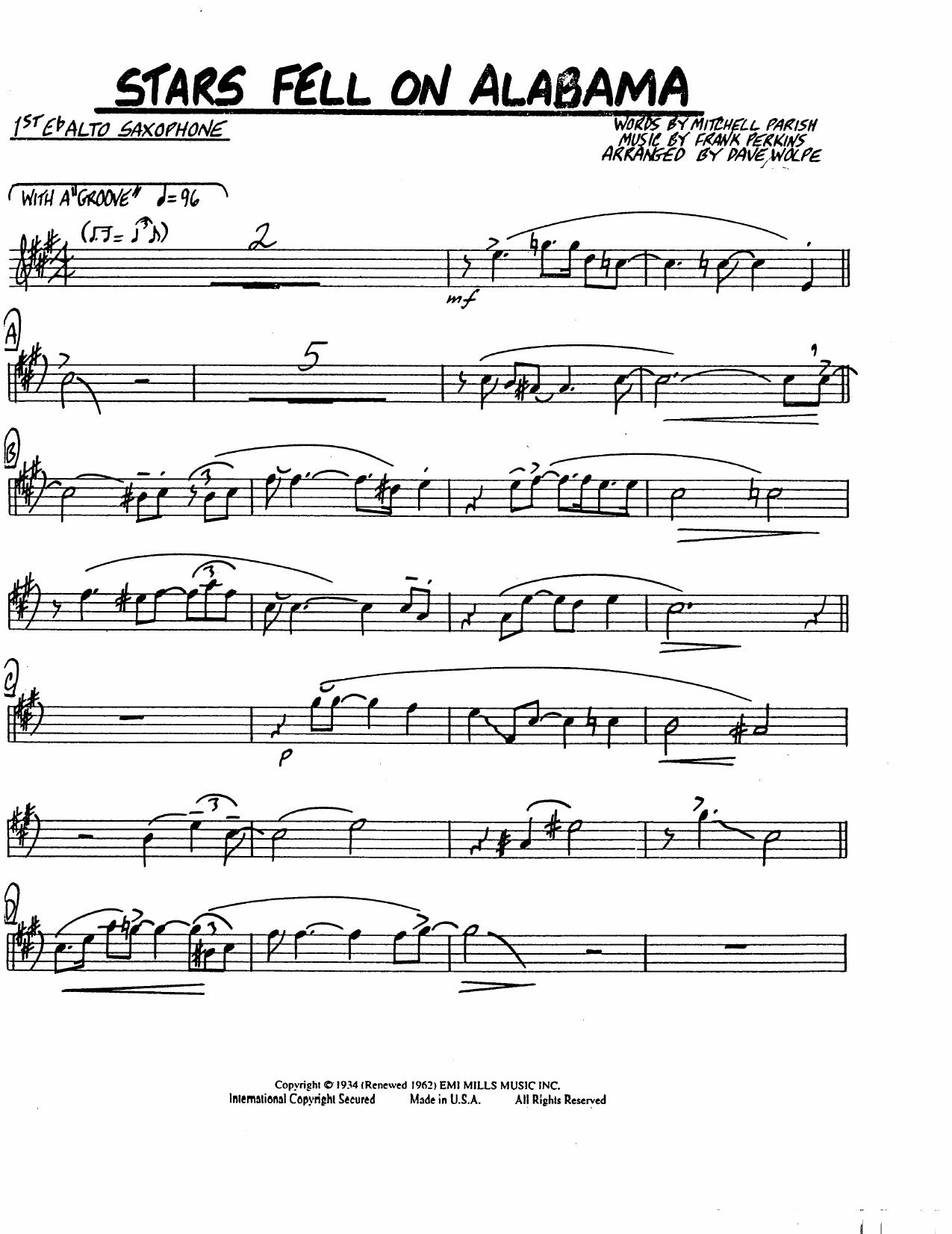
Stars Fell On Alabama (D.Wolpe)
Composed by Frank Perkins
Arranged by Dave Wolpe
- Ensemble: Big Band
- Pages: 35
- Instruments (17): 1st Eb Alto Saxophone, 2nd Eb Alto Saxophone, 1st Bb Tenor Saxophone, 2nd Bb Tenor Saxophone, Eb Baritone Saxophone, 1st Bb Trumpet, 2nd Bb Trumpet, 3rd Bb Trumpet, 4th Bb Trumpet, 1st Trombone, 2nd Trombone, 3rd Trombone, Bass Trombone, Piano, Bass, Drums, Guitar
- Difficulty: medium
- Content: Individual Parts
- Format: PDF Download (Instant)
- Price: $24.99
Composed in 1934 with music by Frank Perkins and lyrics by Mitchell Parish, "Stars Fell On Alabama" rapidly ascended from a popular Tin Pan Alley tune to an indispensable vehicle for jazz improvisation, famously immortalized by artists like Louis Armstrong and Ella Fitzgerald. Capturing the romantic, smoky atmosphere of the mid-1930s swing era, the standard evokes a nostalgic, starry-eyed sentimentality through its sweeping, cyclical chord progression and hauntingly memorable melody line. The composition relies on lush harmonic changes that invite expressive interpretation, making it a timeless canvas for sophisticated jazz arranging. Veteran arranger Dave Wolpe approaches this timeless classic with a masterclass in classic big band scoring, balancing warm, dense saxophone voicings with restrained, punchy brass accents. Written with a relaxed, flowing medium-swing feel in 4/4 time, Wolpe’s chart creates a velvety texture that immediately envelops the listener. The arrangement utilizes rich extended harmonies and subtle chromatic motion in the inner voices, driving a lush harmonic palette typical of professional studio writing. Rather than relying on high-energy pyrotechnics, the emotional arc of the chart is built on sophisticated ensemble interplay, romantic dynamic swells, and a deeply satisfying, cohesive flow from the opening statement to the final chord. The melody is primarily introduced by the saxophone section working in close harmony, gradually opening up to include the full brass ensemble as the arrangement builds in density. A standout feature of Wolpe’s setting is a beautifully crafted improvised solo section that allows a featured horn player—typically alto saxophone or trumpet—to stretch out over traditional, supportive background figures from the rest of the band. Technical challenges center on stylistic cohesion rather than sheer velocity; musicians must maintain a relaxed, laid-back swing eighth-note feel while executing seamless dynamic control, delicate intonation in the reed section, and precise articulation on muted brass lines. Advanced high school, collegiate, and community jazz ensembles will find this chart to be an exceptionally rewarding addition to their repertoire. It serves as an ideal vehicle for teaching stylistic maturity, ensemble blend, and the art of ballad-adjacent medium-swing phrasing. Directors will appreciate how naturally the arrangement sits under the fingers of the players while still offering enough harmonic and textural sophistication to challenge advanced musicianship and elevate a festival or concert program. Achieving the authentic mood of this Dave Wolpe chart requires prioritizing a relaxed, unhurried medium-swing feel. The rhythm section is the anchor here; the drummer should maintain a feather-light ride cymbal pattern with a gentle hi-hat chick on beats two and four, while the bass player walks a steady, acoustic-sounding quarter-note line without rushing. Horn players must avoid over-articulating the swing eighth notes; aim for a smooth, connected, vocal style reminiscent of 1950s studio recordings. Pay close attention to dynamic markings, particularly during the transition from the intimate intro into the main melody. The brass section should utilize cup or harmon mutes where indicated to achieve that classic smoky timbre, ensuring that muted lines blend into the saxophone textures rather than cutting through aggressively. In rehearsal, isolate the saxophone soli sections to lock in intonation and balance before integrating the rhythm section. Encourage the featured soloist to lean into the harmonic changes, utilizing space and lyricism rather than dense scalar passages to match the romantic character of the arrangement. Q: What instruments and parts are included in this big band arrangement? A: The instrumentation features a standard 17-piece big band lineup comprising 5 saxophones (Alto 1, Alto 2, Tenor 1, Tenor 2, Baritone Sax), 4 trumpets, 4 trombones, and a 4-piece rhythm section consisting of piano, bass, guitar, and drums, spanning a total of 35 pages of music. Q: What is the difficulty level of this Dave Wolpe chart? A: This arrangement is graded as medium-advanced, making it ideal for high-level high school bands, collegiate ensembles, and professional community big bands looking for stylistic and harmonic depth. Q: What is the historical context and musical style of "Stars Fell On Alabama"? A: Originating as a 1934 Tin Pan Alley standard made famous by icons like Louis Armstrong and Ella Fitzgerald, this arrangement sets the tune in a classic, relaxed medium-swing jazz style evocative of the golden age of big bands. Q: What makes this specific arrangement by Dave Wolpe unique? A: Wolpe’s chart stands out for its lush, sophisticated inner-voice harmonies, expertly crafted saxophone solis, and a sensitive arrangement style that prioritizes rich textural blend and romantic lyricism over aggressive volume. Q: What is the performance duration and tempo framework for this piece? A: While performance time varies based on the length of the improvised solos, the chart typically runs around 3 to 4 minutes at a relaxed, flowing medium-swing tempo of approximately 116 to 124 beats per minute.
Questions and answers
- What is included in the Stars Fell On Alabama (D.Wolpe) PDF?
- The verified current file contains individual parts across 35 pages.
- How many instruments or parts are listed for Stars Fell On Alabama (D.Wolpe)?
- The verified instrumentation list contains 17 entries for this Big Band arrangement.
- Who is credited for Stars Fell On Alabama (D.Wolpe)?
- Composer: Frank Perkins. Arranger: Dave Wolpe.
- What difficulty is listed for Stars Fell On Alabama (D.Wolpe)?
- The verified difficulty level is medium.
- Can I preview Stars Fell On Alabama (D.Wolpe) before buying?
- Yes. The product page provides a preview generated from the current PDF file.
- How is Stars Fell On Alabama (D.Wolpe) delivered?
- After successful payment, the digital PDF is made available for download. The displayed price is $24.99.
Musicians Also Search For
Stars Fell On Alabama Dave Wolpe PDF • Stars Fell On Alabama Dave Wolpe sheet music • Stars Fell On Alabama arranged by Dave Wolpe • Dave Wolpe big band charts • Dave Wolpe jazz arrangements PDF • Stars Fell On Alabama Frank Perkins sheet music • Stars Fell On Alabama Frank Perkins big band arrangements • Frank Perkins big band charts • Stars Fell On Alabama big band arrangements • Stars Fell On Alabama big band PDF download • Stars Fell On Alabama jazz sheet music • big band sheet music download • Stars Fell On Alabama individual parts download • Stars Fell On Alabama sheet music PDF • buy Stars Fell On Alabama sheet music • download Stars Fell On Alabama PDF • Stars Fell On Alabama jazz charts • best Dave Wolpe big band arrangements • Frank Perkins arranged by Dave Wolpe • Stars Fell On Alabama printable sheet music • big band repertoire PDF