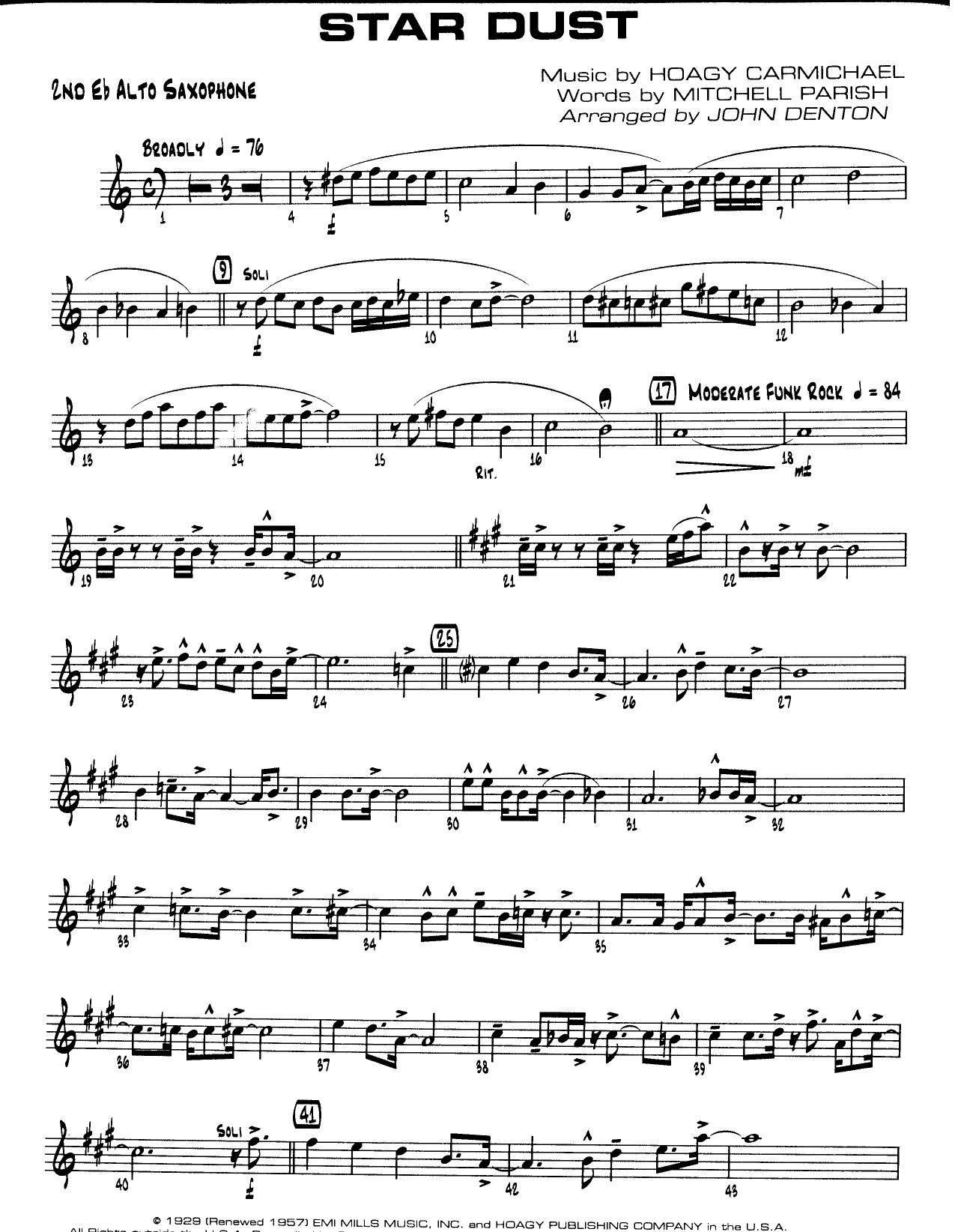
Stardust (J.Denton)
Composed by Hoagy Carmichael
Arranged by J.Denton
- Ensemble: Big Band
- Style: Jazz Standard
- Pages: 66
- Instruments (22): 2nd Eb Alto Saxophone, Eb Baritone Saxophone, 1st Baritone T.C., 2nd Baritone T.C., 3rd Baritone T.C., Bass, 1st Trombone, 2nd Trombone, 3rd Trombone, 4th Trombone, Drums, Horn in F, C Flute, Guitar, Piano, 1st Bb Tenor Saxophone, 2nd Bb Tenor Saxophone, 1st Bb Trumpet, 2nd Bb Trumpet, 3rd Bb Trumpet, 4th Bb Trumpet, Tuba
- Difficulty: advanced
- Content: Individual Parts
- Format: PDF Download (Instant)
- Price: $24.99
Hoagy Carmichael’s timeless 1927 masterpiece "Stardust" stands as one of the most frequently recorded standards in the American Songbook, defining the pinnacle of pre-bebop melodic architecture and romantic lyricism. Initially conceived as a sprightly piano instrumental before acquiring Mitchell Parish’s evocative lyrics, the composition evolved through definitive interpretations by Louis Armstrong, Artie Shaw, and Nat King Cole into a quintessential vehicle for lush, expressive jazz orchestration. Its sophisticated harmonic progression—characterized by a deceptive verse moving into a sweeping, structurally expansive 32-bar chorus—has challenged and inspired generations of arrangers seeking to capture its haunting, nostalgic emotional landscape. J.Denton’s sophisticated big band interpretation transforms this iconic standard into a sweeping, emotionally resonant tour de force designed for intermediate-to-advanced ensembles. Styled as a lush, expressive ballad with an underlying rubato feel that settles into a gentle, flowing halftime swing pulse, the chart evokes a profound sense of vintage elegance and cinematic grandeur. The arrangement avoids static harmonization by utilizing rich, modern extended voicings, gorgeous chromatic counterlines in the lower reeds, and subtle harmonic shifts that breathe fresh life into Carmichael’s familiar cadence points without ever obscuring the core melody. The structural narrative unfolds with the lead alto saxophone and flugelhorn carrying the initial statement of the theme, floating gracefully over a warm, shimmering brass pad and a meticulously balanced rhythm section. A striking, harmonically adventurous interlude leads into a dramatic full-ensemble soli section that showcases the saxophones in a tightly knit, harmonized block. While primarily designed as a showcase of mood and dynamic control, the arrangement features a poignant, improvised solo space for tenor saxophone or trumpet, supported by sparse, impressionistic chordal comping from the piano and guitar. The emotional peak arrives in a breathtaking shout chorus where the brass section swells with soaring upper-register extensions, before the texture gracefully decrescendos into a tranquil, whispered coda that leaves a lasting impression on the audience. Advanced high school, collegiate, and professional community big bands will find this chart an exceptional vehicle for developing sophisticated ensemble blend, intonation, and stylistic nuance. Because the technical demands rely far less on raw velocity and far more on breath support, balance, and rubato phrasing, it serves as a masterclass in musical maturity. Conductors looking to feature a premier guest soloist while elevating their ensemble's capacity for deep, expressive ballad playing will discover that J.Denton's treatment of "Stardust" is an indispensable addition to their concert library. Achieving success with this arrangement hinges on the ensemble's ability to maintain a relaxed, forward-moving momentum even during the slowest rubato passages. The rhythm section must lay down an ultra-transparent, feather-light feel; the drummer should favor brush work on the snare with subtle, shimmering ride cymbal accents, completely avoiding heavy backbeats. Horn players must prioritize a warm, centered tone with a minimum of vibrato during the unison and harmonized soli sections to let the rich, complex chord voicings speak with absolute clarity. Pay careful attention to the dynamic markings; the transition from the lush, soaring shout chorus down to the delicate pianissimo ending requires immense breath control and dynamic discipline from the entire brass section. Balance is paramount—the chordal accompaniment in the trombones and inner saxophones must never overpower the lead voices carrying the melodic line. Q: What specific instruments and parts are included in this big band arrangement? A: The 22-instrument instrumentation includes standard big band forces with specialized parts such as Alto Saxophone 2, Baritone Saxophone, and multiple Baritone T.C. parts (1, 2, and 3), alongside the complete 66-page manuscript featuring a full conductor score. Q: What is the overall difficulty level of this chart? A: This arrangement is tailored for advanced high school, collegiate, and professional community big bands, scoring at a medium-advanced difficulty level primarily due to its demands on intonation, breath support, and subtle dynamic control rather than fast technical passages. Q: What is the historical and stylistic background of the music? A: Based on Hoagy Carmichael's 1927 standard, this chart embraces the grand tradition of jazz ballad interpretations, reimagining the classic American Songbook entry through a lush, sophisticated contemporary big band lens. Q: What makes J.Denton's arrangement of "Stardust" unique? A: It distinguishes itself through innovative extended harmonic voicings, a striking saxophone soli section, and a dramatic, cinematic shout chorus that seamlessly bridge vintage romanticism with modern big band textures. Q: What is the suggested performance tempo and duration? A: The piece is structured as a flowing, expressive ballad with a flexible tempo feel, typically performing at around 65 to 72 BPM with a total duration of approximately 4 to 5 minutes depending on solo lengths.
Questions and answers
- What is included in the Stardust (J.Denton) PDF?
- The verified current file contains a conductor score and individual parts across 66 pages.
- How many instruments or parts are listed for Stardust (J.Denton)?
- The verified instrumentation list contains 22 entries for this Big Band arrangement.
- Who is credited for Stardust (J.Denton)?
- Composer: Hoagy Carmichael. Arranger: J.Denton.
- What difficulty is listed for Stardust (J.Denton)?
- The verified difficulty level is advanced.
- What style is listed for Stardust (J.Denton)?
- The catalog lists the style as Jazz Standard.
- Can I preview Stardust (J.Denton) before buying?
- Yes. The product page provides a preview generated from the current PDF file.
- How is Stardust (J.Denton) delivered?
- After successful payment, the digital PDF is made available for download. The displayed price is $24.99.
Musicians Also Search For
Stardust J.Denton PDF • Stardust J.Denton sheet music • Stardust arranged by J.Denton • J.Denton big band charts • J.Denton jazz arrangements PDF • Stardust Hoagy Carmichael sheet music • Stardust Hoagy Carmichael big band arrangements • Hoagy Carmichael big band charts • Stardust big band arrangements • Stardust big band PDF download • Stardust jazz sheet music • big band sheet music download • Stardust conductor score PDF • Stardust individual parts download • Stardust sheet music PDF • Stardust Jazz Standard charts • Jazz Standard big band arrangements • buy Stardust sheet music • download Stardust PDF • Stardust jazz charts • best J.Denton big band arrangements • Hoagy Carmichael arranged by J.Denton • Stardust printable sheet music • big band repertoire PDF