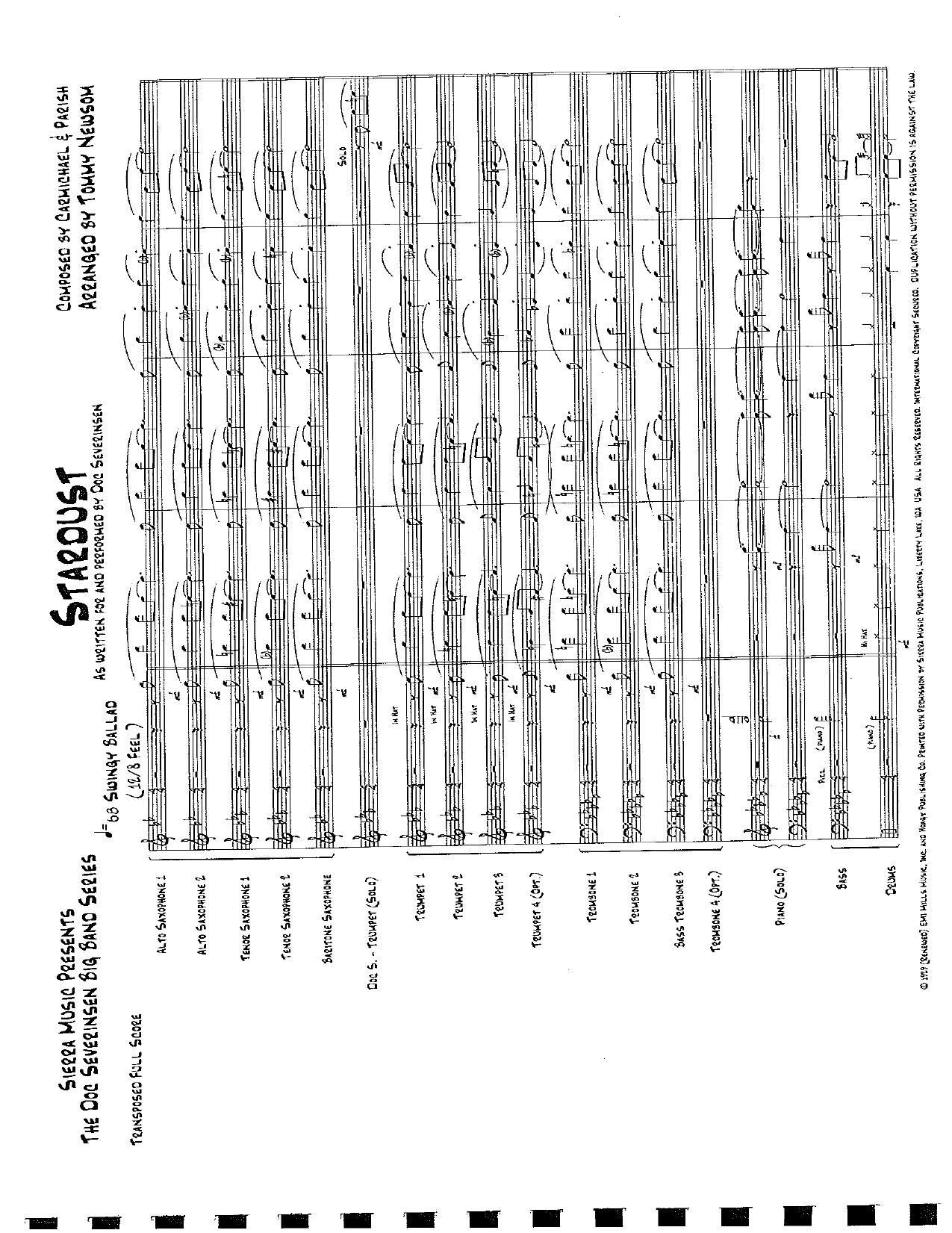
Stardust (T.Newsom)
Composed by Hoagy Carmichael
Arranged by Doc Severinsen
- Ensemble: Big Band
- Pages: 98
- Instruments (22): Doc S. - Trumpet (Solo as recorded), Optional Solo in Bb (Orig. Melody), Optional Solo in C, Optional Solo in Eb, Optional Solo in C: Bass Clef, Alto Saxophone 1, Alto Saxophone 2, Tenor Saxophone 1, Tenor Saxophone 2, Baritone Saxophone, Trumpet 1, Trumpet 2, Trumpet 3, Trumpet 4 (if 5 Tpts.), Trombone 1, Trombone 2, Bass Trombone 3, Trombone 4, Guitar, Piano, Bass, Drums
- Difficulty: advanced
- Content: Individual Parts
- Format: PDF Download (Instant)
- Price: $24.99
Hoagy Carmichael’s timeless 1927 masterpiece "Stardust" stands as one of the most frequently recorded American popular songs in history, anchoring the Great American Songbook and serving as a touchstone for generations of jazz artists. While initially conceived as an upbeat piano novelty, it was soon refashioned into an achingly romantic ballad that defined the atmospheric elegance of the swing era, immortalized by legendary interpreters like Artie Shaw, Louis Armstrong, and Nat King Cole. This iconic standard possesses a sweeping, unconventional harmonic architecture and a soaring melodic contour that invites sophisticated reharmonization, making it a natural vehicle for premier orchestrators seeking to explore lush textures and deep emotional resonance within a large ensemble framework. Master trumpeter and consummate showman Doc Severinsen brings his virtuosic flair and profound command of the idiom to this definitive big band setting. Conceived as a sublime, slow-to-medium ballad infused with shimmering brass warmth and rich harmonic suspension, the arrangement balances introspective vulnerability with cinematic grandeur. The mood shifts seamlessly from tender, solitary reflection to sweeping, emotionally charged crescendos. Severinsen’s signature approach leverages the full dynamic spectrum of the 18-piece big band, utilizing exquisite, contemporary extended harmonies in the saxes and velvety, muted brass backdrops that evoke the golden age of late-night radio broadcasts while remaining refreshingly modern in its voicing structures. The melodic narrative unfolds through carefully curated solo and sectional spotlights, demanding supreme tonal control and expressive phrasing from the lead players. Rich reed solis interweave beneath the primary thematic statements, while the brass section provides warm, cushion-like pads that gradually build in density toward a breathtaking, emotionally gripping climax. Technical challenges center less on raw velocity and more on intonation, breath support, and subtle rubato-esque pacing within a cohesive ensemble pulse. Players must master delicate dynamic control, maintaining a rich, centered sound down to a whisper, making the payoff immensely rewarding for ensembles capable of nuance and deep musical communication. Advanced high school, collegiate, and professional jazz ensembles will find this chart an extraordinary centerpiece for a concert program or festival performance. Because it relies heavily on listening, blend, and lyrical interpretation rather than sheer technical pyrotechnics, it serves as an exceptional pedagogical tool for developing mature section playing and stylistic sensitivity. Advanced groups will appreciate the sophisticated voice-leading and the opportunity to showcase a high level of expressive artistry, ensuring audiences are captivated from the opening chord to the final fading resonance. Navigating this lush ballad requires meticulous attention to intonation, balance, and stylistic cohesion across all sections. The conductor should establish a flexible, breathing tempo feel rather than a rigid metronomic grid, allowing the rubato elements of the melody to feel natural while maintaining an underlying groove. Key technical challenges involve sustaining a warm, centered tone at ultra-soft dynamics, particularly in the trumpet and trombone sections where muted passages must blend seamlessly with the saxophones. Ensure that the lead alto and lead trumpet players project a vocal quality of phrasing, treating every eighth-note subdivision with expressive weight rather than mechanical precision. Rehearsals should begin with sectional work focused purely on blend and tuning of close-voiced harmonies. Pay close attention to the dynamic swells; ensure the ensemble does not peak too early in the chart's trajectory, preserving enough headroom for the emotional apex of the arrangement. Plunger mutes and subtle cup-mute colors must be matched carefully across the brass to achieve the intended vintage yet pristine orchestral sheen. Q: What specific instruments and parts are included in this arrangement? A: This chart is scored for a standard 18-instrument big band instrumentation, featuring Alto Saxophone 1, Alto Saxophone 2, Tenor Saxophone 1, Tenor Saxophone 2, Baritone Saxophone, and a complete conductor score spanning 98 pages. Q: What is the difficulty level of this Doc Severinsen arrangement? A: This arrangement is best suited for advanced high school, collegiate, and professional jazz bands due to its heavy demand for mature intonation, subtle dynamic control, and lyrical phrasing. Q: What is the musical style and historical context of this version of "Stardust"? A: Set as a lush, expressive jazz ballad, this arrangement reimagines Hoagy Carmichael’s 1927 standard through the sophisticated, brass-centric lens of the legendary Doc Severinsen. Q: What makes this specific arrangement unique compared to other big band versions of "Stardust"? A: It features Severinsen’s signature treatment of rich, extended chord voicings, exquisite sectional writing, and a cinematic build that balances intimate solo expression with sweeping big band power. Q: What is the general performance duration and tempo feel of the piece? A: The arrangement is performed as a slow-to-medium romantic ballad with a flexible, expressive pulse, typically running between 4 and 5 minutes depending on the conductor's pacing of the rubato sections.
Questions and answers
- What is included in the Stardust (T.Newsom) PDF?
- The verified current file contains a conductor score and individual parts across 98 pages.
- How many instruments or parts are listed for Stardust (T.Newsom)?
- The verified instrumentation list contains 22 entries for this Big Band arrangement.
- Who is credited for Stardust (T.Newsom)?
- Composer: Hoagy Carmichael. Arranger: Doc Severinsen.
- What difficulty is listed for Stardust (T.Newsom)?
- The verified difficulty level is advanced.
- Can I preview Stardust (T.Newsom) before buying?
- Yes. The product page provides a preview generated from the current PDF file.
- How is Stardust (T.Newsom) delivered?
- After successful payment, the digital PDF is made available for download. The displayed price is $24.99.
Musicians Also Search For
Stardust Doc Severinsen PDF • Stardust Doc Severinsen sheet music • Stardust arranged by Doc Severinsen • Doc Severinsen big band charts • Doc Severinsen jazz arrangements PDF • Stardust Hoagy Carmichael sheet music • Stardust Hoagy Carmichael big band arrangements • Hoagy Carmichael big band charts • Stardust big band arrangements • Stardust big band PDF download • Stardust jazz sheet music • big band sheet music download • Stardust conductor score PDF • Stardust individual parts download • Stardust sheet music PDF • buy Stardust sheet music • download Stardust PDF • Stardust jazz charts • best Doc Severinsen big band arrangements • Hoagy Carmichael arranged by Doc Severinsen • Stardust printable sheet music • big band repertoire PDF