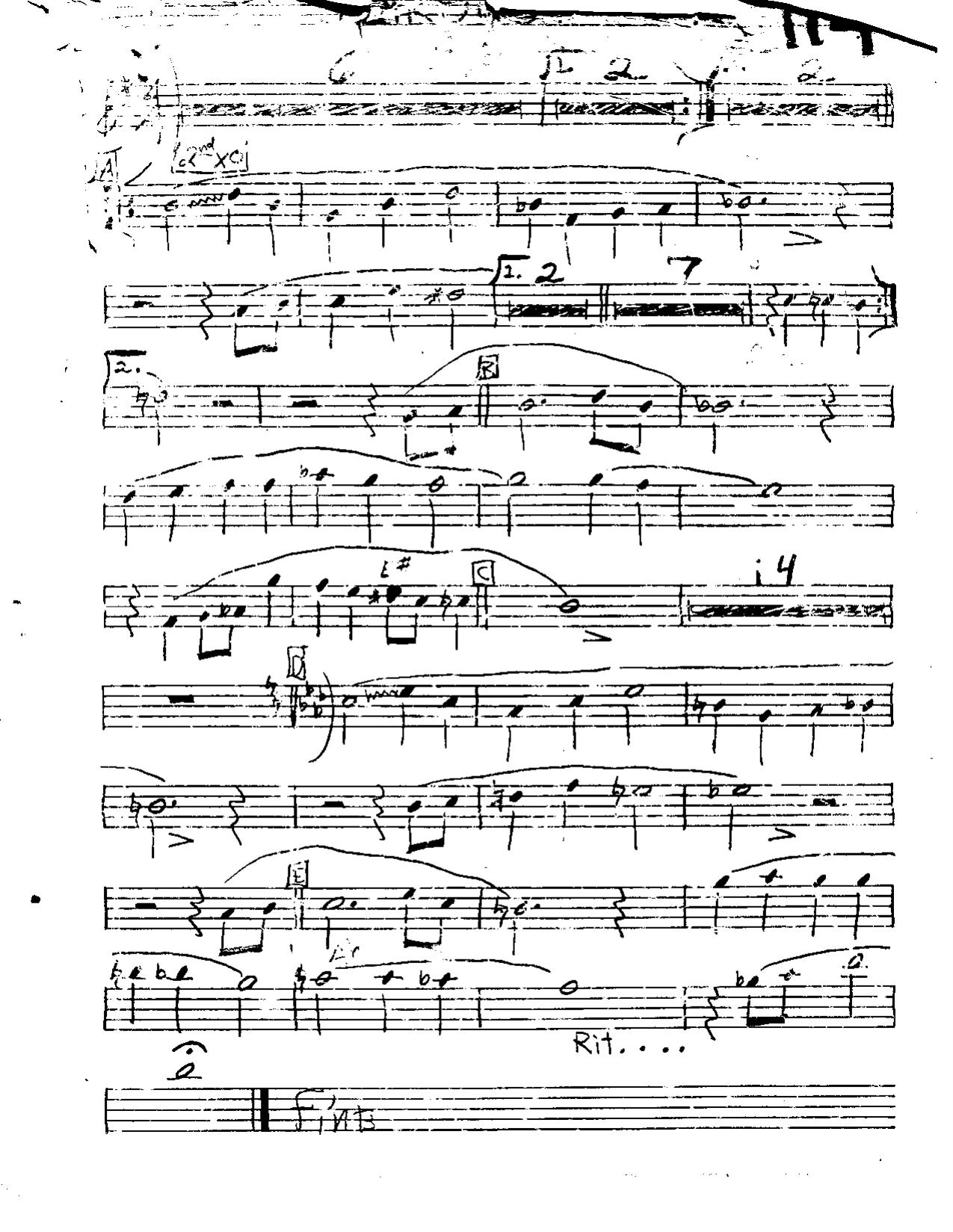
Stardust (D.Higgins)
Composed by Hoagy Carmichael
Arranged by D.Higgins
- Ensemble: Small Ensemble
- Style: Jazz Standard
- Pages: 14
- Instruments (4): Piano, Tenor Saxophone, Trombone, Trumpet
- Difficulty: easy
- Content: Individual Parts
- Format: PDF Download (Instant)
- Price: $12.99
Hoagy Carmichael's "Stardust," originally conceived as a mid-tempo instrumental in 1927, quickly evolved into one of the most beloved and frequently recorded jazz standards of all time. Its enduring appeal lies in its timeless melody and sophisticated harmonic progression, which perfectly encapsulate the romanticism and melodic invention of the Great American Songbook era. While Carmichael's own vocal rendition in 1931 cemented its lyrical fame, it was the countless instrumental interpretations by jazz luminaries like Louis Armstrong, Artie Shaw, and Nat King Cole that solidified its place in the jazz canon, showcasing its adaptability across various styles from early swing to bebop and beyond. The piece's characteristic AABA form, rich chromaticism, and emotional depth make it a cornerstone for improvisational exploration and a benchmark for melodic interpretation. D. Higgins' small ensemble arrangement of "Stardust" reimagines this classic as a captivating medium-slow swing ballad, set in the key of F Major. The mood is one of tender introspection and understated elegance, evoking the nostalgic warmth of a late-night club performance. Higgins masterfully balances the original's melodic integrity with fresh harmonic perspectives, employing lush, close-voiced harmonies that shimmer beneath the iconic melody. The arrangement opens with a rubato introduction, allowing for expressive freedom before settling into a gentle, flowing swing feel. This specific treatment highlights Higgins' signature approach: a deep respect for the source material combined with an inventive use of contemporary jazz voicings and subtle rhythmic nuances that breathe new life into familiar forms. The melody is primarily carried by the lead voice, often doubled or harmonized in rich soli sections that showcase the ensemble's blend and balance. While the arrangement is through-composed for significant portions, ample space is provided for featured improvisational solos over the classic "Stardust" changes, allowing individual musicians to express their unique voice within the established mood. Technical challenges include precise control of dynamics, particularly in the delicate rubato sections and sustained chord voicings, as well as maintaining a consistent, relaxed swing feel at a slower tempo. The rewarding aspect of performing this arrangement lies in its profound emotional impact and the opportunity for the ensemble to collectively craft a deeply moving musical narrative, culminating in a beautifully reharmonized final chorus that gently fades to a poignant close. This arrangement is ideally suited for college-level jazz combos, advanced high school ensembles, or community jazz groups seeking a sophisticated and emotionally resonant piece for their repertoire. Its detailed voicings and interpretive demands offer excellent opportunities for developing advanced ensemble playing, harmonic awareness, and expressive phrasing. Professional groups will also find it a refreshing and engaging take on a classic, perfect for showcasing their interpretive prowess and refined musicianship. The arrangement's 14 pages of meticulously notated parts ensure clarity and comprehensive guidance for all performers. This arrangement of "Stardust" thrives on a collective sense of rubato and expressive phrasing, particularly in the opening and transitional sections. Conductors should emphasize a medium-slow swing feel, around quarter note = 80-90 bpm, ensuring a relaxed yet forward momentum. The primary technical challenge lies in achieving seamless blend and balance within the close-voiced harmonies, requiring careful attention to intonation and dynamic control, especially in the sustained chords. Encourage musicians to "sing" through their instruments, focusing on a warm, sustained tone. The improvised solo sections should be approached with melodic sensitivity, respecting the ballad character. Rehearsal tips include isolating the rubato introduction to synchronize phrasing and dynamics, and practicing the soli sections slowly to ensure harmonic clarity and unified articulation. No special techniques like mutes or falls are explicitly notated, allowing for performer discretion within the ballad context. Q: What instruments or parts are included in the "Stardust (D.Higgins)" small ensemble arrangement? A: This arrangement is designed for a standard small jazz ensemble, typically including lead melodic instrument (e.g., trumpet, alto sax, or tenor sax), other horn parts, piano, bass, and drums. Specific instrumentation details are provided within the 14 pages of the score and parts. Q: What is the difficulty level of this arrangement? A: This arrangement is considered advanced intermediate to advanced. It requires strong sight-reading skills, good command of dynamics, precise intonation, and a mature understanding of jazz ballad interpretation, making it suitable for college or advanced high school ensembles. Q: What musical style and historical context does this arrangement represent? A: This is a small ensemble jazz standard arrangement of Hoagy Carmichael's "Stardust," originally composed in 1927. It is presented as a medium-slow swing ballad, embodying the romantic and harmonically rich characteristics of the Great American Songbook era. Q: What makes D.Higgins' arrangement of "Stardust" unique? A: D.Higgins' arrangement is distinguished by its lush, close-voiced harmonic treatment, a captivating rubato introduction, and a fresh reharmonization of the classic melody while maintaining its emotional integrity. It offers a sophisticated and tender interpretation of the timeless standard. Q: What is the typical performance duration or tempo for this arrangement? A: The typical performance duration for this arrangement is approximately 4-5 minutes, depending on the length of improvised solos. It is intended to be performed at a medium-slow swing tempo, generally around quarter note = 80-90 bpm.
Questions and answers
- What is included in the Stardust (D.Higgins) PDF?
- The verified current file contains individual parts across 14 pages.
- How many instruments or parts are listed for Stardust (D.Higgins)?
- The verified instrumentation list contains 4 entries for this Small Ensemble arrangement.
- Who is credited for Stardust (D.Higgins)?
- Composer: Hoagy Carmichael. Arranger: D.Higgins.
- What difficulty is listed for Stardust (D.Higgins)?
- The verified difficulty level is easy.
- What style is listed for Stardust (D.Higgins)?
- The catalog lists the style as Jazz Standard.
- Can I preview Stardust (D.Higgins) before buying?
- Yes. The product page provides a preview generated from the current PDF file.
- How is Stardust (D.Higgins) delivered?
- After successful payment, the digital PDF is made available for download. The displayed price is $12.99.
Musicians Also Search For
Stardust D.Higgins PDF • Stardust D.Higgins sheet music • Stardust arranged by D.Higgins • D.Higgins small ensemble charts • D.Higgins jazz arrangements PDF • Stardust Hoagy Carmichael sheet music • Stardust Hoagy Carmichael small ensemble arrangements • Hoagy Carmichael small ensemble charts • Stardust small ensemble arrangements • Stardust small ensemble PDF download • Stardust jazz sheet music • small ensemble sheet music download • Stardust individual parts download • Stardust sheet music PDF • Stardust Jazz Standard charts • Jazz Standard small ensemble arrangements • buy Stardust sheet music • download Stardust PDF • Stardust jazz charts • best D.Higgins small ensemble arrangements • Hoagy Carmichael arranged by D.Higgins • Stardust printable sheet music • small ensemble repertoire PDF