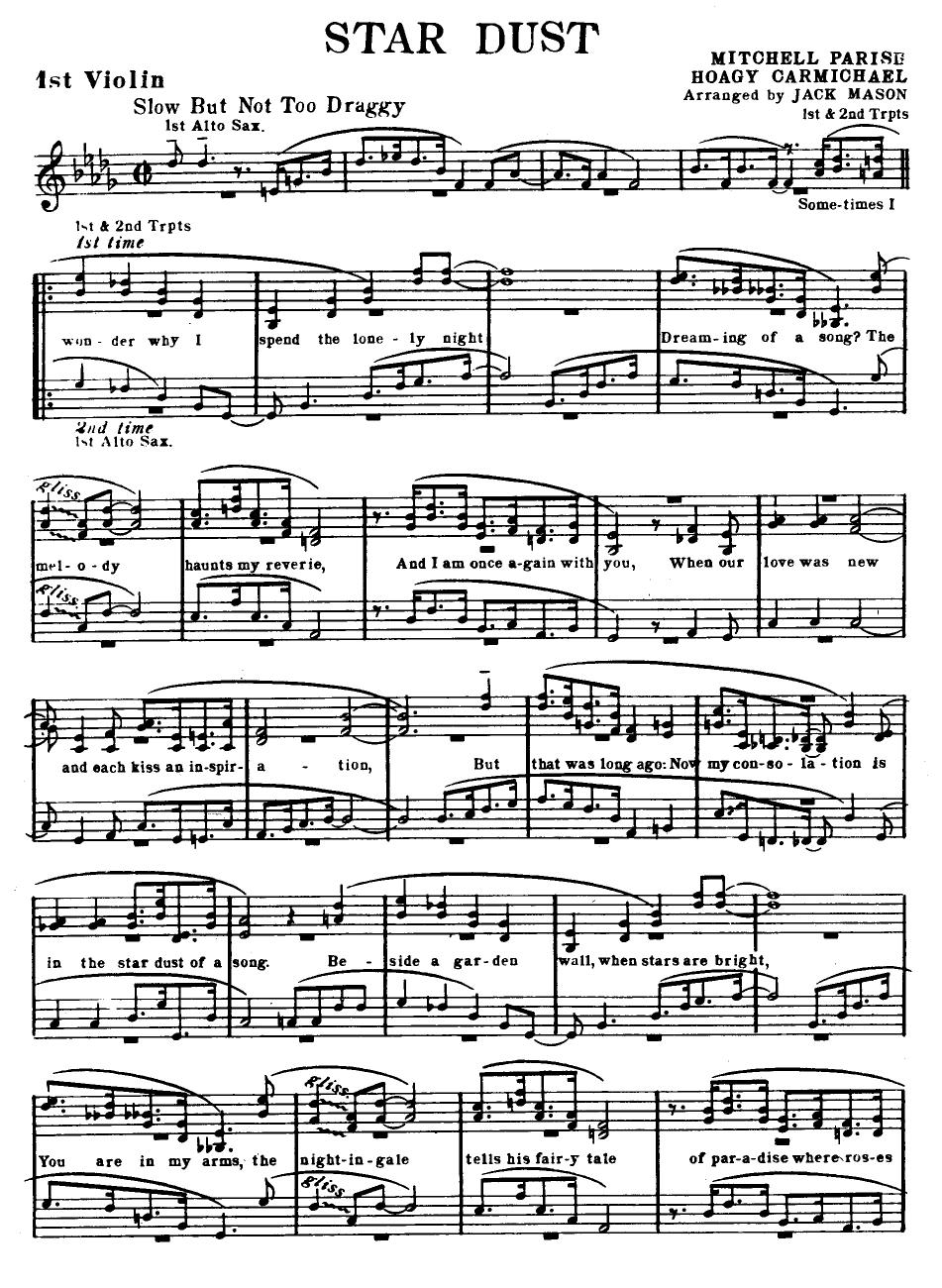
Stardust (J.Mason) sheet music preview

Stardust (J.Mason)

Composed by Hoagy Carmichael

Arranged by Jack Mason

  • Ensemble: Big Band
  • Pages: 26
  • Instruments (14): 1st Violin, 1st Saxophone - Eb Alto, 3rd Saxophone - Eb Alto, 2nd Saxophone - Bb Tenor, 4th Saxophone - Baritone, 1st Trumpet, 2nd Trumpet, 3rd Trumpet, 1st Trombone, 2nd Trombone, Piano, Guitar or Banjo, Bass, Drums
  • Difficulty: medium
  • Content: Individual Parts
  • Format: PDF Download (Instant)
  • Price: $24.99

Hoagy Carmichael’s 1927 masterpiece "Stardust" stands as one of the most enduring and frequently recorded American popular songs of the 20th century, cementing its legacy as a cornerstone of the Great American Songbook. Immortalized by Glenn Miller, Artie Shaw, and countless jazz vocalists and instrumentalists, the composition bridges early Tin Pan Alley craftsmanship with sophisticated jazz harmony. Its sprawling, conversational verse gives way to a chorus of sweeping, romantic intervals that naturally invite rich, expressive reharmonization. Within the jazz tradition, "Stardust" represents the ultimate test of a soloist's lyricism and an arranger's ability to maintain structural tension across a lush, expansive canvas. Jack Mason’s masterful big band adaptation reimagines Carmichael’s timeless ballad through a sophisticated, modern-traditional lens, establishing a gorgeous, cinematic mood from the opening measure. Conceived as a lush, expressive slow ballad with a shimmering rubato introduction, the arrangement quickly settles into a warm, undulating half-time swing feel at a relaxed tempo of approximately 64 beats per minute. The harmonic landscape is rich with extended dominant voicings, chromatic inner-voice movement, and subtle modal shifts that evoke the evocative elegance of the late swing era while maintaining a contemporary freshness. The emotional arc moves effortlessly from introspective nostalgia to soaring, cinematic grandeur, making it a powerful focal point for any concert program. Mason’s distinctive approach to scoring for a streamlined 9-piece ensemble shines through his inventive utilization of limited forces, achieving the depth and warmth of a full seventeen-piece big band. The sax section—comprising Alto, Tenor, and Baritone—functions as a cohesive, velvety choir, frequently delivering lush block-chord harmonizations beneath the lead melodic voices. The brass, featuring Trumpet and Trombone, are employed with immense dynamic sensitivity, avoiding over-embellishment in favor of warm, muted backdrops and soaring countermelodies. A standout structural feature is the gorgeously woven sax soli that bridges the primary theme into a brief, emotionally charged modulation, showcasing Mason's knack for idiomatic, flowing voice-leading that sits comfortably under the fingers while challenging the ensemble's intonation and blend. Carrying the melodic weight primarily is the lead trumpet and tenor saxophone, both of which require a mature, vocalized approach to phrasing and tone production. The arrangement features designated solo space—ideally suited for an expressive tenor saxophonist or flugelhorn player—where the rhythm section drops into a sparse, supportive texture featuring shimmering ride-cymbal pulsations and sensitive chordal accompaniment. Technical challenges within the 26-page score center primarily on balance, breath control during long, sustained phrases, and maintaining an unhurried, floating pulse across the ensemble. Performers and audiences alike will find immense satisfaction in the climactic emotional release of the final chorus, where the full ensemble swells into a rich, resonant tutti chord before fading into a peaceful, luminous cadence. Advanced high school, collegiate, and professional jazz ensembles will find this chart to be an invaluable addition to their library. While the individual technical demands on the rhythm section and horns are moderate rather than virtuosic, the arrangement requires a high degree of musical maturity, dynamic control, and listening awareness. It serves as an ideal vehicle for teaching young musicians the art of ballad playing, rubato interpretation, and sophisticated ensemble blend. Conductors should approach this arrangement of "Stardust" with an emphasis on horizontal line and unhurried lyricism. The tempo must remain steady yet flexible, avoiding any rigid mechanical feel during the swung passages; encourage the rhythm section to play behind the beat to establish a heavy, relaxed groove. Key technical hurdles involve intonation within the saxophone section during close-position chord clusters and breath support for long, lyrical phrases in the brass. Horn players should utilize warm, rounded tones with minimal vibrato in the ensemble sections, reserving expressive pitch-bending and wider vibrato for featured solo moments. The rhythm section plays a pivotal role: the pianist should voice chords cleanly in the middle register, avoiding clutter, while the bassist provides a deep, half-note or two-beat foundation. Rehearsals should initially focus on sectional balance, ensuring the inner voices do not obscure the primary melodic line carried by the lead trumpet and tenor saxophone. Q: What instruments and parts are included in this arrangement? A: This arrangement is scored for a 9-instrument big band ensemble, specifically featuring Alto Saxophone, Tenor Saxophone, Baritone Saxophone, Trumpet, Trombone, and a full rhythm section across a comprehensive 26-page score and parts set. Q: What is the difficulty level of Jack Mason's "Stardust"? A: It is graded as medium-advanced, making it ideal for collegiate ensembles, advanced high school bands, and professional groups looking for a sophisticated, expressive ballad. Q: What musical style and historical era does this chart represent? A: The arrangement is set in a lush jazz ballad style that honors the golden age of swing and the Great American Songbook, originally composed by Hoagy Carmichael. Q: What makes this specific arrangement by Jack Mason unique? A: Mason expertly packs the depth, lush harmonies, and emotional scope of a full 17-piece big band into a streamlined 9-instrument format, highlighting a gorgeous saxophone soli and sensitive dynamic contrast. Q: What is the performance duration and recommended tempo for this piece? A: The piece is performed at a slow, expressive ballad tempo (approximately 64 BPM with a relaxed half-time swing feel) and typically runs for about 4 to 5 minutes depending on solo extensions.

Questions and answers

What is included in the Stardust (J.Mason) PDF?
The verified current file contains individual parts across 26 pages.
How many instruments or parts are listed for Stardust (J.Mason)?
The verified instrumentation list contains 14 entries for this Big Band arrangement.
Who is credited for Stardust (J.Mason)?
Composer: Hoagy Carmichael. Arranger: Jack Mason.
What difficulty is listed for Stardust (J.Mason)?
The verified difficulty level is medium.
Can I preview Stardust (J.Mason) before buying?
Yes. The product page provides a preview generated from the current PDF file.
How is Stardust (J.Mason) delivered?
After successful payment, the digital PDF is made available for download. The displayed price is $24.99.

Musicians Also Search For

Stardust Jack Mason PDFStardust Jack Mason sheet musicStardust arranged by Jack MasonJack Mason big band chartsJack Mason jazz arrangements PDFStardust Hoagy Carmichael sheet musicStardust Hoagy Carmichael big band arrangementsHoagy Carmichael big band chartsStardust big band arrangementsStardust big band PDF downloadStardust jazz sheet musicbig band sheet music downloadStardust individual parts downloadStardust sheet music PDFbuy Stardust sheet musicdownload Stardust PDFStardust jazz chartsbest Jack Mason big band arrangementsHoagy Carmichael arranged by Jack MasonStardust printable sheet musicbig band repertoire PDF

All arrangements by Jack Mason All Hoagy Carmichael sheet music