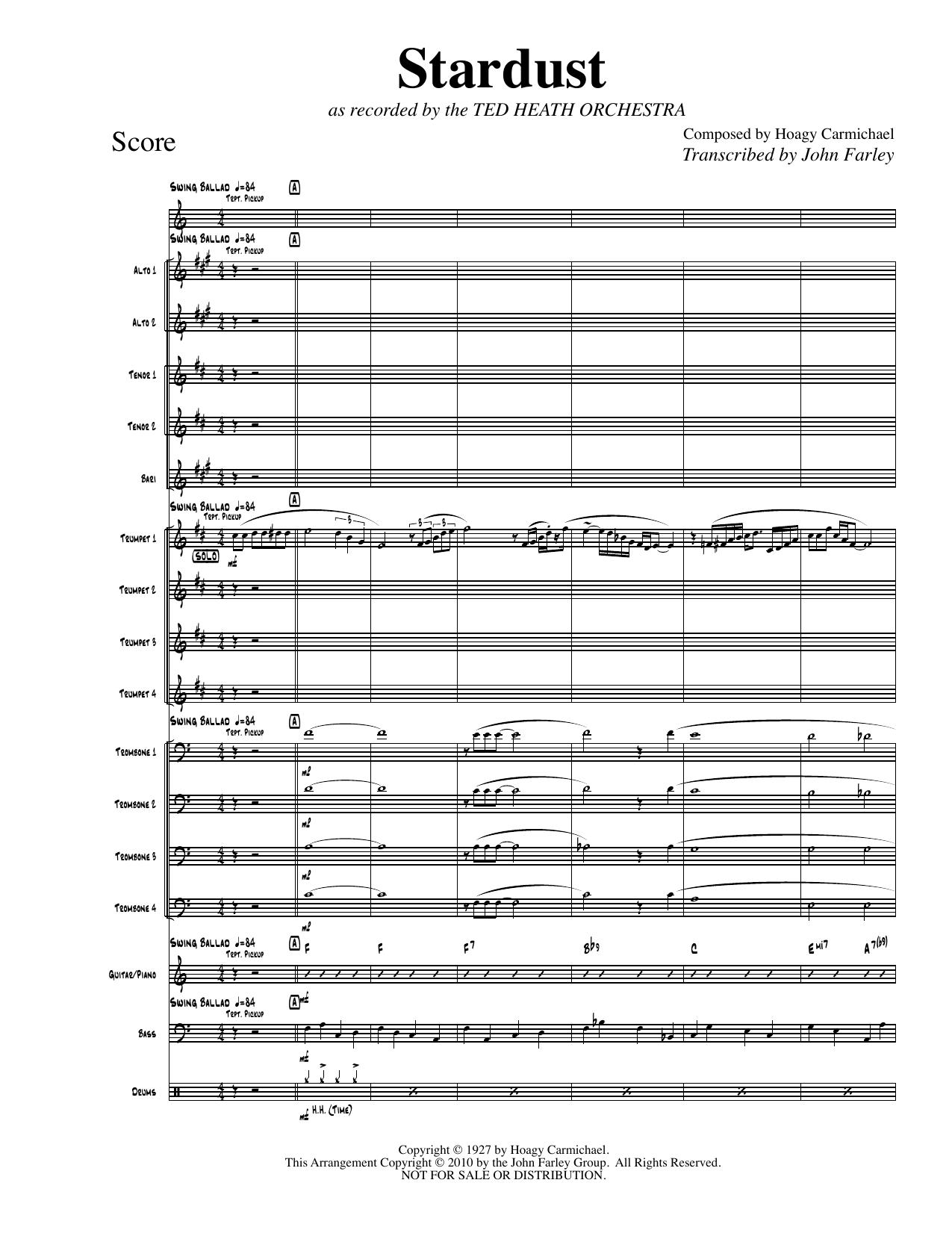
Stardust (J.Farley)
Composed by Hoagy Carmichael
Arranged by John Farley
- Ensemble: Big Band
- Pages: 37
- Instruments (16): Alto Saxophone 1, Alto Saxophone 2, Tenor Saxophone 1, Tenor Saxophone 2, Baritone Saxophone, Trumpet 1, Trumpet 2, Trumpet 3, Trumpet 4, Trombone 1, Trombone 2, Trombone 3, Trombone 4, Guitar/Piano, Bass, Drums
- Difficulty: medium
- Content: Individual Parts
- Format: PDF Download (Instant)
- Price: $24.99
Hoagy Carmichael’s 1927 masterpiece "Stardust" stands as one of the most enduring and frequently recorded American popular songs of the 20th century, cementing its place as an essential pillar of the Great American Songbook. Initially conceived as an upbeat piano novelty before being reframed as a sweeping, nostalgic ballad, the tune achieved its definitive jazz identity through classic interpretations by Louis Armstrong, Artie Shaw, and countless modern jazz icons. Its sophisticated harmonic architecture—featuring a deceptive verse-chorus structure and unusual melodic intervals—offers an ideal canvas for sophisticated big band arranging, bridging early jazz lyricism with lush, harmonically rich swing-era aesthetics. John Farley’s masterful big band adaptation reimagines the timeless standard as a lush, evocative slow ballad in 4/4 time, anchored by rich extended harmonies and a deeply cinematic mood. The chart opens with a rubato atmospheric introduction that highlights shimmering brass voicings and gentle saxophone pads, establishing an introspective, velvet-toned atmosphere before settling into a relaxed, pulsing half-time swing feel. Farley utilizes modern chord extensions—including major sevenths, minor ninths, and altered dominants—to color Carmichael’s original melody, evoking the sophisticated warmth of mid-century West Coast arranging while maintaining a deeply traditional emotional core. The primary melodic weight is carried by the lead alto saxophone and flugelhorn, who trade lyrical phrases in the opening choruses before expanding into a full sax-soli section characterized by lush block chords and subtle harmonic shifts. A soaring trumpet feature takes center stage in the bridge, demanding a warm, vibrato-laden tone and precise breath control, while the lower brass provide a warm, pillowy foundation. Technical demands lean heavily on blend, intonation, and dynamic control rather than velocity; musicians must maintain a whispered pianissimo in the ensemble backgrounds and execute seamless, cascading voice-leading without sacrificing warmth. Advanced high school ensembles, collegiate jazz orchestras, and professional community bands will find this arrangement an exceptional vehicle for developing mature ballad-playing skills, sectional cohesion, and expressive phrasing. Farley’s chart avoids rhythmic complexity in favor of deep emotional resonance, making it a show-stopping ballad feature for formal concerts, festival adjudications, and sophisticated club settings where ensemble dynamic sensitivity is paramount. Conductors should approach John Farley’s arrangement of "Stardust" with a primary focus on horizontal phrasing, lush balance, and absolute rhythmic precision during rubato transitions. The tempo should hover around a relaxed quarter note = 66-72 BPM, ensuring the underlying swing pulse remains felt rather than explicitly driven. Key technical challenges include maintaining a unified intonation profile across the saxophone section during dense block-voicing passages and sustaining a warm, centered tone in the extreme registers of the brass. The rhythm section must treat the time loosely during the intro and outro, leaning into an elastic, breathing rubato, while locking into a feather-light, unhurried ride cymbal pulse when the half-time groove settles in. No special plunger mutes or unconventional extended techniques are required, though players should utilize subtle vibrato to emulate the classic vocal styling of 1950s ballad interpretations. Rehearsal time should be heavily invested in achieving a transparent dynamic balance; the accompanying brass and reeds must never overpower the featured soloist or lead melodic voice, ensuring every nuanced harmonic substitution is clearly heard. Q: What instruments and parts are included in this arrangement? A: This chart is scored for an 8-instrument big band ensemble configuration, specifically featuring Alto Saxophone, Tenor Saxophone, Baritone Saxophone, Trumpet, Trombone, and a complete rhythm section core across its 37 pages of fully realized parts. Q: What is the difficulty level of this arrangement? A: It is graded as advanced intermediate to advanced, designed primarily for collegiate, high-level high school, and professional community jazz ensembles that possess strong sectional blend, mature intonation, and refined ballad-playing sensibilities. Q: What musical style and historical era does this arrangement reflect? A: The arrangement is set in a lush, sophisticated slow ballad jazz style that pays homage to the classic swing-era interpretation of Hoagy Carmichael’s 1927 standard, infused with modern extended harmonies and cinematic voicings. Q: What makes John Farley’s arrangement unique? A: Farley’s treatment stands out through its use of modern harmonic extensions, seamless modulation between rubato textures and a half-time swing groove, and a distinctive sax-soli that reinterprets Carmichael’s iconic melody with fresh, contemporary colors. Q: What is the performance duration and suggested tempo for this piece? A: The performance duration is approximately 4.5 to 5 minutes when executed at the recommended tempo of a relaxed quarter note = 66 to 72 BPM.
Questions and answers
- What is included in the Stardust (J.Farley) PDF?
- The verified current file contains a conductor score and individual parts across 37 pages.
- How many instruments or parts are listed for Stardust (J.Farley)?
- The verified instrumentation list contains 16 entries for this Big Band arrangement.
- Who is credited for Stardust (J.Farley)?
- Composer: Hoagy Carmichael. Arranger: John Farley.
- What difficulty is listed for Stardust (J.Farley)?
- The verified difficulty level is medium.
- Can I preview Stardust (J.Farley) before buying?
- Yes. The product page provides a preview generated from the current PDF file.
- How is Stardust (J.Farley) delivered?
- After successful payment, the digital PDF is made available for download. The displayed price is $24.99.
Musicians Also Search For
Stardust John Farley PDF • Stardust John Farley sheet music • Stardust arranged by John Farley • John Farley big band charts • John Farley jazz arrangements PDF • Stardust Hoagy Carmichael sheet music • Stardust Hoagy Carmichael big band arrangements • Hoagy Carmichael big band charts • Stardust big band arrangements • Stardust big band PDF download • Stardust jazz sheet music • big band sheet music download • Stardust conductor score PDF • Stardust individual parts download • Stardust sheet music PDF • buy Stardust sheet music • download Stardust PDF • Stardust jazz charts • best John Farley big band arrangements • Hoagy Carmichael arranged by John Farley • Stardust printable sheet music • big band repertoire PDF