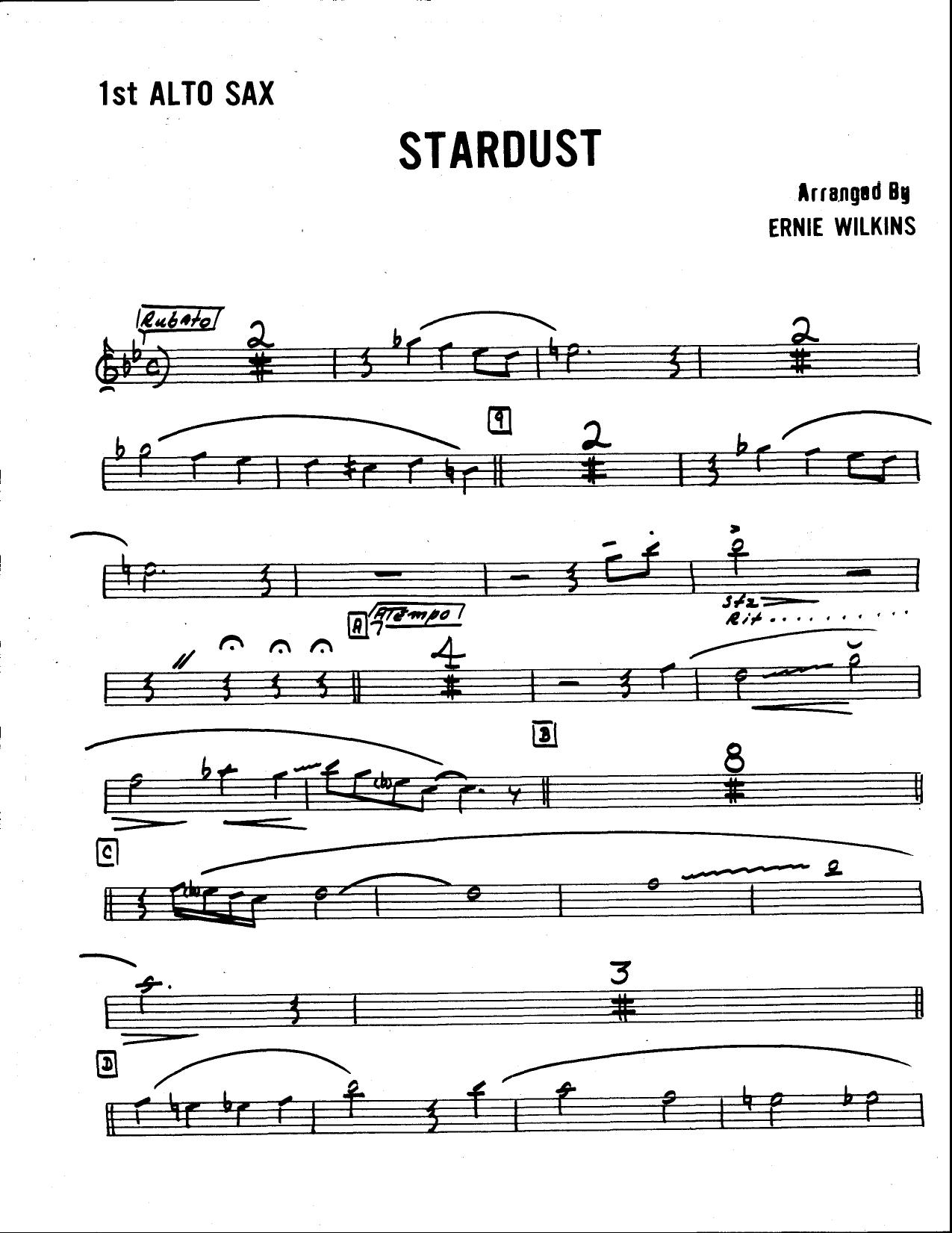
Stardust (E.Wilkins) sheet music preview

Stardust (E.Wilkins)

Composed by Hoagy Carmichael

Arranged by Ernie Wilkins

  • Ensemble: Big Band
  • Pages: 31
  • Instruments (18): 1st Alto Saxophone, 2nd Alto Saxophone, 1st Tenor Saxophone, 2nd Tenor Saxophone, 5th Baritone Saxophone, Solo Trumpet, 1st Trumpet, 2nd Trumpet, 3rd Trumpet, 4th Trumpet, 1st Trombone, 2nd Trombone, 3rd Trombone, 4th Trombone, Bass, Drums, Piano, Guitar
  • Difficulty: medium
  • Content: Individual Parts
  • Format: PDF Download (Instant)
  • Price: $24.99

Hoagy Carmichael’s immortal 1927 ballad "Stardust" stands as one of the most frequently recorded standards in the American Songbook, capturing a profound sense of nostalgic melancholy and romantic longing. While countless vocalists and small groups have interpreted its soaring, chromatic contours, translating its intimate lyricism into a full-scale big band canvas requires a master architect of jazz orchestration. Enter Ernie Wilkins, whose legendary writing for the Count Basie Orchestra and various elite mid-century ensembles uniquely equipped him to balance lush, impressionistic harmonies with the driving, sophisticated momentum of the modern jazz tradition. In this definitive arrangement, Wilkins transforms a timeless parlor-style melody into a sophisticated orchestral journey that retains the aching vulnerability of the original tune while injecting a rich, burnished jazz-ensemble vitality. The musical character of this chart unfolds through a delicate equilibrium of warm, atmospheric textures and subtle, undulating swing grooves. Rather than treating the melody as a rigid template, Wilkins employs lush, extended chord voicings in the brass and reeds that shift beneath the surface like twilight shadows. The mood is deeply evocative, transitioning seamlessly from introspective, rubato-like expressive passages into gentle, flowing medium-tempo swing feels that allow the melody to breathe. The emotional weight of the piece relies heavily on dynamic control; the ensemble must navigate whispered subtones and velvety mutes before blossoming into rich, resonant tutti declarations that amplify Carmichael's harmonic genius without ever overwhelming its fragile beauty. Ernie Wilkins approaches the orchestration with his trademark economy and elegance, favoring transparent, horn-driven textures over dense, cluttered counterpoint. The arrangement brilliantly showcases the woodwinds, utilizing a classic 8-instrument configuration (including Alto, Tenor, and Baritone Saxophones, Trumpet, and Trombone) where every voice functions as an essential pillar of the harmony. The saxophone section enjoys lush, block-chord solis that recall the sophisticated writing of the Basie Kansas City school, while the brass provide warm, cushioning backgrounds that converse directly with the lead voice. A standout feature of the chart is its masterclass pacing—Wilkins builds tension incrementally across the 31 pages of score and parts, utilizing subtle modulation and harmonic surprises that keep both the performers and the audience utterly captivated. Advanced high school, collegiate, and professional jazz ensembles will find this arrangement an exceptional vehicle for developing ensemble blend, intonation, and stylistic maturity. Because the chart relies so heavily on rubato phrasing, delicate balance, and nuanced dynamic shading rather than sheer velocity, it serves as an ultimate test of a band's collective listening skills and musical sensitivity. Featured solo spaces allow a sensitive horn player to step forward and interpret the iconic melody with personal conviction, while the surrounding ensemble writing provides a masterclass in professional big band arranging. Performing this Ernie Wilkins classic offers audiences a deeply moving concert experience and provides student musicians with an invaluable lesson in the art of jazz ballad interpretation. Conductors tackling this Ernie Wilkins arrangement must prioritize lyrical phrasing and meticulous balance above all else. The tempo should remain flexible and expressive, anchored by a relaxed, conversational swing feel that never feels rushed or mechanical. Intonation across the saxophone section is paramount during the dense, harmonized soli passages; players must lock their pitch centers, particularly when utilizing extended upper-structure chords. Brass players should focus on a warm, vocal tone quality, employing soft cup or harmon mutes where indicated to achieve that velvety, mid-century studio aura. Rehearsal strategy should begin by having the rhythm section establish a rock-solid, understated pulse that breathes with the soloists. Directors must spend dedicated rehearsal time balancing the chordal backgrounds so they act as a living, shifting cushion rather than a barrier to the featured melodic voice. Emphasize linear movement and gentle crescendos into minor structural peaks, ensuring the emotional climax feels earned rather than forced. Q: What instruments and parts are included in this publication? A: This arrangement is scored for an 8-instrument ensemble comprising Alto Saxophone, Tenor Saxophone, Baritone Saxophone, Trumpet, Trombone, and a complete rhythm section, spanning a comprehensive 31 pages of authoritative score and individual parts. Q: What is the difficulty level of this arrangement? A: This chart is graded as advanced, making it ideal for skilled college, community, and advanced high school jazz ensembles that excel in ballad playing, ensemble blend, and subtle stylistic nuance. Q: What is the historical and stylistic context of this chart? A: Composed originally by Hoagy Carmichael in 1927, "Stardust" is filtered here through the sophisticated arranging lens of Ernie Wilkins, a giant of the mid-century big band era known for his work with Count Basie and Dizzy Gillespie. Q: What makes this specific arrangement unique? A: Unlike aggressive up-tempo shout-chorus charts, Wilkins's arrangement is unique for its impressionistic voicings, transparent 8-instrument textures, and its ability to maintain the intimate, melancholic essence of a vocal ballad within an instrumental jazz framework. Q: What is the approximate performance duration and tempo feel? A: The piece runs approximately 4 to 5 minutes in duration and features a relaxed, expressive medium-tempo swing feel anchored by rubato sections that demand flexible, organic time-keeping from the rhythm section.

Questions and answers

What is included in the Stardust (E.Wilkins) PDF?
The verified current file contains individual parts across 31 pages.
How many instruments or parts are listed for Stardust (E.Wilkins)?
The verified instrumentation list contains 18 entries for this Big Band arrangement.
Who is credited for Stardust (E.Wilkins)?
Composer: Hoagy Carmichael. Arranger: Ernie Wilkins.
What difficulty is listed for Stardust (E.Wilkins)?
The verified difficulty level is medium.
Can I preview Stardust (E.Wilkins) before buying?
Yes. The product page provides a preview generated from the current PDF file.
How is Stardust (E.Wilkins) delivered?
After successful payment, the digital PDF is made available for download. The displayed price is $24.99.

Musicians Also Search For

Stardust Ernie Wilkins PDFStardust Ernie Wilkins sheet musicStardust arranged by Ernie WilkinsErnie Wilkins big band chartsErnie Wilkins jazz arrangements PDFStardust Hoagy Carmichael sheet musicStardust Hoagy Carmichael big band arrangementsHoagy Carmichael big band chartsStardust big band arrangementsStardust big band PDF downloadStardust jazz sheet musicbig band sheet music downloadStardust individual parts downloadStardust sheet music PDFbuy Stardust sheet musicdownload Stardust PDFStardust jazz chartsbest Ernie Wilkins big band arrangementsHoagy Carmichael arranged by Ernie WilkinsStardust printable sheet musicbig band repertoire PDF

All arrangements by Ernie Wilkins All Hoagy Carmichael sheet music