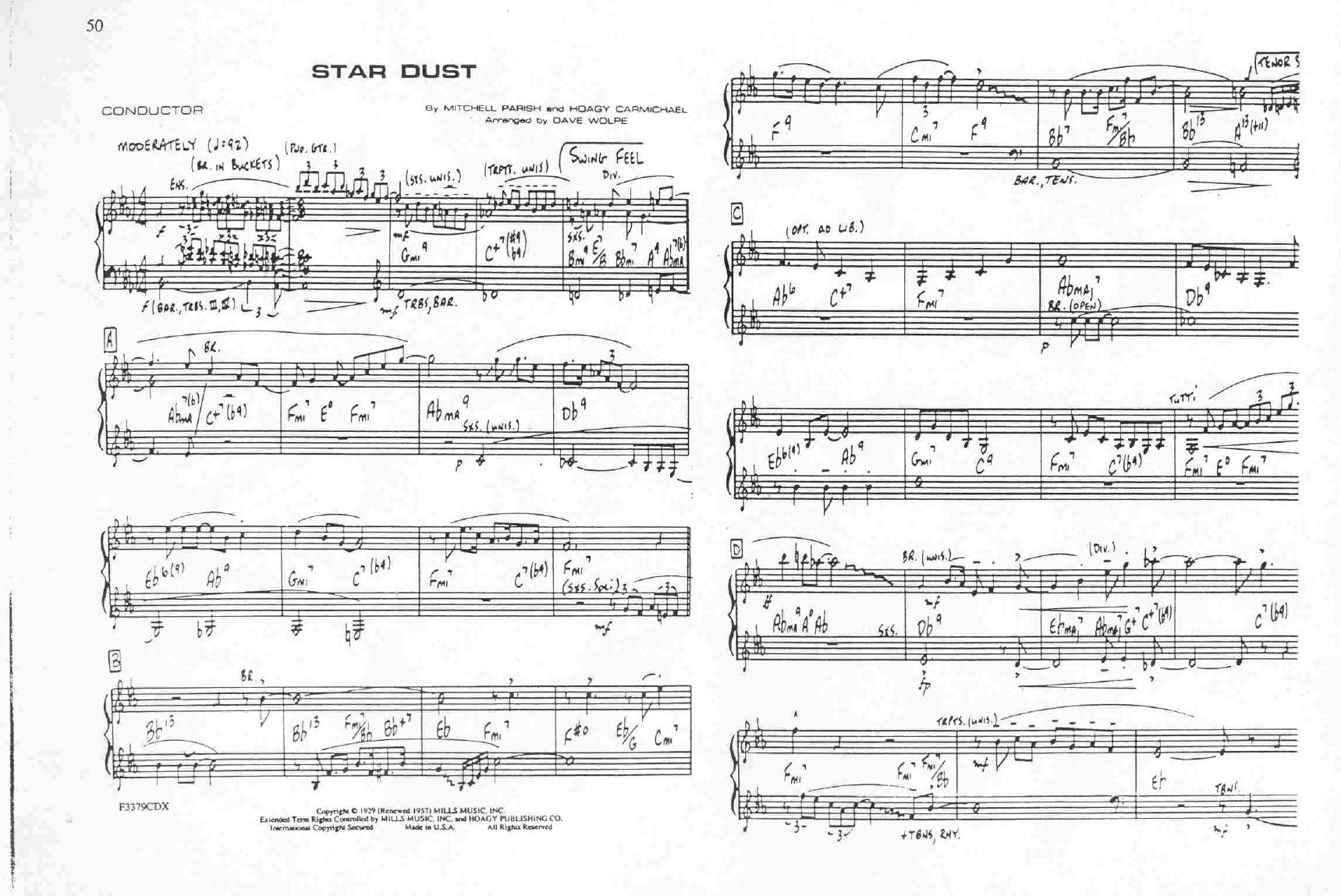
Stardust (D.Wolpe) sheet music preview

Stardust (D.Wolpe)

Composed by Hoagy Carmichael

Arranged by Dave Wolpe

  • Ensemble: Big Band
  • Pages: 38
  • Instruments (18): Conductor, 1st Eb Alto Saxophone, 2nd Eb Alto Saxophone, 1st Bb Tenor Saxophone, 2nd Bb Tenor Saxophone, Eb Baritone Saxophone, 1st Bb Trumpet, 2nd Bb Trumpet, 3rd Bb Trumpet, 4th Bb Trumpet, 1st Trombone, 2nd Trombone, 3rd Trombone, 4th Trombone, Guitar, Piano, Bass, Drums
  • Difficulty: medium
  • Content: Individual Parts
  • Format: PDF Download (Instant)
  • Price: $24.99

Hoagy Carmichael’s timeless masterpiece "Stardust," written in 1927 and enhanced by Mitchell Parish’s evocative lyrics in 1929, stands as one of the most frequently recorded songs in the history of American popular music. Representing the pinnacle of the Great American Songbook, the composition achieved legendary status through definitive interpretations by Louis Armstrong, Artie Shaw, and Nat King Cole. It epitomizes the sophisticated harmonic language of the early-to-mid 20th century, bridging the gap between Tin Pan Alley craftsmanship and the evolving language of jazz improvisation. Its enduring appeal lies in its sweeping, melancholic melody and sophisticated chord progressions, which naturally invite sensitive, expressive reharmonization and ensemble staging. Dave Wolpe’s magnificent big band adaptation transforms this iconic standard into a lush, cinematic ballad framed by a lush, late-night atmosphere. Set in a relaxed, rubato-to-tempo ballad feel in 4/4 time, the arrangement opens with an atmospheric, rubato piano and horn introduction before settling into a warm, flowing medium-slow swing groove. The harmonic landscape is rich with extended chord voicings, lush saxophone solis, and shimmering brass pads that evoke the classic sound of the 1950s Capitol Records studio orchestras. The emotional arc moves from introspective nostalgia to soaring, passionate climaxes, making it a profound emotional centerpiece for any concert program. Wolpe expertly balances full ensemble textures with delicate chamber-like passages. The melody is initially carried by the lead alto saxophone, supported by warm, harmonized saxophones in tight, beautiful voicings, before passing to a featured trumpet or tenor saxophone soloist. The arrangement features a tasteful, open improvised solo section over the standard AABA form, allowing a featured artist to stretch out over lush chord changes. Technical demands center primarily on breath control, intonation in extreme registers, and dynamic subtlety rather than sheer velocity. The primary challenge lies in maintaining a consistent, relaxed momentum through the rubato transitions and executing the delicate dynamic shifts required to make the ensemble breathe as one unified voice. Advanced high school, collegiate, and professional jazz ensembles will find this chart an ideal vehicle for developing lyrical phrasing, blend, and stylistic maturity. Because it eschews aggressive modern dissonance in favor of rich, traditional jazz-colossus harmonies, it connects instantly with audiences of all generations. Directors will appreciate how the chart naturally showcases a lead soloist while providing every section with deeply satisfying, beautifully crafted independent lines that elevate the standard big band repertoire to high art. Mastering this arrangement requires meticulous attention to blend, balance, and rubato phrasing. The conductor must carefully manage the tempo transitions, ensuring that the shift from the rubato rubato introduction into the steady ballad swing feel feels organic and unforced. Technically, the primary challenge rests in maintaining pristine intonation during exposed, soft dynamic passages, particularly within the saxophone section solis and muted brass statements. Players should utilize a warm, centered tone without excessive vibrato to preserve the classic studio-orchestra aesthetic. Subtle use of cup or harmon mutes in the brass can add wonderful color texture during the secondary theme, though open-horn playing with a warm, round sound is standard. In rehearsal, isolate the dynamic swells and practice the phrase endings collectively to ensure a unified release. Encourage the soloist to take rhythmic liberties with the melody during the opening statement before settling into a confident, lyrical exploration of the changes during the solo chorus. Q: What instrumentation and parts are included in this Dave Wolpe arrangement of "Stardust"? A: The chart is scored for a standard 17-piece big band instrumentation, comprising 5 saxophones (Alto 1, Alto 2, Tenor 1, Tenor 2, Baritone), 4 trumpets, 4 trombones, and a 4-piece rhythm section consisting of piano, bass, drums, and guitar, spanning 38 total pages of music. Q: What is the difficulty level of this arrangement? A: This arrangement is rated as medium-advanced, making it highly suitable for skilled high school, collegiate, and professional community big bands that possess strong lyrical phrasing and intonation control. Q: What is the historical style and background of this piece? A: Based on Hoagy Carmichael’s 1927 jazz standard, this chart reflects the sophisticated ballad style of the mid-20th-century studio big band era, emphasizing lush harmonies, romantic nostalgia, and rich ensemble voicings. Q: What makes Dave Wolpe's treatment of "Stardust" unique? A: Wolpe distinguishes this setting through his masterful use of cinematic, rich extended voicings, a flowing ballad swing groove, and delicate transitions that elevate a standard vocal-style melody into an engaging instrumental showpiece. Q: What is the approximate performance duration and tempo feel? A: The arrangement is set in a relaxed, expressive ballad tempo with a flowing swing feel, typically running between 4 and 5 minutes depending on the length of the improvised solo section.

Questions and answers

What is included in the Stardust (D.Wolpe) PDF?
The verified current file contains a conductor score and individual parts across 38 pages.
How many instruments or parts are listed for Stardust (D.Wolpe)?
The verified instrumentation list contains 18 entries for this Big Band arrangement.
Who is credited for Stardust (D.Wolpe)?
Composer: Hoagy Carmichael. Arranger: Dave Wolpe.
What difficulty is listed for Stardust (D.Wolpe)?
The verified difficulty level is medium.
Can I preview Stardust (D.Wolpe) before buying?
Yes. The product page provides a preview generated from the current PDF file.
How is Stardust (D.Wolpe) delivered?
After successful payment, the digital PDF is made available for download. The displayed price is $24.99.

Musicians Also Search For

Stardust Dave Wolpe PDFStardust Dave Wolpe sheet musicStardust arranged by Dave WolpeDave Wolpe big band chartsDave Wolpe jazz arrangements PDFStardust Hoagy Carmichael sheet musicStardust Hoagy Carmichael big band arrangementsHoagy Carmichael big band chartsStardust big band arrangementsStardust big band PDF downloadStardust jazz sheet musicbig band sheet music downloadStardust conductor score PDFStardust individual parts downloadStardust sheet music PDFbuy Stardust sheet musicdownload Stardust PDFStardust jazz chartsbest Dave Wolpe big band arrangementsHoagy Carmichael arranged by Dave WolpeStardust printable sheet musicbig band repertoire PDF

All arrangements by Dave Wolpe All Hoagy Carmichael sheet music