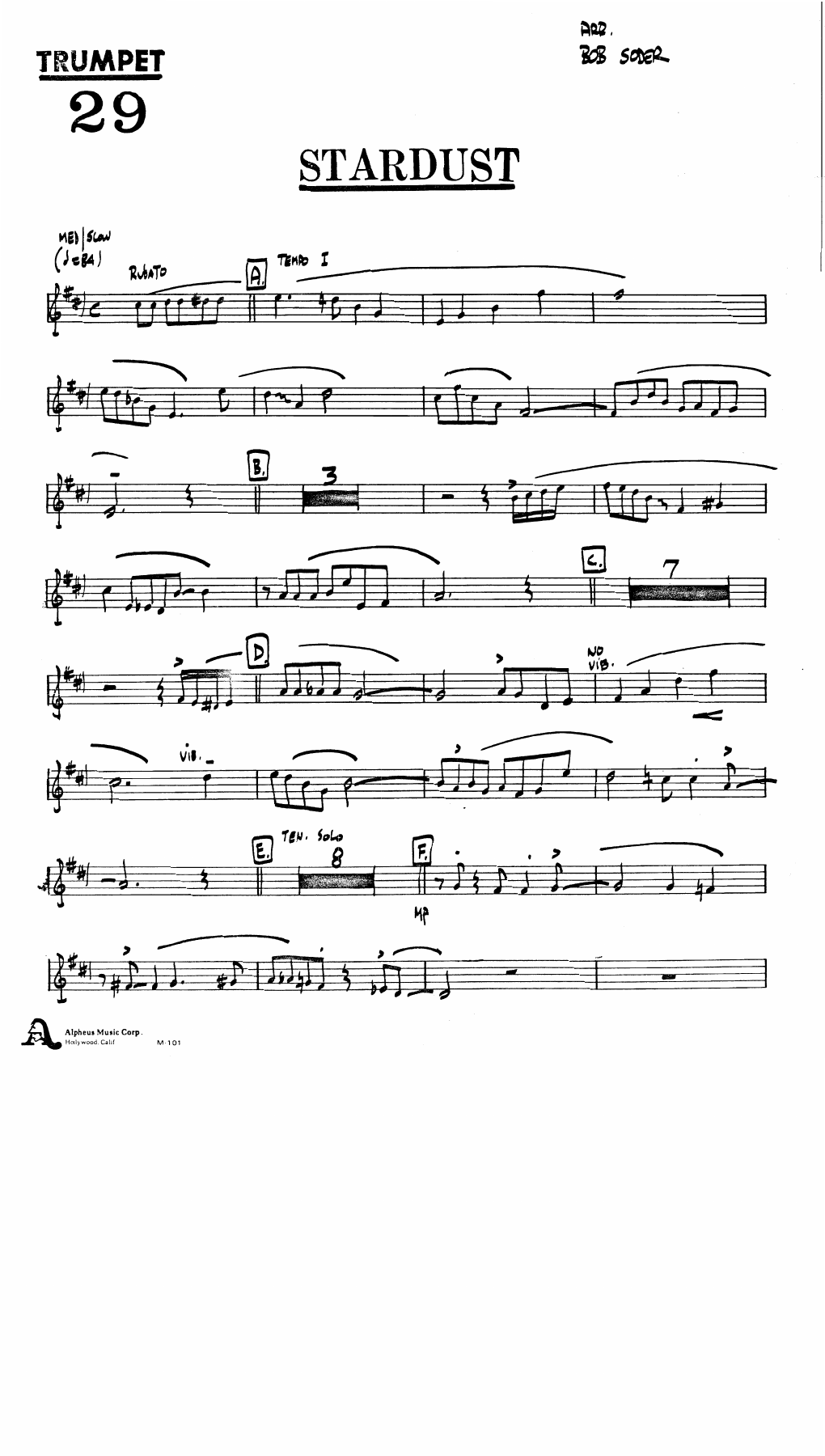
Stardust (B.Soder)
Composed by Hoagy Carmichael
Arranged by Bob Soder
- Ensemble: Small Ensemble
- Style: Jazz Standard
- Pages: 10
- Difficulty: easy
- Content: Sheet Music
- Format: PDF Download (Instant)
- Price: $12.99
Hoagy Carmichael’s "Stardust" stands as a monumental pillar of the Great American Songbook, a timeless jazz standard composed in 1927. Initially recorded by Carmichael and His Pals as an instrumental at a medium tempo, it gained widespread fame and its iconic ballad tempo after Mitchell Parish added lyrics in 1929. This piece transcends eras, having been recorded over 1,500 times by an astonishing array of artists, from Louis Armstrong and Artie Shaw to Nat King Cole and Willie Nelson, solidifying its place as one of the most beloved and enduring compositions of the 20th century. Its distinctive 32-bar A-B-A-C structure, combined with Carmichael's complex melody featuring wide leaps and sophisticated harmonic movement, including numerous sevenths, ninths, and thirteenths, gives "Stardust" a unique, bittersweet character that evokes feelings of nostalgic longing and romantic reflection. Bob Soder’s arrangement of "Stardust" for small ensemble masterfully captures the tune's inherent beauty while infusing it with a fresh, yet respectful, jazz sensibility. Soder, known for his work with high school jazz ensembles, approaches this classic with an ear for clarity, balance, and pedagogical effectiveness. This rendition likely features rich, close voicings characteristic of small group jazz, emphasizing harmonic depth without sacrificing transparency. Expect a medium-slow swing feel, allowing ample space for the melody to breathe and for the ensemble to articulate the nuanced harmonies. Soder's signature might include thoughtful counter-melodies, perhaps in a soli section, and a dynamic build that culminates in a tasteful shout chorus, all while maintaining the melancholic and dreamy mood that defines "Stardust." The arrangement places the iconic melody primarily in the lead horn, often with supportive harmonies from other ensemble members, creating a warm and inviting texture. While the arrangement is designed to be accessible, it offers rewarding challenges that foster musical growth. Featured solo sections, typically over the original chord changes, provide opportunities for improvisation, with Soder potentially offering written-out solo suggestions or clear chord symbols for developing improvisers. Technical demands might include precise articulation, controlled dynamics, and blend within the small group setting. The true reward lies in the ensemble's ability to convey the emotional depth of the piece, navigating its sophisticated harmonic landscape and delivering a cohesive, expressive performance that honors the original while showcasing the arranger's thoughtful interpretation. This arrangement is particularly well-suited for college, community, and advanced high school jazz ensembles, providing a sophisticated yet achievable vehicle for exploring a cornerstone of jazz repertoire. Approaching "Stardust (B.Soder)" requires a focus on lyrical phrasing and harmonic sensitivity. The primary technical challenge lies in maintaining a consistent, relaxed medium-slow swing feel, ensuring that the eighth notes are properly swung without rushing. Conductors should emphasize blend and balance within the small ensemble, particularly in the harmonized melody and soli sections, where precise intonation is paramount. Encourage musicians to listen across the ensemble, allowing the lead voice to project while supporting parts provide a rich harmonic bed. Dynamics are crucial; subtle crescendos and decrescendos will enhance the emotional arc of the piece. For any improvised solos, guide players to focus on melodic development that complements the song's melancholic mood, utilizing the provided chord changes as a foundation. Rehearsal time should also be dedicated to refining the ensemble's collective interpretation of the ballad style, ensuring a unified and expressive performance. Q: What instruments are typically included in this small ensemble arrangement? A: While specific instrumentation can vary, a small ensemble arrangement of "Stardust (B.Soder)" generally includes a lead melodic instrument (e.g., trumpet or alto saxophone), other horn parts for harmony and counterpoint, and a standard jazz rhythm section of piano, bass, and drums. Q: What is the difficulty level of this arrangement? A: This arrangement is considered appropriate for college, community, and advanced high school jazz ensembles, offering a balance of accessible melodic lines and harmonically rich sections that present rewarding challenges for developing musicians. Q: What musical style and historical context does "Stardust (B.Soder)" represent? A: This arrangement is a jazz standard, rooted in the classic American popular song tradition of the late 1920s and 1930s. It embodies the lyrical and harmonically sophisticated characteristics of the swing era ballad. Q: What makes Bob Soder's arrangement of "Stardust" unique? A: Bob Soder's approach is characterized by clear voicings, thoughtful counter-melodies, and a focus on ensemble blend and balance, making this arrangement both pedagogically sound and musically expressive, while honoring the original's melancholic beauty. Q: What is the typical performance duration and tempo feel for this piece? A: As a medium-slow swing ballad, the performance duration will typically be around 4-6 minutes, depending on the number and length of improvised solos, with a tempo that allows for expressive phrasing and a relaxed, flowing feel.
Musicians Also Search For
Stardust Bob Soder PDF • Stardust Bob Soder sheet music • Stardust arranged by Bob Soder • Bob Soder small ensemble charts • Bob Soder jazz arrangements PDF • Stardust Hoagy Carmichael sheet music • Stardust Hoagy Carmichael small ensemble arrangement • Hoagy Carmichael small ensemble charts • Stardust small ensemble arrangement • Stardust small ensemble PDF download • Stardust jazz ensemble sheet music • small ensemble sheet music instant download • Stardust sheet music with parts • Stardust Jazz Standard chart • Jazz Standard small ensemble arrangements • buy Stardust sheet music online • download Stardust PDF • Stardust jazz chart • best Bob Soder small ensemble arrangements • Hoagy Carmichael songs arranged by Bob Soder • Stardust printable sheet music • small ensemble repertoire PDF