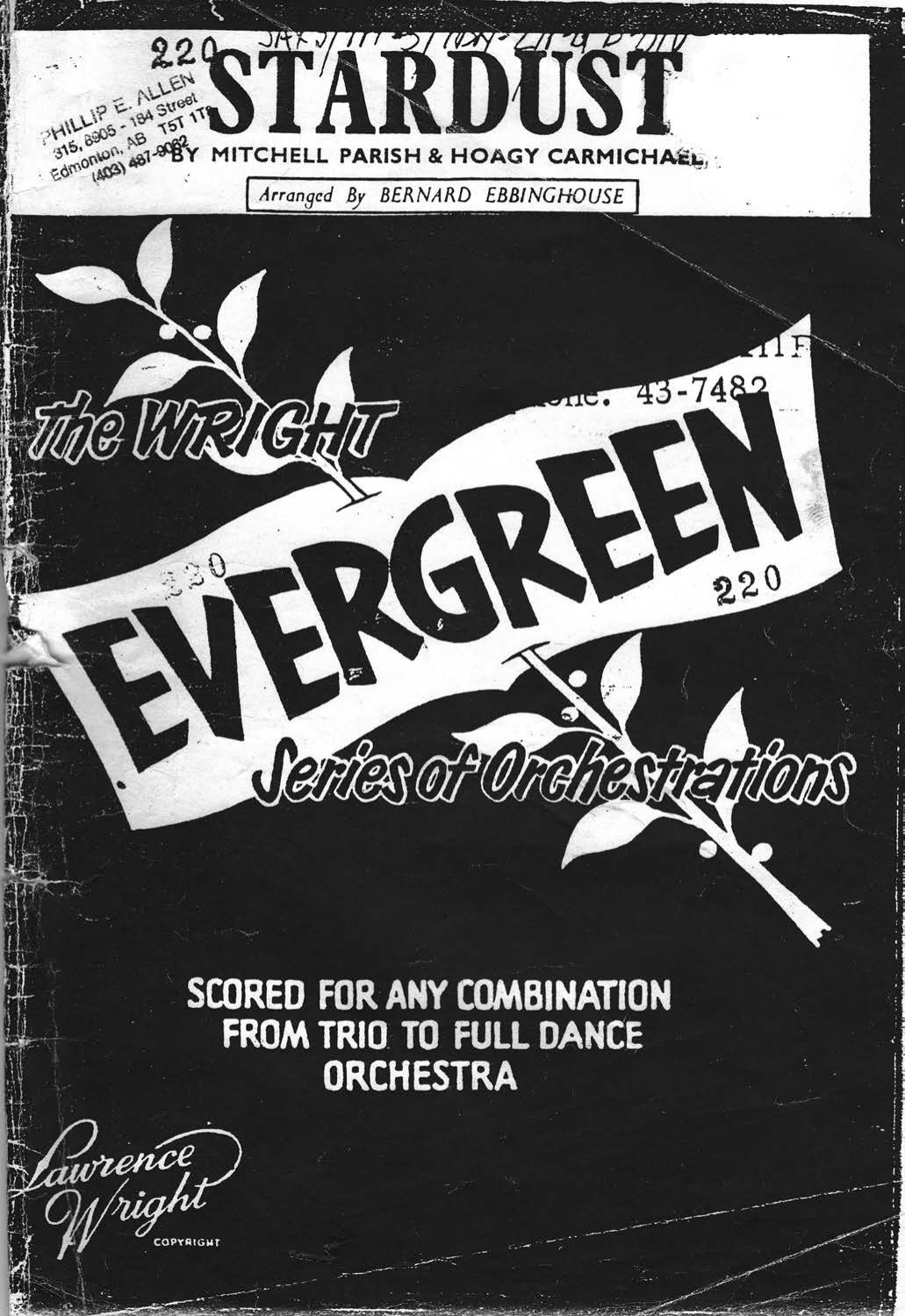
Stardust (B.Ebbinghouse) vocal
Composed by Hoagy Carmichael
Arranged by B. Ebbinghouse
- Ensemble: Big Band Dance
- Style: Big Band Dance
- Pages: 24
- Instruments (16): 1st Sax Eb Alto, 3rd Sax Eb Alto, 2nd Sax Bb Tenor, 4th Sax Bb Tenor, Eb Baritone Sax, 1st Bb Trumpet, 2nd Bb Trumpet, 3rd Bb Trumpet, 1st Trombone, 2nd Trombone, Guitar, Bass, Piano Conductor & Accordion Guide, Drums, Violins, Vocal
- Difficulty: medium
- Content: Individual Parts
- Format: PDF Download (Instant)
- Price: $24.99
Hoagy Carmichael's timeless ballad, "Stardust," stands as one of the most enduring and beloved compositions in the Great American Songbook. Penned in 1927, initially as a medium-tempo instrumental, it gained widespread recognition and its iconic slow ballad tempo after Mitchell Parish added lyrics in 1929. The song quickly transcended its jazz origins, becoming a staple for big bands, vocalists, and orchestras throughout the 1930s and beyond, famously recorded by artists such as Louis Armstrong, Artie Shaw, Glenn Miller, and Frank Sinatra. Its melancholic yet hopeful melody, coupled with evocative lyrics, captures a profound sense of nostalgia and romantic longing, establishing it as a cornerstone of the big band dance era and a perennial jazz standard. B. Ebbinghouse's vocal arrangement of "Stardust" reimagines this classic for a Big Band Dance ensemble, retaining its quintessential elegance while infusing it with a fresh, yet historically informed, perspective. Set in a medium-slow ballad tempo, likely around 60-70 BPM, the arrangement maintains the original's reflective and tender mood, emphasizing lush harmonies and a smooth, flowing rhythmic feel. Ebbinghouse's signature approach often involves meticulous voice leading and a sophisticated understanding of period-appropriate orchestration, ensuring that the arrangement sounds authentic to the big band dance tradition while offering contemporary clarity. The arrangement is likely set in a comfortable vocal key, facilitating expressive delivery. This particular arrangement highlights the vocal soloist throughout, with the ensemble providing a rich, supportive backdrop. Expect beautifully voiced saxophone soli sections that echo the vocal melody or provide counter-melodic interest, characteristic of the era. The brass sections will likely feature warm, sustained chords and carefully placed melodic figures, avoiding overly aggressive or modernistic voicings. While "Stardust" is primarily a feature for the vocalist, there may be opportunities for brief, lyrical instrumental solos, perhaps from the alto saxophone or trumpet, maintaining the song's reflective character. The technical challenges lie primarily in achieving a cohesive, blended ensemble sound, maintaining precise intonation in slow, sustained passages, and supporting the vocalist with sensitivity and dynamic control. The reward lies in performing a genuinely moving and historically rich piece that captivates audiences with its timeless beauty. This arrangement is ideally suited for college, community, and professional big bands seeking to perform a classic big band dance number with a dedicated vocal feature. Its authentic styling and thoughtful orchestration make it an excellent choice for ensembles looking to explore the repertoire of the 1930s and 40s, providing both an educational experience in period performance practice and a deeply satisfying musical journey for both performers and listeners. To capture the true essence of this "Stardust" arrangement, prioritize a unified, warm ensemble sound. The medium-slow ballad tempo (approx. 60-70 BPM) requires meticulous rhythmic precision, particularly in sustained chords and lyrical lines, to avoid dragging or rushing. Focus on blend and intonation, especially within the saxophone and brass sections during soli passages. Dynamics are crucial; ensure the ensemble provides a sensitive, supportive cushion for the vocalist, allowing their melody to always shine through. Brass players should aim for a smooth, legato articulation, avoiding harsh attacks. Rehearse the transitions between vocal and instrumental sections carefully to ensure seamless flow. The emotional depth of the piece relies on a collective commitment to its melancholic yet hopeful mood. Q: What instruments and parts are included in this arrangement? A: This arrangement is scored for 9 instruments: Vocal, Alto Saxophone, Tenor Saxophone, Baritone Saxophone, Trumpet, Trombone, Piano, Bass, and Drums. The full 24 pages include all individual parts and a conductor's score. Q: What is the difficulty level of B. Ebbinghouse's "Stardust" arrangement? A: This arrangement is suitable for college, community, and professional big bands. While not overly technically demanding, it requires strong musicianship, precise intonation, and a nuanced understanding of big band ballad style for an authentic performance. Q: What musical style and historical context does this arrangement represent? A: This arrangement is firmly rooted in the Big Band Dance style of the 1930s and 1940s, featuring Hoagy Carmichael's classic composition "Stardust." It evokes the romantic and nostalgic atmosphere of that era's dance halls and radio broadcasts. Q: What makes B. Ebbinghouse's arrangement of "Stardust" unique? A: B. Ebbinghouse's approach emphasizes lush, period-appropriate voicings and a sensitive orchestration that perfectly frames the vocal soloist. It captures the authentic big band dance sound while offering a clear, playable chart for modern ensembles. Q: What is the approximate performance duration and tempo for this arrangement? A: While variable depending on soloists and interpretation, a typical performance duration would be around 3.5 to 4.5 minutes. The tempo is a medium-slow ballad, generally around 60-70 beats per minute.
Questions and answers
- What is included in the Stardust (B.Ebbinghouse) vocal PDF?
- The verified current file contains a conductor score and individual parts across 24 pages.
- How many instruments or parts are listed for Stardust (B.Ebbinghouse) vocal?
- The verified instrumentation list contains 16 entries for this Big Band Dance arrangement.
- Who is credited for Stardust (B.Ebbinghouse) vocal?
- Composer: Hoagy Carmichael. Arranger: B. Ebbinghouse.
- What difficulty is listed for Stardust (B.Ebbinghouse) vocal?
- The verified difficulty level is medium.
- What style is listed for Stardust (B.Ebbinghouse) vocal?
- The catalog lists the style as Big Band Dance.
- Can I preview Stardust (B.Ebbinghouse) vocal before buying?
- Yes. The product page provides a preview generated from the current PDF file.
- How is Stardust (B.Ebbinghouse) vocal delivered?
- After successful payment, the digital PDF is made available for download. The displayed price is $24.99.
Musicians Also Search For
Stardust B. Ebbinghouse PDF • Stardust B. Ebbinghouse sheet music • Stardust arranged by B. Ebbinghouse • B. Ebbinghouse big band dance charts • B. Ebbinghouse jazz arrangements PDF • Stardust Hoagy Carmichael sheet music • Stardust Hoagy Carmichael big band dance arrangements • Hoagy Carmichael big band dance charts • Stardust big band dance arrangements • Stardust big band dance PDF download • Stardust jazz sheet music • big band dance sheet music download • Stardust conductor score PDF • Stardust individual parts download • Stardust sheet music PDF • Stardust Big Band Dance charts • Big Band Dance big band dance arrangements • buy Stardust sheet music • download Stardust PDF • Stardust jazz charts • best B. Ebbinghouse big band dance arrangements • Hoagy Carmichael arranged by B. Ebbinghouse • Stardust printable sheet music • big band dance repertoire PDF