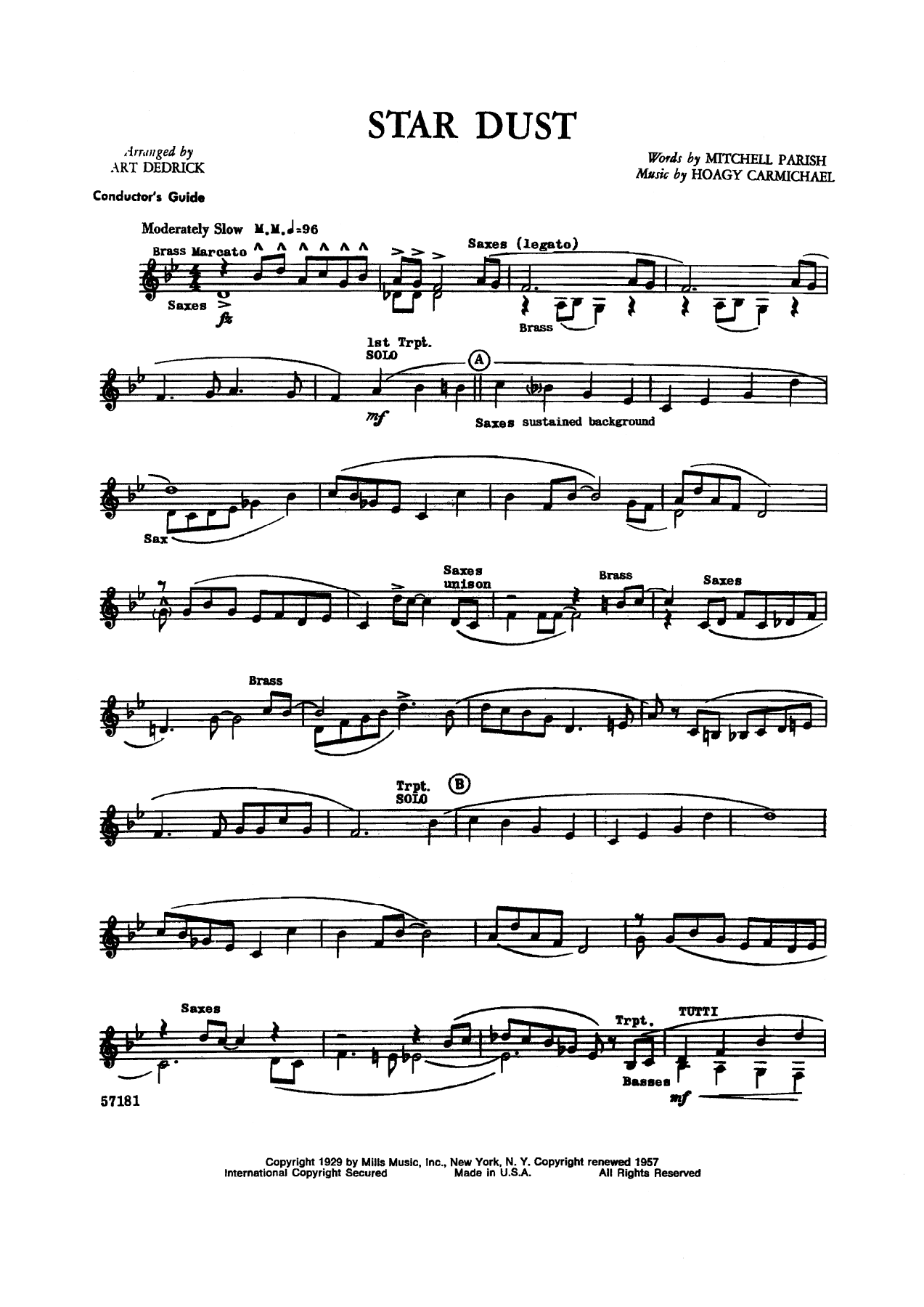
Stardust (A.Dedrick)
Composed by Hoagy Carmichael
Arranged by Art Dedrick
- Ensemble: Big Band
- Style: Jazz Standard
- Pages: 20
- Instruments (18): 1st Alto Saxophone, 2nd Tenor Saxophone, 3rd Alto Saxophone, 4th Tenor Saxophone, 5th Baritone Saxophone, 1st Trumpet, 2nd Trumpet, 3rd Trumpet, 4th Bb Trumpet, 1st Trombone, 2nd Trombone, 3rd Trombone, 4th Trombone, Bass Tuba, Piano, Guitar, String Bass, Drum Set
- Difficulty: easy
- Content: Individual Parts
- Format: PDF Download (Instant)
- Price: $24.99
Hoagy Carmichael's "Stardust," a timeless American standard, emerged in 1927, initially as a medium-tempo instrumental and later gaining widespread acclaim with Mitchell Parish's poignant lyrics in 1929. This enduring melody quickly transcended its Tin Pan Alley origins to become a cornerstone of the jazz repertoire, famously interpreted by legends such as Louis Armstrong, Artie Shaw, Glenn Miller, and Nat King Cole. Its wistful, romantic character, often associated with the Big Band Era, captures a profound sense of nostalgia and longing, making it one of the most recorded and cherished compositions in musical history. The piece's harmonic sophistication and memorable melodic contours have solidified its status as an indispensable jazz standard, representing the golden age of American popular song. Art Dedrick's arrangement of "Stardust" for big band masterfully preserves the song's inherent beauty while infusing it with his signature big band flair. Dedrick, known for his accessible yet musically rich arrangements, approaches this classic as a slow, expressive ballad, typically set in a contemplative 4/4 time signature. The arrangement opens with a delicate, often rubato, introduction, setting a reflective mood before settling into a gentle, flowing tempo. His voicings are characteristically lush and warm, particularly in the saxophone and brass sections, creating a rich harmonic tapestry that cradles Carmichael's iconic melody. Dedrick frequently employs layered textures, allowing different sections to contribute to the overall emotional arc without ever overwhelming the central theme. This arrangement features the melody prominently, often passed between lead alto saxophone or trumpet, ensuring its lyrical integrity remains at the forefront. Dedrick's treatment includes thoughtfully placed soli sections for the saxophones, showcasing their blend and articulation, and often a brief, lyrical improvised solo opportunity, typically for tenor saxophone or trumpet, allowing a soloist to add a personal touch to the established mood. Technical challenges are moderate, focusing more on sustained tone, expressive phrasing, and precise ensemble balance rather than rapid-fire technical passages. The brass ranges are well within the capabilities of most ensembles, avoiding extreme high notes but demanding controlled dynamics and rich tone. The rhythm section maintains a supportive, understated role, providing a steady yet flexible foundation for the melodic and harmonic development. Ideal for high school, college, and community jazz ensembles, this "Stardust" arrangement offers a rewarding performance experience. It provides an excellent opportunity for bands to develop their ballad playing, emphasizing blend, intonation, and dynamic control. The arrangement's emotional depth and familiar melody resonate strongly with audiences, making it a powerful addition to any concert program. Its approachable difficulty level allows bands to focus on musicality and expression, cultivating a mature and polished sound that honors the timeless elegance of the original composition. Conductors should emphasize a truly slow, expressive ballad feel, avoiding any tendency to rush. The opening should be played with a sustained, almost rubato quality, allowing the melody to breathe before settling into a steady, gentle pulse. Key technical challenges include maintaining consistent intonation and blend, particularly in the sustained chords and saxophone soli sections. Encourage players to listen across sections to achieve a unified sound. Dynamics are crucial; ensure a wide dynamic range is explored, from hushed pianissimos to warm, flowing fortissimos, without ever becoming harsh. Articulation should be legato and lyrical throughout, with careful attention to releases to maintain the piece's melancholic beauty. There are no special techniques like plunger mutes or falls required; focus on pure tone and expressive phrasing. Rehearsal time should be dedicated to shaping phrases, balancing voicings, and ensuring the rhythm section provides a sensitive, supportive foundation without overpowering the melodic lines. Q: What instruments and parts are included in this arrangement? A: This big band arrangement includes parts for 17 instruments: Alto Saxophone 1, Alto Saxophone 2, Tenor Saxophone 1, Tenor Saxophone 2, Baritone Saxophone, Trumpet 1, Trumpet 2, Trumpet 3, Trumpet 4, Trombone 1, Trombone 2, Trombone 3, Trombone 4, Piano, Bass, Drums, and Guitar. Q: What is the difficulty level of Art Dedrick's "Stardust" arrangement? A: This arrangement is considered to be of moderate difficulty, suitable for high school, college, and community jazz ensembles. It emphasizes musicality, blend, and expressive phrasing over extreme technical demands. Q: What is the musical style and historical context of this arrangement? A: This is a classic jazz standard, "Stardust," arranged in a slow, expressive big band ballad style. The original song, composed by Hoagy Carmichael in 1927, is a cornerstone of the American Songbook and the Big Band Era. Q: What makes Art Dedrick's arrangement of "Stardust" unique? A: Dedrick's arrangement is distinguished by its lush, warm voicings, particularly in the saxophones and brass, and its focus on preserving the original melody's lyrical beauty. It offers a balanced approach, providing rich harmonic textures while remaining accessible for a wide range of ensembles. Q: What is the typical performance duration and tempo for this arrangement? A: As a slow ballad, the typical performance duration is approximately 4-5 minutes. The tempo is slow and expressive, usually around quarter note = 60-72 BPM, allowing for ample melodic and harmonic development.
Musicians Also Search For
Stardust Art Dedrick PDF • Stardust Art Dedrick sheet music • Stardust arranged by Art Dedrick • Art Dedrick big band charts • Art Dedrick jazz arrangements PDF • Stardust Hoagy Carmichael sheet music • Stardust Hoagy Carmichael big band arrangement • Hoagy Carmichael big band charts • Stardust big band arrangement • Stardust big band PDF download • Stardust jazz ensemble sheet music • big band sheet music instant download • Stardust conductor score PDF • Stardust individual parts download • Stardust sheet music with parts • Stardust Jazz Standard chart • Jazz Standard big band arrangements • buy Stardust sheet music online • download Stardust PDF • Stardust jazz chart • best Art Dedrick big band arrangements • Hoagy Carmichael songs arranged by Art Dedrick • Stardust printable sheet music • big band repertoire PDF