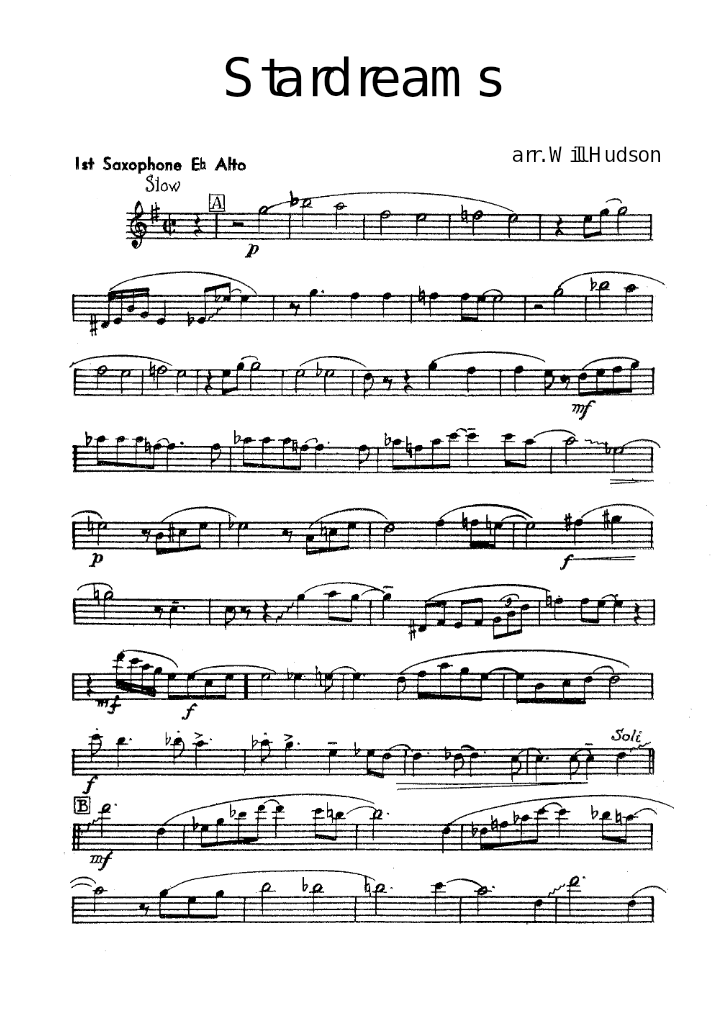
Stardreams (Ch.Spivak)
Composed by Charlie Spivak
Arranged by Benny Goodman
- Ensemble: Big Band
- Style: Jazz Standard
- Pages: 31
- Instruments (17): Alto Saxophone 1, Tenor Saxophone 2, Alto Saxophone 3, Tenor Saxophone 4, Baritone Saxophone 5, Trumpet 1, Trumpet 2, Trumpet 3, Trumpet 4, Trombone 1, Trombone 2, Trombone 3, Trombone 4, Drum Set, Bass, Guitar, Piano
- Difficulty: medium
- Content: Individual Parts
- Format: PDF Download (Instant)
- Price: $24.99
"Stardreams," a quintessential jazz standard, emerged from the vibrant Swing Era, first gaining prominence through Charlie Spivak's trumpet and his orchestra in the early 1940s. Its enduring melodic charm and harmonic sophistication quickly cemented its place in the big band repertoire, becoming a beloved staple for its romantic yet swinging sensibility. The piece embodies the lush, orchestral sound characteristic of the era, offering a blend of memorable melody and rich harmonic textures that continue to captivate audiences and performers alike. Its timeless appeal lies in its ability to evoke a sense of nostalgic elegance while providing ample opportunity for expressive jazz interpretation. This particular arrangement by the legendary "King of Swing," Benny Goodman, reimagines "Stardreams" as a medium-swing ballad, typically performed in the key of F major. Goodman’s signature touch is evident throughout, emphasizing clarity, precision, and a sophisticated, yet accessible, swing feel. The mood is one of tender reflection, building to moments of understated power. Unlike some more overtly virtuosic arrangements, Goodman's approach here prioritizes lyrical phrasing and ensemble blend, allowing the inherent beauty of Spivak's melody to shine. While maintaining a steady, relaxed 4/4 pulse, the arrangement offers dynamic contrasts that keep the listener engaged, moving from hushed ensemble passages to gently swelling soli sections. Goodman's distinctive arranging style is particularly apparent in the nuanced voicings for the saxophone section, which often carry the primary melodic statements with a warm, blended sound. The brass sections provide supportive harmonies and punctuations, rather than aggressive bursts, contributing to the arrangement's overall smooth character. While there isn't a traditional "shout chorus" in the bombastic sense, the arrangement builds to a satisfying climax through layered ensemble textures and judicious use of dynamics. Featured solos are typically allocated to the trumpet and tenor saxophone, offering opportunities for lyrical improvisation over the standard's well-loved chord changes. The technical challenges lie more in achieving a cohesive ensemble sound, precise articulation for the medium-swing feel, and expressive melodic shaping rather than breakneck tempos or extreme ranges. This arrangement is ideally suited for college-level jazz ensembles, advanced high school bands, and community big bands seeking to perform authentic Swing Era repertoire with a focus on musicality and ensemble precision. Its moderate technical demands make it rewarding for bands looking to refine their ballad playing, dynamic control, and interpretation of classic jazz standards. Performing this piece offers a valuable lesson in the art of subtle swing and the power of a beautifully crafted melody, making it a standout addition to any concert program. "Stardreams" by Benny Goodman should be approached as a medium-swing ballad, with a tempo around quarter note = 90-100 BPM. The primary technical challenge lies in achieving a unified, lyrical ensemble sound, particularly within the saxophone section's melodic lines. Emphasize precise articulation – a smooth legato with subtle swing inflections – avoiding overly aggressive attacks. Balance is crucial; brass should support without overpowering the saxophones, especially during soli passages. Trumpet and tenor saxophone soloists should focus on melodic improvisation, drawing from the piece's romantic character. Rehearsal should focus on dynamic shaping, ensuring crescendos and decrescendos are controlled and expressive. Pay close attention to sustained notes and releases, ensuring they decay gracefully. No special mutes or extended techniques are required, allowing the focus to remain on core musicianship and ensemble blend. Q: What instruments and parts are included in this arrangement? A: This big band arrangement includes parts for 17 instruments: Alto Saxophone 1, Alto Saxophone 2, Tenor Saxophone 1, Tenor Saxophone 2, Baritone Saxophone, Trumpet 1, Trumpet 2, Trumpet 3, Trumpet 4, Trombone 1, Trombone 2, Trombone 3, Trombone 4, Piano, Bass, Guitar, and Drums. The full score is also included, totaling 31 pages. Q: What is the difficulty level of Benny Goodman's "Stardreams" arrangement? A: This arrangement is rated as intermediate to advanced. While not overtly technically demanding in terms of speed or extreme ranges, it requires a mature understanding of ensemble balance, dynamic control, and a refined medium-swing feel, making it suitable for college, advanced high school, or experienced community big bands. Q: What is the musical style and historical context of "Stardreams"? A: "Stardreams" is a classic jazz standard from the Swing Era, first popularized by Charlie Spivak in the early 1940s. Benny Goodman's arrangement captures the romantic, lyrical big band sound of that period, characterized by lush harmonies, smooth melodic lines, and a relaxed, elegant swing feel. Q: What makes Benny Goodman's arrangement of "Stardreams" unique? A: Goodman's arrangement is distinguished by its emphasis on lyrical phrasing, sophisticated saxophone voicings, and a balanced ensemble sound that highlights the beauty of the original melody. It showcases his signature approach to big band arranging, prioritizing musicality and precise execution over flashiness, creating a timeless and elegant interpretation. Q: What is the typical performance duration and tempo for this arrangement? A: When performed as a medium-swing ballad, "Stardreams" typically runs for approximately 3-4 minutes. The recommended tempo is around quarter note = 90-100 BPM, allowing for a relaxed yet flowing feel that emphasizes the melody's expressive qualities.
Musicians Also Search For
Stardreams Benny Goodman PDF • Stardreams Benny Goodman sheet music • Stardreams arranged by Benny Goodman • Benny Goodman big band charts • Benny Goodman jazz arrangements PDF • Stardreams Charlie Spivak sheet music • Stardreams Charlie Spivak big band arrangement • Charlie Spivak big band charts • Stardreams big band arrangement • Stardreams big band PDF download • Stardreams jazz ensemble sheet music • big band sheet music instant download • Stardreams individual parts download • Stardreams sheet music with parts • Stardreams Jazz Standard chart • Jazz Standard big band arrangements • buy Stardreams sheet music online • download Stardreams PDF • Stardreams jazz chart • best Benny Goodman big band arrangements • Charlie Spivak songs arranged by Benny Goodman • Stardreams printable sheet music • big band repertoire PDF